Showing posts with label YA. Show all posts

Thursday, January 18, 2018

Recently Read

The Book of Dust
Vol. 1: La Belle Sauvage
by Philip Pullman

It has been a long time since His Dark Materials first burst onto the literary landscape--so long that, at this remove, it may be difficult for Philip Pullman fans to actually remember everything that went on in the trilogy. Having that background knowledge helps, but is not necessary, if you decide to pick up La Belle Sauvage, the first volume in Pullman's tripartite return to the world of Lyra Belacqua, daemons, and Dust.

However, what may be (somewhat surprisingly) necessary for Pullman's readers to bring to the author's new epic is a fair amount of patience, and a memory of the goodwill he built with them through his earlier, quite spectacular effort.
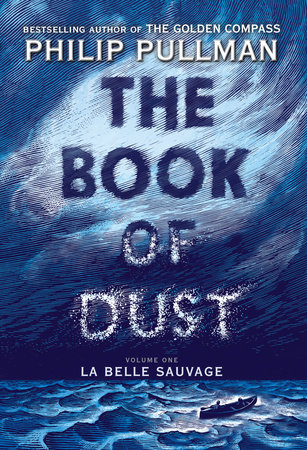
The Book of Dust:
Volume 1--La Belle Sauvage
It is probably worth declaring, right now, that the above sentiment is not meant to dissuade anyone from reading La Belle Sauvage, or to suggest that Pullman's new work is a bad book. In many ways, La Belle Sauvage delivers much of the promise that fans would expect from a new episode of the HDM epic. But, when viewed with the inevitably jaundiced eye that one must bring to a new work that hopes to build upon a previous lofty achievement, it becomes all the more apparent that the mark has in fact been missed, even if the author's new effort came about as close as one could expect it to have.

Partially, the problem Pullman faces with this new volume is self-inflicted, because the early chapters of La Belle Sauvage are a pure pleasure to read, and thus the expectations get raised considerably. It takes but a few pages for fans to be reminded of just how good a prose stylist Pullman is; his talent for a clever turn of phrase remains firmly within his mastery, and one can't help but smile--if not outright laugh--at the author's cleverness as he relates the early pages of his tale. The description of the life of innkeeper's son--and soon to be epic hero--Malcolm Polstead is perfectly charming, witty, vivid in creating a sense of time and place, and full of promise of wonderful things to come. Intrigue arrives quickly, and in no time the reader is off on an adventure that appears certain to provide plenty of excitement, enchantment, and maybe a little danger, too.

The problem arises, oddly enough, once the action of the story finally starts to happen. Most of the early chapters of La Belle Sauvage are composed of scene-setting; much of what goes on is talky and lays the groundwork for the adventure that is about to come.

That description is not a disparagement. Quite the contrary: again, Pullman's penchant for clever turns of phrase, his talent at characterization, and his world-building vision all make the early chapters of the book into something fascinating--and those expectations build as the reader awaits the inevitable payoff of a fully realized saga.

Unfortunately, it doesn't quite work out that way. Once the crisis moment comes, and Malcolm, his partner-antagonist Alice (the dishwasher at his parents' inn), and the infant Lyra make their desperate escape from danger, La Belle Sauvage presents the paradox of a story where the action finally starts...but the narrative somehow slows down. As the three kids follow the Thames through the flooded Oxfordshire landscape and down towards London--pursued all the way by a very dangerous character--Pullman's story bogs down somewhat, despite the characters' literal movement and the high narrative stakes.

What's the problem? Mostly, it seems that the author, having plotted himself into an epic flood, feels compelled to give the disaster a fittingly epic amount of attention. Pullman indulges in a great deal of detailed description of the water-logged Oxfordshire landscape--a patch of earth that is obviously much loved by the author, but is most likely quite unfamiliar to most of his readers, and thus not nearly the object of fascination that Pullman obviously believes it to be.

There are other issues with Malcolm and Alice's odyssey. Pullman uses the trip down the river--really, across a temporary ocean that may as well be an ancient Greek hero's Mediterranean--as the setting for a series of stops along the way, most of which serve as the staging for some supernatural tableaux. Most of these scenes veer past the point of diversion and reach the unwanted shore that is distraction. The reader can only hope that Pullman is setting up something for the new trilogy's future volumes, for there's precious little payoff in these vaguely Homeric episodes.

Problems also spring not just from the narrative's set pieces, but also from the book's characters as well. Daemons, Pullman's unique contribution to fantasy literature--and a clever device for converting internal monologues into actual external dialogue--get strangely inconsistent treatment from the author. Malcolm's daemon Asta is always named and lives as a fully developed character in her own right; meanwhile, Alice's daemon Ben is often obscure, sometimes unnamed, and frequently seemingly forgotten. That, and other, similar, almost lazy treatment of other characters' daemons, can be found throughout the tale--an odd bit of literary clumsiness given Pullman's status as the sire of the device.

As for the human characters themselves, Malcolm and Alice start off as antagonists, then inevitably become allies and friends, and perhaps even more than that--which is odd and a little uncomfortable, given the difference in their stated ages. Malcolm starts the book as an eleven-year-old; Alice is described as "about sixteen." That's a major difference in developmental stages, and makes some of the story's later developments strange and improbable. Indeed, when the final confrontation comes with the book's chief villain, it includes a bit of ugliness that is of questionable necessity to the plot. The affront seems gratuitous, and while the guilty party receives justice, the entire scene stains the proceedings and makes the book's denouement arrive under a disturbing cloud.

Further character problems include the outright disappearance of at least two characters who, based upon the early chapters of the book, seem to be poised to play major roles in the later narrative. They don't. Again, one hopes that further developments are being set up for payoff in future volumes, but there are no guarantees.

So then, is La Belle Sauvage a bad book? No. But it feels very incomplete--more incomplete than even a volume 1 of any trilogy should feel. Unintentionally, perhaps, Pullman has put his readers into a story with stakes about as high as those faced by Malcolm, Alice, and the rest of Lyra's guardians: the high stakes of judging a literary work for its quality, and whether that attribute is great enough to make moving forward with the work's sequels worth one's while. I think there's enough in Volume 1 of The Book of Dust to make a fan anticipate Volume 2...but, as with the kids in La Belle Sauvage, it's a precarious thing, and the escape may be a narrow one. We'll see.

Thursday, March 21, 2013

Recently Read

A twofer for one of my favorite authors!

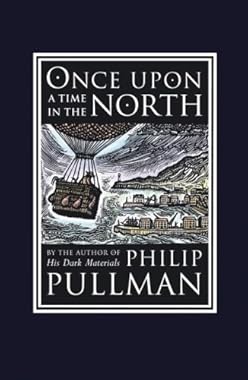
Once Upon a Time in the North
by Philip Pullman

It's been such a long time since I've had the chance to dig into anything by Philip Pullman. Part of the blame falls with me, as I've been wandering further afield, and part must fall on Pullman, who has been lax lately when it comes to producing works that just scream "Read me!" (More on this matter below.)

Once Upon A Time In The North
by Phillip Pullman
Here's a case in point: the novella Once Upon a Time in the North, the second short story entry into the His Dark Materials canon (the first being Lyra's Oxford). Since the HDM books were the magnet that drew me to Pullman in the first place, and still retain their place in my pantheon of favorite books, I felt true delight when I discovered (thanks to a library catalog search) that there was another addition to the series. Add in the fact that it's a story focused on the early career of Lee Scoresby and his soul-mate hare Hester--two of the best characters in the original trilogy--and I was ticked a ruddy shade of pink.

And Once Upon a Time in the North delivers the goods: the witty Texan Scoresby and his snap-tounged Hester are in fine form this quick moving adventure tale of a couple of hairy (harey?) days in an Arctic town. It is a delight to spend a few more minutes with Lee and Hester, who are characters a reader wants to follow anywhere: brave, smart, able, and only lightly touched by a non-incapacitating cynicism.

Unfortunately, minutes are all we get here. While brevity may be the soul of wit, and 96 small pages do serve to tell the story of the pair's involvement in a bit of local politics--with a touch of mayhem and potential murder thrown in to keep things exciting--the ultimate outcome is to leave the reader wanting so much more. It seems unlikely that we're going to get more; Pullman produced Once Upon a Time... back in 2008, and the HDM trail seems, in the intervening years, to have grown colder than Iorek Byrnison's Arctic homeland. The failure of the film version of The Golden Compass may have made that inevitable; perhaps Pullman has pulled up creative stakes and headed for greener literary pastures.

Still, Once Upon a Time... demonstrates how robust and rich a source the HDM world could still be, if the author is so inclined. Other characters from the original work could have their own past/origin stories brought to fruition and presented to an eager reading public. And for those who are not already fans, Once Upon a Time...  (or similar series-based novellas) could serve as a terrific intro to the wider works: a brief, excellent, entertaining entryway for those not already familiar with just how good Pullman and his work can be.

At the very least, I am grateful I had the chance to get a little more joy from one of my most loved literary adventures. And I'll welcome any more chances to reenter that world, should they come down the line.


The Good Man Jesus and the Scoundrel Christ
by Philip Pullman

News flash: Philip Pullman is not a fan of Christianity, or organized religion, or "the Church," however you want to put it.

So why, then, did he decide to write a Gospel?

Whatever the motivation, Pullman's impulse led to the publication of The Good Man Jesus and the Scoundrel Christ, the author's attempt to reconcile what he perceives to be the admirable qualities of Jesus's message with his personal world view--and the anathema status that the Church has within that world view.

The Good Man Jesus
and the Scoundrel Christ

by Philip Pullman
Pullman tries to pull this split personality trick by cleaving the Savior himself into two separate characters: Jesus, who is more or less the traditional prophet most of us have come to know, and Christ, the other's younger, sicklier, shrewder, and somewhat more contemptible twin brother. Throughout the narrative, Jesus goes about living his life as described in the canonical Gospels, while the brother Christ shifts about on the periphery of the "greatest story," serving as both scribe and secret mover of the action, both by his own volition and through collaboration with "the Stranger"--a mysterious character who may or may not ultimately turn out to be the Apostle Paul. (Pullman hints, but never comes right out and identifies who the Stranger actually is supposed to be.)

Naturally, this manipulation of the story causes problems for the reader, especially those who are familiar with the standard story (which is to say, virtually everyone in two thirds of the world, at least). Jesus, in most respects, comes across as a character worth rooting for; but Christ is presented much more ambiguously. The character never seems like an organic creation; from the start we are highly conscious that we are reading the tale of a literary device. Despite his titular appellation, and a story thread that obviously implies plenty of envy, Christ has admirable qualities, too. Too bad, then, that the character ultimately comes across as a stooge who serves the narrative role of the slightly reluctant tool by whose deeds the Christian Church is to be founded.

It is for that sin--being the necessary component in the Stranger's machinations to found an organized religion--that Pullman ultimately damns his own creation. Conversations between Christ and the Stranger, concerning the philosophical underpinnings of the Church, and why it must be founded upon lies, read like wiretap transcripts of racketeers caught in the midst of their conspiracies. When at last Christ, long after the unfortunate events, voices his pain and regret, the reader has little clue about how he should feel for this made up man.

Not only does the plotting suffer at the hands of Pullman's ulterior cause, but the author's own writing comes across as damaged by his agenda. Some passages retain their power, despite Pullman's tinkering with story, character and meaning. The Sermon on the Mount can still inspire and move the reader, even when presented in the author's purposefully banal language. (Much of this work comes across as a new, revised version of The Book, that laughably lowbrow version of the Bible that came out back in the 1980s.) In a few places, the author's talent still shines through, as with the very subtle manipulations that cast more than a little doubt upon Mary's pre-motherhood purity. At other times, however, Pullman's text degenerates into little more than philosophical screed. Nowhere is this more evident than in the Garden of Gethsemane, where Jesus has a one way conversation with God that neatly refutes every word of Christ's and the Stranger's conceptual architecture for building a Church. The reader knows with absolute certainty that these words are Pullman's, with no attempt made to portray them as anything that might have sprung from Jesus's own philosophy. If you were at a pub talking religion, or lack thereof, with the author over a pint, such direct personal opinion might be accepted and welcome. But when the author is trying to make his own ideas into those of a character many consider to be the Son of God, it's fair for the reader to accuse him of being a little full of himself--especially when the presentation of those ideas makes for less than riveting reading.

I am a fully confessed Pullman fan. I have delighted in any number of his works. So I expected to come to The Good Man Jesus and the Scoundrel Christ and find an admirable work. Even as I read the book, I figured that the work would merit a "so-so" (~) review once I got around to posting it on this site. But in retrospect, I can not view this book as anything but a failure; perhaps a noble failure, but even that is questionable. And considering the successes that have come before this work, it would be the worst kind of "grade inflation" to give Pullman a pass for this effort. If you too are a Pullman fan, one with a completist bent, or someone whose interest in interpretations of the Christian story is limitless, then I suppose you will want to read The Good Man Jesus and the Scoundrel Christ. Otherwise, the not so good news is, you can skip it.

Wednesday, May 4, 2011

Recently Read

Deep
by Susanna Vance

See, here's what happens when you collect your readings from those "recommended reading" lists that show up in your library, or newspaper, or (possibly) the Hot Topic store at the local mall.

Deep
How else to explain middle-aged male me reading Deep by Susanna Vance--a book aimed squarely at the thirteen-year-old girl population? Not that Deep is particularly girly in tone or subject, or unworthy of attention; it is an adventure tale--though with a distinctly distaff leaning--and relatively well-written at that.

Deep follows the not particularly parallel paths of two teenage girls: comfortably suburban Oregonian thirteen-year-old Birdie Sidwell; and lonely, seafaring Norwegian near-nature-child seventeen-year-old Morgan Bera. The two threads of the tale are told alternatively, each girl trading off chapters of first person narrative in which they relate the details of their wildly dissimilar lives, until circumstances bring the pair together in a fight for their survival.

Birdie is a charmer. As the book's ostensible protagonist--Morgan, though billed equally, gets slightly less screen time (so to speak) and focus throughout--Birdie tells her story with a glib, breezy voice that instantly appeals. All of the elements of her young life, both good and bad--her possibly psychosomatic asthma, a complicated relationship with her grade-school friend Kirin, her aspiration to be a renowned writer, among others--come together to draw a picture of sweet girl the reader is bound to root for.

Morgan, by contrast, is something of a drag. Her voice comes off the page in serious, almost dour tones. The details of her backstory--born to vagabond parents in the Caribbean, witness to the deaths of two siblings, and finally the author of her own escape from her parents' defeated, drunken stupors--make that tone appropriate, but the reader still feels brought down by Morgan's presence in the narrative. Thankfully, a character who could be the book's biggest burden is redeemed at the climax, when Morgan's independence and strength play pivotal roles in saving not just her self, but the more appealing Birdie.

The danger arises when the Sidwell family takes a long anticipated, year-long vacation to the Caribbean--and Birdie is almost immediately kidnapped by a scalawag named Nicholas. The reader never really learns why the smuggling, forging, pirating, at least slightly disturbed Nicholas hauls off with Birdie; his character is given many facets, yet remains unfinished, or sketchily drawn. Although the sophisticated--that is, adult--reader may come up with a handful of motivations for Birdie's abduction (in addition to the list Birdie produces herself), her treatment at the hands of her captor never really sinks to depths as harrowing as real life suggests it would. Nicholas, as depicted, never shows enough menace to give Birdie's dilemma the edge it needs. Only when Morgan, seeking forged documents from Nicholas, barely escapes his drunken attempt to rape her, only then does the villain's character approach true evil. The rest of the time, the bad guy stands as a manikin of "evil lite"--bad enough for a book aimed at young girls, perhaps, but too lightweight to put the fear in any other readers.

Still, aside from that failing, Deep offers a good, entertaining read that will undoubtedly appeal to its target audience. Perhaps the main takeaway from Deep are the models represented by the two girls at the story's center: the charming, fun, appealing Birdie, in whom those thirteen-year-old readers can see themselves, and the nearly grown-up Morgan, who serves as an example of the good-hearted, capable young women those readers can grow up to be. If Deep helps produce girls who can stand up for themselves and make their way safely through this world, then author Vance has indeed succeeded with her work.