
Folks tend to be imprecise in their use of words. We've discussed this before in this space, in a post about the definition of stupidity and insanity, among other things. Another place where the subtle difference between similar words causes confusion lies in the space between the terms 'bitching' and 'cunting.'
Almost everyone is familiar with bitching. We've all bitched about this, that, or the other thing now and then. You're bitching when you say, "Dammit, why do I have to do this now? This is so stupid!" whenever your boss asks you to finish those "TPS reports" by the end of today, Friday, when you know perfectly well that no one will even be in the office to look at them until Tuesday at the earliest. Bitching is a form of complaining; it springs from a place of feeling abused, put upon, mistreated, or just simply frustrated. Bitching is complaining that comes from a place of--or at least, the perception of being in a position of--powerlessness.
Showing posts with label Psychology. Show all posts
Showing posts with label Psychology. Show all posts
Saturday, August 1, 2015

Wednesday, May 6, 2015
A Treatise on the Nature of Beauty
I've given a lot of thought to the nature of beauty over the years. Not because of anything I see in the mirror; far from it! But because I recognize--in a way that many people do not realize, or rather do not acknowledge--that beauty has an overwhelming influence on our lives: how we live, who we are, who we are allowed to be, where we fit in in this world (or this society, at least).
We use many words to describe beautiful people. Men are generally characterized as "handsome." We resort to a much broader range of terms when women are the subject: gorgeous, lovely, pretty, cute, alluring, ravishing...when it comes to female beauty, you could fill a thesaurus and the tremendous number of synonyms for what we call beautiful.
I've come to believe that the reason we have so many terms for a female beauty is as an acknowledgement that there are different kinds of beauty. Everyone who is good-looking is beautiful, but beautiful people come in different flavors, so to speak, and those different flavors affect the observer in different ways.
Insofar as most people acknowledge these differences, they tend to categorize those variations as part of a hierarchy. Meaning: the woman who is "pretty" is more beautiful than someone who is "just" "cute," and so on. However, I have come to believe that this is NOT true; the different flavors of beauty are perceived as such, but they do not relate to each other in any kind of tiered ranking. "Cute" is not inferior to "pretty"; it's just a different kind of beauty, one that--in the correct circumstances--can have more impact on the person perceiving it than the other varieties of beauty.
According to my theory, there are three primary forms of beauty. Two of these forms were immediately obvious to me, almost as to be self-evident: the aforementioned "Cute" and "Pretty." Most observers intuitively recognize a beautiful woman as being either of these categories (assuming she does not fall into the third, as yet undiscussed category). This discernment is most likely a culturally ingrained reaction, a thought process that most people have inculcated into their perception from a very early age. (Evidence suggests there's also innate discernment; studies with babies have shown differences in infants' reactions to different (in symmetry/proportion) faces.) How people react to a cute woman versus a pretty woman depends upon circumstances--and, most likely, individual preferences and experiences.
What qualities constitute these first two varieties of beauty?
Cute is that version of beauty that is approachable, youthful (of course, all beauty has a heavy youth bias), perhaps even babyish. Cute, due to its approachability, shows up a lot in TV commercials.
Pretty is something more classical, a more idealized beauty than Cute--one that is nevertheless somewhat commonplace. Or perhaps its better to say Pretty is not rare; we see Pretty all the time, every day, even as we highly value it in the world around us. Beauty queens, high school homecoming queens, girls who work as greeters in restaurants and other businesses--you see these typical examples of the Pretty type all the time, all around you.
And the third category? What is the proper term for that third variety of beauty? Indeed, what is that third variety of beauty? How does it differ from Cute and Pretty?
For a long time, I used the term "gorgeous" as the descriptor for this class of beauty--but mostly as a mental placeholder, since I knew that "gorgeous" is not the right term for this third variety. ("Gorgeous" does more to describe the viewer's reaction to the beautiful person; it does not really address what that person's beauty is.) The third variety of beauty, as can be gleaned from the use of the term gorgeous, is more superficially striking than Cute or Pretty; these beauties are often some somewhat exotic. One can fairly characterize this third class of beauty as rarer than the other two; it is the type of beauty that one typically sees in models, especially the more famous and sought after models (the somewhat ridiculous term "supermodel" is often apt).
It was that connection to modeling and fashion that led me to the best label for this third variety of beauty: "Glamorous." Note that Glamorous derives from glamor (or glamour), the old name for a magical spell. This is most apt, as Glamorous beauty is the most spell-casting of the three--a striking, forceful, perhaps even mesmerizing kind of beauty that almost demands attention, and often leads to its avatars being placed upon a pedestal.
That rare and elevated character of Glamorous beauty probably creates much of the inclination towards seeing different varieties of beauty as steps on a hierarchical ladder; i.e., Glamorous lives at the top of the ranks above Pretty, which is itself a step above Cute. However, this thought model does not reflect reality particularly well. As noted above, individual reactions to different types of beauty differ widely; the relative approachability of the Cute person may make her more valued in the eyes of some individuals, who at the same time may see the lofty nature of the Glamorous one to be too unreachable for his or her tastes. Bad experiences in the past with a Pretty type may lead an individual to devalue others of the same type versus those who fall into the other two categories. Other scenarios can be imagined which would switch the relative rankings of any of the three varieties up or down the ladder according to an individual's personal preferences.
Thus, it is best to view the three varieties of beauty as co-equal in the eyes of the world at large. A chart may help visually define the relationships between the beauty types:
 Some notes about the beauty chart:
The three varieties of beauty can be seen as a subset of the beauty class as a whole. As in any Venn diagram, it is possible--indeed, with beauty (and human variability) it is a certainty--that some parts of the interior sets will overlap. The upshot of this is (in practical terms) that there are some people out there who are both Cute and Pretty, Cute and Glamorous, Pretty and Glamorous. The very center of the diagram marks those lucky few who--through some remarkable combination of genes and the observer's biases--present (to some extent) all three of the varieties in their persons. I placed Kate Upton there in the center, since she seems to be today's foremost exemplar of all the varieties of beauty rolled into one person.
Note too that the overall set, Beauty, contains not just the three standard varieties but also some subset(s) that fall outside of any of the standard categories; within these bounds you would find those relatively rare birds who embody unconventional beauty (but still meet with the approval of wide swaths of the population), and perhaps those other outliers mentioned above (those who are declared to be beautiful in the service of iconoclasm--maybe even those individuals who make themselves attractive to others not by physical perfection, but through sheer dint of will and personality).
Finally, note that the placement of the categories (Cute and Pretty above, Glamorous below) is arbitrary--the chart can be rotated any number of degrees around its centerpoint and still be representative.
In conclusion, it may be best to recognize one particularly important implication of this intellectual model for beauty: while some of us may be condemned to a lesser status for possessing in our persons little to no physical beauty at all, those who do have one form of beauty or another are not destined to a position inferior to other beautiful people. In other words, if you're Cute, you're not doomed to a lesser life than a Glamorous type. Nor, if you're Pretty, are you necessarily better than a Cute person. Different strokes for different folks--that tends to be the order of things, even within a subset of the general such as beauty.
We use many words to describe beautiful people. Men are generally characterized as "handsome." We resort to a much broader range of terms when women are the subject: gorgeous, lovely, pretty, cute, alluring, ravishing...when it comes to female beauty, you could fill a thesaurus and the tremendous number of synonyms for what we call beautiful.
I've come to believe that the reason we have so many terms for a female beauty is as an acknowledgement that there are different kinds of beauty. Everyone who is good-looking is beautiful, but beautiful people come in different flavors, so to speak, and those different flavors affect the observer in different ways.
(An aside: Let's get one thing straight--beauty is NOT in the eye of the beholder. Beauty is one of the most rigidly defined aspects of human existence.
Studies have shown again and again that the symmetry and proportions of the human face determine how that face is perceived as beautiful or not. If you don't believe that, just drop a few words in that search bar up at the top of this window and you can find those results. [Here's a starting point: http://legacy.jyi.org/volumes/volume6/issue6/features/feng.html ]
Even when somebody declares as beautiful a person who is not, according to the common understanding of that term, that declaration is usually made to make a point--to engage in a certain amount of iconoclasm for one reason or another.
Individual tastes vary, for one reason or another, but if you ask a broad swath of observers to judge the beauty of this, that, or the other person, the vast majority will agree, whether the answer is yes, no, or meh--and if it's yes, that answer will apply to people so similar to other "yes" examples that researchers have developed masks that define a beautiful face based on the averages of such proportions.
Beauty, to put it bluntly, is mathematical; it's geometric. It is not a subjective experience.)
Insofar as most people acknowledge these differences, they tend to categorize those variations as part of a hierarchy. Meaning: the woman who is "pretty" is more beautiful than someone who is "just" "cute," and so on. However, I have come to believe that this is NOT true; the different flavors of beauty are perceived as such, but they do not relate to each other in any kind of tiered ranking. "Cute" is not inferior to "pretty"; it's just a different kind of beauty, one that--in the correct circumstances--can have more impact on the person perceiving it than the other varieties of beauty.
According to my theory, there are three primary forms of beauty. Two of these forms were immediately obvious to me, almost as to be self-evident: the aforementioned "Cute" and "Pretty." Most observers intuitively recognize a beautiful woman as being either of these categories (assuming she does not fall into the third, as yet undiscussed category). This discernment is most likely a culturally ingrained reaction, a thought process that most people have inculcated into their perception from a very early age. (Evidence suggests there's also innate discernment; studies with babies have shown differences in infants' reactions to different (in symmetry/proportion) faces.) How people react to a cute woman versus a pretty woman depends upon circumstances--and, most likely, individual preferences and experiences.
What qualities constitute these first two varieties of beauty?
Cute is that version of beauty that is approachable, youthful (of course, all beauty has a heavy youth bias), perhaps even babyish. Cute, due to its approachability, shows up a lot in TV commercials.
Pretty is something more classical, a more idealized beauty than Cute--one that is nevertheless somewhat commonplace. Or perhaps its better to say Pretty is not rare; we see Pretty all the time, every day, even as we highly value it in the world around us. Beauty queens, high school homecoming queens, girls who work as greeters in restaurants and other businesses--you see these typical examples of the Pretty type all the time, all around you.
And the third category? What is the proper term for that third variety of beauty? Indeed, what is that third variety of beauty? How does it differ from Cute and Pretty?
For a long time, I used the term "gorgeous" as the descriptor for this class of beauty--but mostly as a mental placeholder, since I knew that "gorgeous" is not the right term for this third variety. ("Gorgeous" does more to describe the viewer's reaction to the beautiful person; it does not really address what that person's beauty is.) The third variety of beauty, as can be gleaned from the use of the term gorgeous, is more superficially striking than Cute or Pretty; these beauties are often some somewhat exotic. One can fairly characterize this third class of beauty as rarer than the other two; it is the type of beauty that one typically sees in models, especially the more famous and sought after models (the somewhat ridiculous term "supermodel" is often apt).
It was that connection to modeling and fashion that led me to the best label for this third variety of beauty: "Glamorous." Note that Glamorous derives from glamor (or glamour), the old name for a magical spell. This is most apt, as Glamorous beauty is the most spell-casting of the three--a striking, forceful, perhaps even mesmerizing kind of beauty that almost demands attention, and often leads to its avatars being placed upon a pedestal.
That rare and elevated character of Glamorous beauty probably creates much of the inclination towards seeing different varieties of beauty as steps on a hierarchical ladder; i.e., Glamorous lives at the top of the ranks above Pretty, which is itself a step above Cute. However, this thought model does not reflect reality particularly well. As noted above, individual reactions to different types of beauty differ widely; the relative approachability of the Cute person may make her more valued in the eyes of some individuals, who at the same time may see the lofty nature of the Glamorous one to be too unreachable for his or her tastes. Bad experiences in the past with a Pretty type may lead an individual to devalue others of the same type versus those who fall into the other two categories. Other scenarios can be imagined which would switch the relative rankings of any of the three varieties up or down the ladder according to an individual's personal preferences.
Thus, it is best to view the three varieties of beauty as co-equal in the eyes of the world at large. A chart may help visually define the relationships between the beauty types:
The three varieties of beauty can be seen as a subset of the beauty class as a whole. As in any Venn diagram, it is possible--indeed, with beauty (and human variability) it is a certainty--that some parts of the interior sets will overlap. The upshot of this is (in practical terms) that there are some people out there who are both Cute and Pretty, Cute and Glamorous, Pretty and Glamorous. The very center of the diagram marks those lucky few who--through some remarkable combination of genes and the observer's biases--present (to some extent) all three of the varieties in their persons. I placed Kate Upton there in the center, since she seems to be today's foremost exemplar of all the varieties of beauty rolled into one person.
Note too that the overall set, Beauty, contains not just the three standard varieties but also some subset(s) that fall outside of any of the standard categories; within these bounds you would find those relatively rare birds who embody unconventional beauty (but still meet with the approval of wide swaths of the population), and perhaps those other outliers mentioned above (those who are declared to be beautiful in the service of iconoclasm--maybe even those individuals who make themselves attractive to others not by physical perfection, but through sheer dint of will and personality).
Finally, note that the placement of the categories (Cute and Pretty above, Glamorous below) is arbitrary--the chart can be rotated any number of degrees around its centerpoint and still be representative.
In conclusion, it may be best to recognize one particularly important implication of this intellectual model for beauty: while some of us may be condemned to a lesser status for possessing in our persons little to no physical beauty at all, those who do have one form of beauty or another are not destined to a position inferior to other beautiful people. In other words, if you're Cute, you're not doomed to a lesser life than a Glamorous type. Nor, if you're Pretty, are you necessarily better than a Cute person. Different strokes for different folks--that tends to be the order of things, even within a subset of the general such as beauty.
Saturday, April 28, 2012
Recently Read
The Believing Brain
by Michael Shermer
If you've got a party that needs spoiling, Michael Shermer is your guy.
This is not to cast Shermer with nefarious motives. I doubt the well-known skeptic and founder of the magazine of that name seeks to ruin anyone's fun with his latest work of analysis, The Believing Brain. The author is simply a man of science, and wishes everyone else could be, too.
But I must admit to feeling twinges of disappointment and sadness while I read Shermer's latest. I remember how much fun I had as a kid, reading books about hokum like the Loch Ness monster, Bigfoot, sea serpents, and ghosts. That stuff was, as Denzel Washington's Training Day character Alonzo Harris put it, "bullshit...but entertaining bullshit." Much as folks of all ages spice up their dull as dishwater lives with the imagined possibilities of science fiction, so too the more colorful products of pseudo-science help us retain a bit of that childlike wonder, some semblance of a belief that there's more to the world around us than the banality of everyday life.
To be fair, The Believing Brain is not simply a debunking report on those characters of our dreams (and not a few nightmares). Shermer has attacked such targets in previous works, notably the earlier book, Why People Believe Weird Things. This current work serves up a straightforward examination of how the human brain works; it is a discourse on the cognitive processes that lead us believe ideas both common, ordinary and demonstrable (that sound in the bushes might be a dangerous predator, so watch out) and odd, outrageous and unprovable (the aliens have already arrived and are ruling the world from behind the scenes). Shermer makes his strong case that, contrary to intuitive thought, our beliefs come first, then we use our cognitive biases to reinforce those beliefs, until we find ourselves well convinced of our hold on the "truth."
All well and good, for the psych student. But such discourse does not necessarily make compelling reading for the casual observer. Though Shermer is by now a seasoned pro at writing interesting, accessible, and often humorous prose, parts of The Believing Brain can be difficult to connect with. Some readers will find it easy to get lost in the author's descriptions of the various parts of the brain and their various functions in perception and belief building. While Shermer's account of his personal journey from believer to skeptic is instructive and quite readable, his descriptions of "patternicity" and "agenticity" may prove too technical for many to understand. Reading the early sections The Believing Brain gives you the distinct impression that you're slogging through a bunch of details in order to get to "the good stuff" later in the book.
There are, in fact, pieces of "good stuff" in the book's latter pages. Particularly intriguing is the discussion of Galileo's discoveries at the end of the Middle Ages, and how the reliance on authority so prevalent at the time led otherwise intelligent observers not to see the very objects so readily apparent in Galileo's telescope. (The story suggests obvious parallel's to today's conservatives--current society's arch-lovers of authority--and their obstinate disbelief in evolution, climate change, etc.) And Shermer's account of the debates among astrophysicists regarding the nature of the universe--arguments that ultimately led to Hubble's cosmological discoveries--stands as an eloquent exemplar of the value of the scientific method.
So you can learn a lot reading The Believing Brain. Particularly, you will learn a lot about the author himself. How the reader responds to the ideas presented in the book may depend not upon empirical evidence, but upon how you feel about Shermer. It's hard not to view Shermer himself as part of this equation; the book is littered with the author's imprimatur regarding his subject matter. Many terms of the discourse are categorized as "what I call..." terms; i.e., "we practice what I call 'agenticity'." One suspects that many of the terms so labeled in the book are not necessarily of Shermer's own coinage. Plus, numerous concepts in the text are fleshed out through examples from the author's own experience--particularly when it allows Shermer to recall one of his television appearances, or the marathon bike race he founded and participated in, or to educate his audience about his preference for libertarianism. In fact, a reader could readily draw the conclusion that the one thing Michael Shermer truly believes in is Michael Shermer. That perspective must necessarily color the reader's judgment of the arguments presented in The Believing Brain. Is that shading enough to invalidate the concepts presented in the text? Not in this reader's view; Shermer's arguments retain their validity, based on their own strength. But it's easy to see others having their judgment thrown by the author's somewhat obtrusive personality.
Overall, The Believing Brain succeeds on its own terms. It may not be everyone's cup of tea, but the strength of the scholarship and reasoned argument it presents is not easily refuted. If we all read this book, and were moved to question our own deeply held beliefs--even for a few moments--that would probably be a good thing.
by Michael Shermer
If you've got a party that needs spoiling, Michael Shermer is your guy.
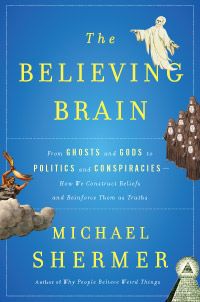 |
| Michael Shermer's The Believing Brain |
But I must admit to feeling twinges of disappointment and sadness while I read Shermer's latest. I remember how much fun I had as a kid, reading books about hokum like the Loch Ness monster, Bigfoot, sea serpents, and ghosts. That stuff was, as Denzel Washington's Training Day character Alonzo Harris put it, "bullshit...but entertaining bullshit." Much as folks of all ages spice up their dull as dishwater lives with the imagined possibilities of science fiction, so too the more colorful products of pseudo-science help us retain a bit of that childlike wonder, some semblance of a belief that there's more to the world around us than the banality of everyday life.
To be fair, The Believing Brain is not simply a debunking report on those characters of our dreams (and not a few nightmares). Shermer has attacked such targets in previous works, notably the earlier book, Why People Believe Weird Things. This current work serves up a straightforward examination of how the human brain works; it is a discourse on the cognitive processes that lead us believe ideas both common, ordinary and demonstrable (that sound in the bushes might be a dangerous predator, so watch out) and odd, outrageous and unprovable (the aliens have already arrived and are ruling the world from behind the scenes). Shermer makes his strong case that, contrary to intuitive thought, our beliefs come first, then we use our cognitive biases to reinforce those beliefs, until we find ourselves well convinced of our hold on the "truth."
All well and good, for the psych student. But such discourse does not necessarily make compelling reading for the casual observer. Though Shermer is by now a seasoned pro at writing interesting, accessible, and often humorous prose, parts of The Believing Brain can be difficult to connect with. Some readers will find it easy to get lost in the author's descriptions of the various parts of the brain and their various functions in perception and belief building. While Shermer's account of his personal journey from believer to skeptic is instructive and quite readable, his descriptions of "patternicity" and "agenticity" may prove too technical for many to understand. Reading the early sections The Believing Brain gives you the distinct impression that you're slogging through a bunch of details in order to get to "the good stuff" later in the book.
There are, in fact, pieces of "good stuff" in the book's latter pages. Particularly intriguing is the discussion of Galileo's discoveries at the end of the Middle Ages, and how the reliance on authority so prevalent at the time led otherwise intelligent observers not to see the very objects so readily apparent in Galileo's telescope. (The story suggests obvious parallel's to today's conservatives--current society's arch-lovers of authority--and their obstinate disbelief in evolution, climate change, etc.) And Shermer's account of the debates among astrophysicists regarding the nature of the universe--arguments that ultimately led to Hubble's cosmological discoveries--stands as an eloquent exemplar of the value of the scientific method.
So you can learn a lot reading The Believing Brain. Particularly, you will learn a lot about the author himself. How the reader responds to the ideas presented in the book may depend not upon empirical evidence, but upon how you feel about Shermer. It's hard not to view Shermer himself as part of this equation; the book is littered with the author's imprimatur regarding his subject matter. Many terms of the discourse are categorized as "what I call..." terms; i.e., "we practice what I call 'agenticity'." One suspects that many of the terms so labeled in the book are not necessarily of Shermer's own coinage. Plus, numerous concepts in the text are fleshed out through examples from the author's own experience--particularly when it allows Shermer to recall one of his television appearances, or the marathon bike race he founded and participated in, or to educate his audience about his preference for libertarianism. In fact, a reader could readily draw the conclusion that the one thing Michael Shermer truly believes in is Michael Shermer. That perspective must necessarily color the reader's judgment of the arguments presented in The Believing Brain. Is that shading enough to invalidate the concepts presented in the text? Not in this reader's view; Shermer's arguments retain their validity, based on their own strength. But it's easy to see others having their judgment thrown by the author's somewhat obtrusive personality.
Overall, The Believing Brain succeeds on its own terms. It may not be everyone's cup of tea, but the strength of the scholarship and reasoned argument it presents is not easily refuted. If we all read this book, and were moved to question our own deeply held beliefs--even for a few moments--that would probably be a good thing.
Subscribe to:
Posts (Atom)


 Posts


