
The Cats of Roxville Station
by Jean Craighead George
It's almost impossible for me to resist anything that has to do with cats. So when I spotted this book at the local Friends of the Library book store, I decided to fork over a couple of bucks and see if I could enjoy a little feline entertainment, in literary form.
Turns out I probably should have stuck to LOL cats on the web.
The Cats of Roxville Station is ostensibly a children's book. It was published by a well-known publisher of children's books (Dutton). It has illustrations like a kid's book. It is short and tells a fictional story. All the earmarks of kid lit are there.
But here's the thing: the author is not really interested in telling a story so much as teaching a lesson about what life is like for feral cats.
Uh-oh. Whenever a kid's book is out to teach you lessons, you should probably run the other way.
It's been a truism throughout my many years of reading children's lit: books that are written to be educational--presumably as well as entertaining--are invariably only marginally educational, and hardly entertaining at all.
So it is with Roxville. The story follows the growth and travails of Rachet, a cat who is abandoned by her family and has to make her way among the hierarchy of feral cats who hang around a village train station and its surrounding neighborhood. In parallel, the text also follows a young boy (also an orphan--see what the author did there?) named Mike as he observes the cats of Roxville, roots for Rachet, and generally conspires in various ways to get his guardian to allow him to adopt his hoped-for cat.
Sounds interesting, right? Well, maybe. In reality, the story reads slow, has little that's particularly compelling to hold the interest, and ultimately just lacks a certain amount of literary punch.
The cats are characters in this story, but not as literary creatures. These are not anthropomorphic, talking animals. The cats are just cats, which means they only contribute to the story through actions, not thoughts, feelings, or any abstract expression thereof. That may be a big reason why this reader, at least, found it very hard to connect to these felines, despite being possessed of a passion for these favorite animals. Feline inscrutability may be fascinating in real life, in your living room--but it comes across as static and uninteresting on the written page.
It's possible that this negative vibe about The Cats of Roxville Station may be the product of expectations, but the author is not off the hook for not meeting the reader's anticipation. Things happen to Mike, and the cats--Rachet in particular, of course--but they rarely rise above the level of ordinary stuff. It is perhaps telling that I am writing this review several months after I finished reading the book. Nothing about the experience was all that compelling. I'm mostly producing this write-up just to get the book off my desk.
Overall, it's not a bad book--it's just not a particularly interesting book. And that's a hard idea to wrap one's mind around if you're as crazy about cats as I am. (And no, this feeling is not the product of my being an adult reading a child's book; even a kid's book, if well-written, should produce a certain amount of fascination and delight in an older reader.) I wouldn't necessarily recommend throwing The Cats of Roxville Station out with the litter, but I don't recommend rushing out to the library to pick up a copy of it, either.
Showing posts with label Recently Read. Show all posts
Showing posts with label Recently Read. Show all posts
Thursday, May 24, 2018

Thursday, January 18, 2018
Recently Read
The Book of Dust
Vol. 1: La Belle Sauvage
by Philip Pullman
It has been a long time since His Dark Materials first burst onto the literary landscape--so long that, at this remove, it may be difficult for Philip Pullman fans to actually remember everything that went on in the trilogy. Having that background knowledge helps, but is not necessary, if you decide to pick up La Belle Sauvage, the first volume in Pullman's tripartite return to the world of Lyra Belacqua, daemons, and Dust.
However, what may be (somewhat surprisingly) necessary for Pullman's readers to bring to the author's new epic is a fair amount of patience, and a memory of the goodwill he built with them through his earlier, quite spectacular effort.
It is probably worth declaring, right now, that the above sentiment is not meant to dissuade anyone from reading La Belle Sauvage, or to suggest that Pullman's new work is a bad book. In many ways, La Belle Sauvage delivers much of the promise that fans would expect from a new episode of the HDM epic. But, when viewed with the inevitably jaundiced eye that one must bring to a new work that hopes to build upon a previous lofty achievement, it becomes all the more apparent that the mark has in fact been missed, even if the author's new effort came about as close as one could expect it to have.
Partially, the problem Pullman faces with this new volume is self-inflicted, because the early chapters of La Belle Sauvage are a pure pleasure to read, and thus the expectations get raised considerably. It takes but a few pages for fans to be reminded of just how good a prose stylist Pullman is; his talent for a clever turn of phrase remains firmly within his mastery, and one can't help but smile--if not outright laugh--at the author's cleverness as he relates the early pages of his tale. The description of the life of innkeeper's son--and soon to be epic hero--Malcolm Polstead is perfectly charming, witty, vivid in creating a sense of time and place, and full of promise of wonderful things to come. Intrigue arrives quickly, and in no time the reader is off on an adventure that appears certain to provide plenty of excitement, enchantment, and maybe a little danger, too.
The problem arises, oddly enough, once the action of the story finally starts to happen. Most of the early chapters of La Belle Sauvage are composed of scene-setting; much of what goes on is talky and lays the groundwork for the adventure that is about to come.
That description is not a disparagement. Quite the contrary: again, Pullman's penchant for clever turns of phrase, his talent at characterization, and his world-building vision all make the early chapters of the book into something fascinating--and those expectations build as the reader awaits the inevitable payoff of a fully realized saga.
Unfortunately, it doesn't quite work out that way. Once the crisis moment comes, and Malcolm, his partner-antagonist Alice (the dishwasher at his parents' inn), and the infant Lyra make their desperate escape from danger, La Belle Sauvage presents the paradox of a story where the action finally starts...but the narrative somehow slows down. As the three kids follow the Thames through the flooded Oxfordshire landscape and down towards London--pursued all the way by a very dangerous character--Pullman's story bogs down somewhat, despite the characters' literal movement and the high narrative stakes.
What's the problem? Mostly, it seems that the author, having plotted himself into an epic flood, feels compelled to give the disaster a fittingly epic amount of attention. Pullman indulges in a great deal of detailed description of the water-logged Oxfordshire landscape--a patch of earth that is obviously much loved by the author, but is most likely quite unfamiliar to most of his readers, and thus not nearly the object of fascination that Pullman obviously believes it to be.
There are other issues with Malcolm and Alice's odyssey. Pullman uses the trip down the river--really, across a temporary ocean that may as well be an ancient Greek hero's Mediterranean--as the setting for a series of stops along the way, most of which serve as the staging for some supernatural tableaux. Most of these scenes veer past the point of diversion and reach the unwanted shore that is distraction. The reader can only hope that Pullman is setting up something for the new trilogy's future volumes, for there's precious little payoff in these vaguely Homeric episodes.
Problems also spring not just from the narrative's set pieces, but also from the book's characters as well. Daemons, Pullman's unique contribution to fantasy literature--and a clever device for converting internal monologues into actual external dialogue--get strangely inconsistent treatment from the author. Malcolm's daemon Asta is always named and lives as a fully developed character in her own right; meanwhile, Alice's daemon Ben is often obscure, sometimes unnamed, and frequently seemingly forgotten. That, and other, similar, almost lazy treatment of other characters' daemons, can be found throughout the tale--an odd bit of literary clumsiness given Pullman's status as the sire of the device.
As for the human characters themselves, Malcolm and Alice start off as antagonists, then inevitably become allies and friends, and perhaps even more than that--which is odd and a little uncomfortable, given the difference in their stated ages. Malcolm starts the book as an eleven-year-old; Alice is described as "about sixteen." That's a major difference in developmental stages, and makes some of the story's later developments strange and improbable. Indeed, when the final confrontation comes with the book's chief villain, it includes a bit of ugliness that is of questionable necessity to the plot. The affront seems gratuitous, and while the guilty party receives justice, the entire scene stains the proceedings and makes the book's denouement arrive under a disturbing cloud.
Further character problems include the outright disappearance of at least two characters who, based upon the early chapters of the book, seem to be poised to play major roles in the later narrative. They don't. Again, one hopes that further developments are being set up for payoff in future volumes, but there are no guarantees.
So then, is La Belle Sauvage a bad book? No. But it feels very incomplete--more incomplete than even a volume 1 of any trilogy should feel. Unintentionally, perhaps, Pullman has put his readers into a story with stakes about as high as those faced by Malcolm, Alice, and the rest of Lyra's guardians: the high stakes of judging a literary work for its quality, and whether that attribute is great enough to make moving forward with the work's sequels worth one's while. I think there's enough in Volume 1 of The Book of Dust to make a fan anticipate Volume 2...but, as with the kids in La Belle Sauvage, it's a precarious thing, and the escape may be a narrow one. We'll see.
Vol. 1: La Belle Sauvage
by Philip Pullman
It has been a long time since His Dark Materials first burst onto the literary landscape--so long that, at this remove, it may be difficult for Philip Pullman fans to actually remember everything that went on in the trilogy. Having that background knowledge helps, but is not necessary, if you decide to pick up La Belle Sauvage, the first volume in Pullman's tripartite return to the world of Lyra Belacqua, daemons, and Dust.
However, what may be (somewhat surprisingly) necessary for Pullman's readers to bring to the author's new epic is a fair amount of patience, and a memory of the goodwill he built with them through his earlier, quite spectacular effort.
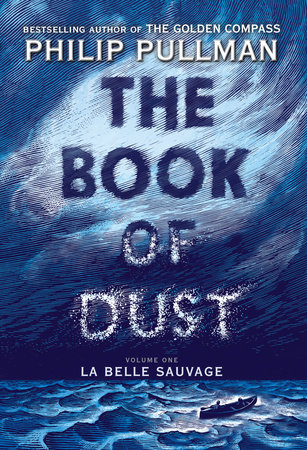 |
| The Book of Dust: Volume 1--La Belle Sauvage |
Partially, the problem Pullman faces with this new volume is self-inflicted, because the early chapters of La Belle Sauvage are a pure pleasure to read, and thus the expectations get raised considerably. It takes but a few pages for fans to be reminded of just how good a prose stylist Pullman is; his talent for a clever turn of phrase remains firmly within his mastery, and one can't help but smile--if not outright laugh--at the author's cleverness as he relates the early pages of his tale. The description of the life of innkeeper's son--and soon to be epic hero--Malcolm Polstead is perfectly charming, witty, vivid in creating a sense of time and place, and full of promise of wonderful things to come. Intrigue arrives quickly, and in no time the reader is off on an adventure that appears certain to provide plenty of excitement, enchantment, and maybe a little danger, too.
The problem arises, oddly enough, once the action of the story finally starts to happen. Most of the early chapters of La Belle Sauvage are composed of scene-setting; much of what goes on is talky and lays the groundwork for the adventure that is about to come.
That description is not a disparagement. Quite the contrary: again, Pullman's penchant for clever turns of phrase, his talent at characterization, and his world-building vision all make the early chapters of the book into something fascinating--and those expectations build as the reader awaits the inevitable payoff of a fully realized saga.
Unfortunately, it doesn't quite work out that way. Once the crisis moment comes, and Malcolm, his partner-antagonist Alice (the dishwasher at his parents' inn), and the infant Lyra make their desperate escape from danger, La Belle Sauvage presents the paradox of a story where the action finally starts...but the narrative somehow slows down. As the three kids follow the Thames through the flooded Oxfordshire landscape and down towards London--pursued all the way by a very dangerous character--Pullman's story bogs down somewhat, despite the characters' literal movement and the high narrative stakes.
What's the problem? Mostly, it seems that the author, having plotted himself into an epic flood, feels compelled to give the disaster a fittingly epic amount of attention. Pullman indulges in a great deal of detailed description of the water-logged Oxfordshire landscape--a patch of earth that is obviously much loved by the author, but is most likely quite unfamiliar to most of his readers, and thus not nearly the object of fascination that Pullman obviously believes it to be.
There are other issues with Malcolm and Alice's odyssey. Pullman uses the trip down the river--really, across a temporary ocean that may as well be an ancient Greek hero's Mediterranean--as the setting for a series of stops along the way, most of which serve as the staging for some supernatural tableaux. Most of these scenes veer past the point of diversion and reach the unwanted shore that is distraction. The reader can only hope that Pullman is setting up something for the new trilogy's future volumes, for there's precious little payoff in these vaguely Homeric episodes.
Problems also spring not just from the narrative's set pieces, but also from the book's characters as well. Daemons, Pullman's unique contribution to fantasy literature--and a clever device for converting internal monologues into actual external dialogue--get strangely inconsistent treatment from the author. Malcolm's daemon Asta is always named and lives as a fully developed character in her own right; meanwhile, Alice's daemon Ben is often obscure, sometimes unnamed, and frequently seemingly forgotten. That, and other, similar, almost lazy treatment of other characters' daemons, can be found throughout the tale--an odd bit of literary clumsiness given Pullman's status as the sire of the device.
As for the human characters themselves, Malcolm and Alice start off as antagonists, then inevitably become allies and friends, and perhaps even more than that--which is odd and a little uncomfortable, given the difference in their stated ages. Malcolm starts the book as an eleven-year-old; Alice is described as "about sixteen." That's a major difference in developmental stages, and makes some of the story's later developments strange and improbable. Indeed, when the final confrontation comes with the book's chief villain, it includes a bit of ugliness that is of questionable necessity to the plot. The affront seems gratuitous, and while the guilty party receives justice, the entire scene stains the proceedings and makes the book's denouement arrive under a disturbing cloud.
Further character problems include the outright disappearance of at least two characters who, based upon the early chapters of the book, seem to be poised to play major roles in the later narrative. They don't. Again, one hopes that further developments are being set up for payoff in future volumes, but there are no guarantees.
So then, is La Belle Sauvage a bad book? No. But it feels very incomplete--more incomplete than even a volume 1 of any trilogy should feel. Unintentionally, perhaps, Pullman has put his readers into a story with stakes about as high as those faced by Malcolm, Alice, and the rest of Lyra's guardians: the high stakes of judging a literary work for its quality, and whether that attribute is great enough to make moving forward with the work's sequels worth one's while. I think there's enough in Volume 1 of The Book of Dust to make a fan anticipate Volume 2...but, as with the kids in La Belle Sauvage, it's a precarious thing, and the escape may be a narrow one. We'll see.
Sunday, January 7, 2018
Recently Read
The Evolution of Beauty
by Richard O. Prum
Whenever we wish to answer any question about the natural world, and we're in doubt about it, we usually turn to Darwin. Except, that is, when it comes to the question of beauty and how it exists in the world, according to Yale professor Richard Prum. The rejection of Darwin's ideas about sexual selection--as opposed to his theory of natural selection--by the bulk of evolutionary scientists serves as the inspiration for Prum's The Evolution of Beauty, a book written as a methodical (and methodological) counterpoint to the field's slavish devotion to adaptation as the answer to everything.
Prum makes it clear that he does not wish to reject the notion of adaptive mate choice--the evolutionary mechanism that is scientists' preferred answer for why animals evolve in every given way--but simply wishes to reassert an arbitrary character to certain processes that lead to many of the extraordinary forms and behaviors displayed by animals and humans.
Yes, humans, too. We're animals of a sort, and one of the great legacies of Darwin's investigation of evolution was to pull modern human beings out of their Ptolemaic universe, where we viewed ourselves as a special creation that lived in the center of the universe, near to but separated from the rest of the animal kingdom, and into a more scientific and realistic conception of ourselves as being the products of an expansive Tree of Life--animals along with all the rest of this planet's occupants, and sharing many similar characteristics, right down to our genes.
Thus, if you're the type who likes to spend weekends hanging out at the Creationist Museum, this book is probably not for you.
If, however, you have an open mind--especially a mind more open than most of today's current crop of evolutionary scientists, according to Prum--then you're likely to profit from reading The Evolution of Beauty, particularly if you have long pondered the signficance of the differences we see among creatures in the world around us--including the creatures we see at the mall, the grocery store, and the office.
Frankly, the idea that much of the organic world's existence is governed by a notion of aesthetic mate choice--that is, mates are chosen not simply for their Darwinian "fitness," but also for how aesthetically pleasing they are to other members of their species--seems like something fairly obvious. This observer has long understood (to his own personal detriment) how "the birds with the brightest plumage are the ones who get the mates." It seems like a strain to deny that being beautiful works heavily to a creature's advantage, be that creature a Great Argus pheasant, a breed of dog, or a USC cheerleader.
Yet, according to Prum, that has largely been the case within the field of evolutionary science, where the out-sized influence of Alfred Russell Wallace (the co-discoverer with Darwin of natural selection) has worked for over a hundred years to champion the primacy of all-powerful adaptation as the cause of all evolutionary change.
As Prum establishes in his book's early chapters, the turn away from Darwin's theory of aesthetic mate choice as a key component of sexual selection was largely driven by Wallace's personal animus, along with hearty doses of Victorian-era primness, particularly with regards to female sexual autonomy. The implications of "this aesthetic view of life"--as Prum puts it, echoing Darwin's famous closing to Origin of Species--were a little too risque if not revolutionary for the staid world in which the famous naturalist first proposed them, and biological sciences clung to adaptation as a shield against any nervous-making ideas interfering with their solidly orderly and reasonable view of how animals evolve.
But now, in the 21st century--where primness is an idea that has dissolved and the culture has moved well beyond the boundary of quaintness--along comes Prum, an ornithologist who has taken a lifetime of observing birds and their mating rituals and identified behaviors and physical characteristics that simply can't be explained by mere adaptation, or "honest advertising" of physical superiority, as the adaptationist creed would have you believe.
Thus, most of the first half of The Evolution of Beauty presents Prum's examples from the field, where his observations--literally, his bird-watching excursions--of Great Argus pheasants, various species of Manakins and Bowerbirds, and other exotic avians introduced him to behaviors and traits that defy classification as advertisements of an individual bird's fitness. Prum explains how, in most of the species studied, female mate choice served as the engine for creating adjustments to the males who were seeking mates, either through changes in appearance or in behavior, that are not only not adaptive in nature, but in some instances can be considered maladaptive, at least from an individual's point of view. (The mating displays of male Manakins--where multiple males show coordinated behaviors that assure certain birds lose out on breeding opportunities--are particularly effective evidence.) The chapter on duck sex presents a surprisingly dramatic scenario that makes a sound case for just how strong--and urgent--is the female drive to adapt in order to preserve their sexual freedom--a freedom of choice that insists upon being able to preserve a hen's desire to mate with the drake who is most appealing to her.
Later in the book, Prum tackles how aesthetic mate choice works in the human species, from our divergence with our ape cousins all the way through to the rise of homosexuality as an open human sexual phenomenon in these later days (at least as a question of sexual identity, if not the more ancient mechanics of the thing). Subjects tackled in these later chapters are as colorful as the human male's lack of a baculum (penis bone) and the utility of female orgasms (maybe there isn't any, besides the fact that it feels good) to the sobering reality that many of the by-products of human aesthetic mate choice (by women) serve the purpose of nullifying "traditions" of sexual coercion and violence. It's a rich tapestry for sure, and bound to be of interest to anyone with an interest in human sexual dynamics--which is to say, everyone.
Prum's treatment of his subject is scholarly, but that doesn't mean it's too opaque for the average reader to comprehend. The professor doesn't dumb things down; he keeps his reporting as straightforward and clear as possible to serve the purpose of reaching, and influencing, a broad audience. So, too, does his writing style; Prum injects a healthy amount of humor and even pop culture references into his text, which certainly helps to lubricate the nonscientist's understanding of the subjects being discussed. For a work as intelligent and dense as The Evolution of Beauty, the book is in fact a relatively easy and enjoyable read. The author's only real misstep comes in his closing chapter, where he presents as a thematic anchor a gross misinterpretation of an old Greek aphorism, which then serves to undermine his closing argument. Other than that one fault, Prum's presentation is lucid, well-argued, and hard to refute.
So, then, does The Evolution of Beauty triumph in beating back the adaptationists' claims to universality? Yes, I think so, at least as far as the notion of the ubiquitous and unchangeable power of adaptive mate choice is concerned. There's too much here that argues too strongly in favor of that "aesthetic view of life" for all the eggs to be placed in the adaptive basket. But some of Prum's conclusions--"intellectual offerings" may be a more accurate description--remain highly speculative and are (by the author's own admission) still wanting in evidence to be claimed as fact. Overall, the case for aesthetic mate choice is strong, but, as the Scots might say, "not proven."
Still, The Evolution of Beauty is a welcome addition to the scientific bookshelf. Science only progresses--indeed, only happens--when questions are asked, particularly questions that challenge entrenched dogmas. Prum had done more than enough with this volume to raise important questions and set the course for the next generation of evolutionary biologists to find the proof for these ideas.
by Richard O. Prum
Whenever we wish to answer any question about the natural world, and we're in doubt about it, we usually turn to Darwin. Except, that is, when it comes to the question of beauty and how it exists in the world, according to Yale professor Richard Prum. The rejection of Darwin's ideas about sexual selection--as opposed to his theory of natural selection--by the bulk of evolutionary scientists serves as the inspiration for Prum's The Evolution of Beauty, a book written as a methodical (and methodological) counterpoint to the field's slavish devotion to adaptation as the answer to everything.
Prum makes it clear that he does not wish to reject the notion of adaptive mate choice--the evolutionary mechanism that is scientists' preferred answer for why animals evolve in every given way--but simply wishes to reassert an arbitrary character to certain processes that lead to many of the extraordinary forms and behaviors displayed by animals and humans.
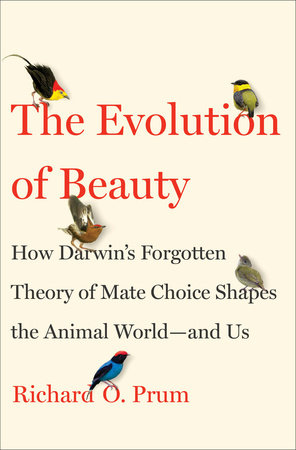 |
| The Evolution of Beauty by Richard O. Prum |
Thus, if you're the type who likes to spend weekends hanging out at the Creationist Museum, this book is probably not for you.
If, however, you have an open mind--especially a mind more open than most of today's current crop of evolutionary scientists, according to Prum--then you're likely to profit from reading The Evolution of Beauty, particularly if you have long pondered the signficance of the differences we see among creatures in the world around us--including the creatures we see at the mall, the grocery store, and the office.
Frankly, the idea that much of the organic world's existence is governed by a notion of aesthetic mate choice--that is, mates are chosen not simply for their Darwinian "fitness," but also for how aesthetically pleasing they are to other members of their species--seems like something fairly obvious. This observer has long understood (to his own personal detriment) how "the birds with the brightest plumage are the ones who get the mates." It seems like a strain to deny that being beautiful works heavily to a creature's advantage, be that creature a Great Argus pheasant, a breed of dog, or a USC cheerleader.
Yet, according to Prum, that has largely been the case within the field of evolutionary science, where the out-sized influence of Alfred Russell Wallace (the co-discoverer with Darwin of natural selection) has worked for over a hundred years to champion the primacy of all-powerful adaptation as the cause of all evolutionary change.
As Prum establishes in his book's early chapters, the turn away from Darwin's theory of aesthetic mate choice as a key component of sexual selection was largely driven by Wallace's personal animus, along with hearty doses of Victorian-era primness, particularly with regards to female sexual autonomy. The implications of "this aesthetic view of life"--as Prum puts it, echoing Darwin's famous closing to Origin of Species--were a little too risque if not revolutionary for the staid world in which the famous naturalist first proposed them, and biological sciences clung to adaptation as a shield against any nervous-making ideas interfering with their solidly orderly and reasonable view of how animals evolve.
But now, in the 21st century--where primness is an idea that has dissolved and the culture has moved well beyond the boundary of quaintness--along comes Prum, an ornithologist who has taken a lifetime of observing birds and their mating rituals and identified behaviors and physical characteristics that simply can't be explained by mere adaptation, or "honest advertising" of physical superiority, as the adaptationist creed would have you believe.
Thus, most of the first half of The Evolution of Beauty presents Prum's examples from the field, where his observations--literally, his bird-watching excursions--of Great Argus pheasants, various species of Manakins and Bowerbirds, and other exotic avians introduced him to behaviors and traits that defy classification as advertisements of an individual bird's fitness. Prum explains how, in most of the species studied, female mate choice served as the engine for creating adjustments to the males who were seeking mates, either through changes in appearance or in behavior, that are not only not adaptive in nature, but in some instances can be considered maladaptive, at least from an individual's point of view. (The mating displays of male Manakins--where multiple males show coordinated behaviors that assure certain birds lose out on breeding opportunities--are particularly effective evidence.) The chapter on duck sex presents a surprisingly dramatic scenario that makes a sound case for just how strong--and urgent--is the female drive to adapt in order to preserve their sexual freedom--a freedom of choice that insists upon being able to preserve a hen's desire to mate with the drake who is most appealing to her.
Later in the book, Prum tackles how aesthetic mate choice works in the human species, from our divergence with our ape cousins all the way through to the rise of homosexuality as an open human sexual phenomenon in these later days (at least as a question of sexual identity, if not the more ancient mechanics of the thing). Subjects tackled in these later chapters are as colorful as the human male's lack of a baculum (penis bone) and the utility of female orgasms (maybe there isn't any, besides the fact that it feels good) to the sobering reality that many of the by-products of human aesthetic mate choice (by women) serve the purpose of nullifying "traditions" of sexual coercion and violence. It's a rich tapestry for sure, and bound to be of interest to anyone with an interest in human sexual dynamics--which is to say, everyone.
Prum's treatment of his subject is scholarly, but that doesn't mean it's too opaque for the average reader to comprehend. The professor doesn't dumb things down; he keeps his reporting as straightforward and clear as possible to serve the purpose of reaching, and influencing, a broad audience. So, too, does his writing style; Prum injects a healthy amount of humor and even pop culture references into his text, which certainly helps to lubricate the nonscientist's understanding of the subjects being discussed. For a work as intelligent and dense as The Evolution of Beauty, the book is in fact a relatively easy and enjoyable read. The author's only real misstep comes in his closing chapter, where he presents as a thematic anchor a gross misinterpretation of an old Greek aphorism, which then serves to undermine his closing argument. Other than that one fault, Prum's presentation is lucid, well-argued, and hard to refute.
So, then, does The Evolution of Beauty triumph in beating back the adaptationists' claims to universality? Yes, I think so, at least as far as the notion of the ubiquitous and unchangeable power of adaptive mate choice is concerned. There's too much here that argues too strongly in favor of that "aesthetic view of life" for all the eggs to be placed in the adaptive basket. But some of Prum's conclusions--"intellectual offerings" may be a more accurate description--remain highly speculative and are (by the author's own admission) still wanting in evidence to be claimed as fact. Overall, the case for aesthetic mate choice is strong, but, as the Scots might say, "not proven."
Still, The Evolution of Beauty is a welcome addition to the scientific bookshelf. Science only progresses--indeed, only happens--when questions are asked, particularly questions that challenge entrenched dogmas. Prum had done more than enough with this volume to raise important questions and set the course for the next generation of evolutionary biologists to find the proof for these ideas.
Saturday, September 23, 2017
Recently Read
Call of the Cats
by Andrew Bloomfield
There are two possible takeaways from reading Andrew Bloomfield's Call of the Cats: What I learned about Life and Love from a Feral Colony.
One is that Bloomfield is an uncommonly dedicated animal lover, one who devoted a huge part of his life to taking care of a group of backyard cats for little more than the intangible rewards of good deeds done (and maybe, perhaps, a decent writing contract).
The other potential takeaway is that Bloomfield confirms many observers' perceptions of cat people as weird, off-center, and perhaps more than a little crazy.
The latter notion comes through to the reader less by way of the author's interaction with the cats in his neighborhood's large feral colony and more through what Bloomfield reveals about himself in the process of telling his story. In various diversions, Bloomfield discusses his time in Nepal, his on-again, off-again work as an astrologer, his spectacularly unsuccessful career as a day trader, his time as a dealer in rare Asian artworks...in short, Bloomfield relates the story of a peripatetic working life in which he apparently did everything except hold a normal job. The implication--no normal job because he's no normal person--seems clear, and certainly reinforces the notion that someone who would dedicate himself so vigorously to taking care of a group of cats--who often feel substantially less care for him--is probably a bit of a misfit, at least as far as the general rules of society go.
Nothing particularly revealing there. Those of us who love cats, in general, would have no problem with characterizing ourselves as misfits. In this world, dog owners are clearly deemed to be the normal people; they fit in, and one could even say they come across as quite satisfied with themselves. No such comfort exists for cat lovers, particularly those who really love cats. Bloomfield, apparently, qualifies on all counts there.
If you can get past the author's eccentricity, you do get an interesting and informative portrait of just how difficult it can be to handle--literally and figuratively--a colony of feral cats. The stories range from heartening--tales of this or that cat's recovery from a seemingly fatal illness--to heartbreaking--the devastation wreaked upon the colony, and particularly its kitten population, by the local predator population (coyotes, raccoons, opossums). It ain't easy living out there in the spaces in between, and it can be a harrowing experience if you're trying to help the cats who have settled into those spaces. That message shines through in Bloomfield's writing, at least as strongly as the characterization of the author himself does.
If there's any problem with Call of the Cats, it's mostly from a sense that the tale told in the book is comprised of many disjointed segments; a sense of flowing narrative rarely comes out of these pages. (Bloomfield's personal diversions do as much harm to that sense of flow as they do to his chance of being perceived as normal.) Also, the cast of feline characters grows too large at certain points for the casual, not-entirely-attentive reader to keep straight. The reader winds up feeling muddled in more than one stretch of the book's length.
But it's hard for a cat lover to make too negative an assessment of a book like this, and for an author who clearly exposes a deep and abiding love for the subjects of his literary inspiration. Those of us who deem ourselves to be true feline friends will find more than enough pleasure from Call of the Cats. And even the dog people among us, if they're feeling charitable towards their eccentric neighbors--and can get past feeling so satisfied with themselves--might get a bit of joy out of this very cat-centric book, too. It's certainly worth picking it up and giving it a try.
by Andrew Bloomfield
There are two possible takeaways from reading Andrew Bloomfield's Call of the Cats: What I learned about Life and Love from a Feral Colony.
One is that Bloomfield is an uncommonly dedicated animal lover, one who devoted a huge part of his life to taking care of a group of backyard cats for little more than the intangible rewards of good deeds done (and maybe, perhaps, a decent writing contract).
The other potential takeaway is that Bloomfield confirms many observers' perceptions of cat people as weird, off-center, and perhaps more than a little crazy.
 |
| Andrew Bloomfield's Call of the Cats |
Nothing particularly revealing there. Those of us who love cats, in general, would have no problem with characterizing ourselves as misfits. In this world, dog owners are clearly deemed to be the normal people; they fit in, and one could even say they come across as quite satisfied with themselves. No such comfort exists for cat lovers, particularly those who really love cats. Bloomfield, apparently, qualifies on all counts there.
If you can get past the author's eccentricity, you do get an interesting and informative portrait of just how difficult it can be to handle--literally and figuratively--a colony of feral cats. The stories range from heartening--tales of this or that cat's recovery from a seemingly fatal illness--to heartbreaking--the devastation wreaked upon the colony, and particularly its kitten population, by the local predator population (coyotes, raccoons, opossums). It ain't easy living out there in the spaces in between, and it can be a harrowing experience if you're trying to help the cats who have settled into those spaces. That message shines through in Bloomfield's writing, at least as strongly as the characterization of the author himself does.
If there's any problem with Call of the Cats, it's mostly from a sense that the tale told in the book is comprised of many disjointed segments; a sense of flowing narrative rarely comes out of these pages. (Bloomfield's personal diversions do as much harm to that sense of flow as they do to his chance of being perceived as normal.) Also, the cast of feline characters grows too large at certain points for the casual, not-entirely-attentive reader to keep straight. The reader winds up feeling muddled in more than one stretch of the book's length.
But it's hard for a cat lover to make too negative an assessment of a book like this, and for an author who clearly exposes a deep and abiding love for the subjects of his literary inspiration. Those of us who deem ourselves to be true feline friends will find more than enough pleasure from Call of the Cats. And even the dog people among us, if they're feeling charitable towards their eccentric neighbors--and can get past feeling so satisfied with themselves--might get a bit of joy out of this very cat-centric book, too. It's certainly worth picking it up and giving it a try.
Monday, March 6, 2017
Recently Read
Listen, Liberal
Or, What Ever Happened to the Party of the People?
by Thomas Frank
It took a decade and a half of political reporting, Barack Obama’s presidency, and a presidential run by Hillary Clinton to make Thomas Frank get serious.
This is not to suggest that Frank, famously the author of What’s The Matter With Kansas? and other works of political analysis, has never taken his subject seriously. But previous iterations of the author’s work have included healthy doses of incisive wit sprinkled within the cogent political analysis.
Not so much with Listen, Liberal. Frank’s writing remains top-notch, and his deconstruction of the dissolution of what used to be the Democratic Party is smart, convincing, and frankly—no pun intended—more than a bit depressing.
Perhaps Frank himself was getting that same vibe as he was crafting his prose. Even though his previous works covered a lot of the same ground, Frank’s earlier texts always included more than a few laugh out loud moments—either through the author’s exposition on the true absurdity of his subject, or simply via his own clever turn of phrase. But here, as Frank recites the laundry list of charges against today’s allegedly liberal political actors, nothing in the writing ever really comes across as funny.
That should be a minor defect when you’re reading a work of political analysis, but Frank has previously set his bar so high that anything less than a complete reading experience comes across as at least a minor failure.
That critique would be unfair as a total analysis of Frank’s tome, since in all other aspects Listen, Liberal succeeds at its task. Frank presents a powerful case—an indictment, really--that the modern so-called Democratic Party has succumbed to narcissism, rationalization, and just plain bullshit instead of sticking to its guns and truly doing the work of being the “party of the people.”
Frank argues that, through fetishizing “innovation” and that concept’s assorted empty promises, the Democrats of the last twenty or so years—particularly the ones carrying around the surname Clinton—performed a pantomime of the traditional party’s platform. Instead of fighting for working people—labor as a political subunit in particular, but in general everyone who falls below the top 20th percentile in earnings—modern Democrats sold out the poor and the middle class in order to cater to the desires of wealthy donors. In other words, they behaved just like their presumed adversaries in the Republican party, with the exception of preferring to kowtow to tech moguls versus the bigwigs of the extraction industries. Regardless of that minor difference, as Frank makes perfectly clear, the nation found itself deprived of two legitimately separate parties—a real monkey wrench for a political system supposedly built around a “two-party system”—which meant that that bottom 80% wound up deprived of pretty much everything that could have made their lives better. No wonder, given Frank’s analysis, that everyone with a keyboard must now type the improbable phrase “President Trump.”
If there is any real failing of Listen, Liberal, it is that Frank’s personal voice sometimes come through a little too stridently. The author clearly takes sides in this political exegesis; not to say that he’s on the wrong side, but Frank certainly veers away from the traditional standard of objectivity that used to be the gold standard of political journalism. If that blatantly biased viewpoint is a failing, it is certainly an understandable one, given the times and political milieu in which a reporter must work today. As with Hunter S. Thompson back in the early ‘70s—when the great Gonzo journalist famously declared that objectivity was a vice when reporting on that time’s largest political actors, that one needed to report subjectively in order to truly see what a monster Richard Nixon was—Frank finds himself faced with characters who also demand a subjective treatment in order to expose their true natures. It is a greater indictment of Bill and Hillary Clinton, and their various political satellites, that they have sunk to such Nixonian depths that make such a subjective viewpoint necessary, than it could ever be of a journalist as worthy as Tom Frank.
All things considered, Listen, Liberal overcomes its weaknesses to stand as a welcome addition to the author’s title list. Frank remains an essential guide to the political movements of our times, and this latest work earns its place within Frank’s impressive canon. What will raise Listen, Liberal up from a good to a great work of political journalism will be if its readers—hopefully including big names within the ostensible “people’s party”—take Frank’s lessons to heart and stop caring so much about obeying the right billionaires, and start caring much more about helping the millions who need good, fair, and equitable government.
Or, What Ever Happened to the Party of the People?
by Thomas Frank
It took a decade and a half of political reporting, Barack Obama’s presidency, and a presidential run by Hillary Clinton to make Thomas Frank get serious.
This is not to suggest that Frank, famously the author of What’s The Matter With Kansas? and other works of political analysis, has never taken his subject seriously. But previous iterations of the author’s work have included healthy doses of incisive wit sprinkled within the cogent political analysis.
Not so much with Listen, Liberal. Frank’s writing remains top-notch, and his deconstruction of the dissolution of what used to be the Democratic Party is smart, convincing, and frankly—no pun intended—more than a bit depressing.
Perhaps Frank himself was getting that same vibe as he was crafting his prose. Even though his previous works covered a lot of the same ground, Frank’s earlier texts always included more than a few laugh out loud moments—either through the author’s exposition on the true absurdity of his subject, or simply via his own clever turn of phrase. But here, as Frank recites the laundry list of charges against today’s allegedly liberal political actors, nothing in the writing ever really comes across as funny.
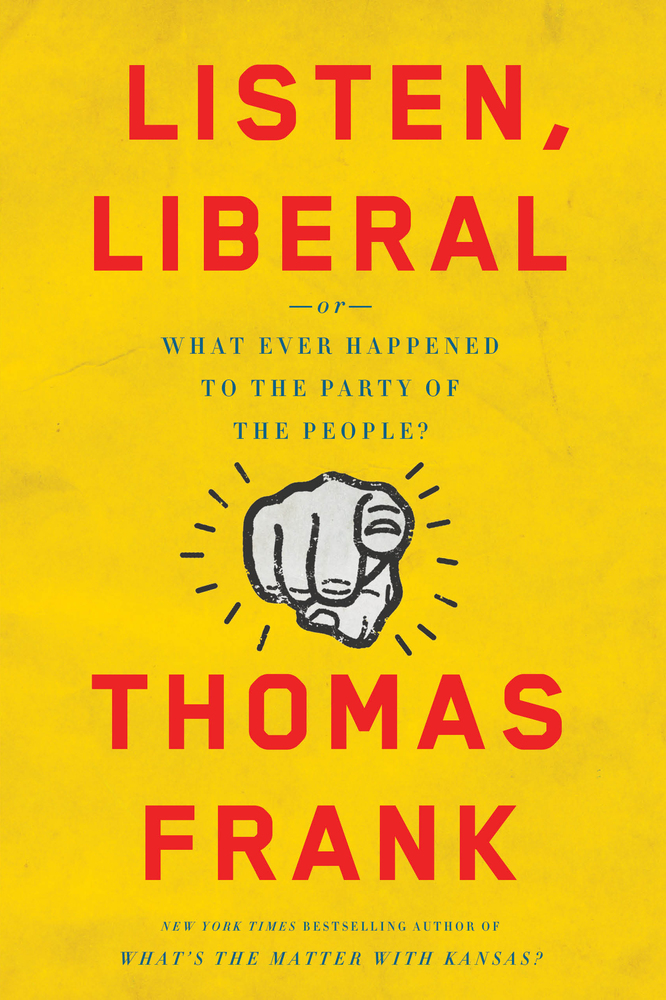 |
| Listen, Liberal by Thomas Frank |
That critique would be unfair as a total analysis of Frank’s tome, since in all other aspects Listen, Liberal succeeds at its task. Frank presents a powerful case—an indictment, really--that the modern so-called Democratic Party has succumbed to narcissism, rationalization, and just plain bullshit instead of sticking to its guns and truly doing the work of being the “party of the people.”
Frank argues that, through fetishizing “innovation” and that concept’s assorted empty promises, the Democrats of the last twenty or so years—particularly the ones carrying around the surname Clinton—performed a pantomime of the traditional party’s platform. Instead of fighting for working people—labor as a political subunit in particular, but in general everyone who falls below the top 20th percentile in earnings—modern Democrats sold out the poor and the middle class in order to cater to the desires of wealthy donors. In other words, they behaved just like their presumed adversaries in the Republican party, with the exception of preferring to kowtow to tech moguls versus the bigwigs of the extraction industries. Regardless of that minor difference, as Frank makes perfectly clear, the nation found itself deprived of two legitimately separate parties—a real monkey wrench for a political system supposedly built around a “two-party system”—which meant that that bottom 80% wound up deprived of pretty much everything that could have made their lives better. No wonder, given Frank’s analysis, that everyone with a keyboard must now type the improbable phrase “President Trump.”
If there is any real failing of Listen, Liberal, it is that Frank’s personal voice sometimes come through a little too stridently. The author clearly takes sides in this political exegesis; not to say that he’s on the wrong side, but Frank certainly veers away from the traditional standard of objectivity that used to be the gold standard of political journalism. If that blatantly biased viewpoint is a failing, it is certainly an understandable one, given the times and political milieu in which a reporter must work today. As with Hunter S. Thompson back in the early ‘70s—when the great Gonzo journalist famously declared that objectivity was a vice when reporting on that time’s largest political actors, that one needed to report subjectively in order to truly see what a monster Richard Nixon was—Frank finds himself faced with characters who also demand a subjective treatment in order to expose their true natures. It is a greater indictment of Bill and Hillary Clinton, and their various political satellites, that they have sunk to such Nixonian depths that make such a subjective viewpoint necessary, than it could ever be of a journalist as worthy as Tom Frank.
All things considered, Listen, Liberal overcomes its weaknesses to stand as a welcome addition to the author’s title list. Frank remains an essential guide to the political movements of our times, and this latest work earns its place within Frank’s impressive canon. What will raise Listen, Liberal up from a good to a great work of political journalism will be if its readers—hopefully including big names within the ostensible “people’s party”—take Frank’s lessons to heart and stop caring so much about obeying the right billionaires, and start caring much more about helping the millions who need good, fair, and equitable government.
Tuesday, August 25, 2015
Recently Read
And Another Thing...
by Eoin Colfer
There are many reasons to approach this book with great skepticism. It's a "Hitchhiker's Guide to the Galaxy" book that was not written by Douglas Adams; strike one. It was written by Eoin Colfer, who achieved success with the Artemis Fowl books, of which I read the first installment and was not particularly impressed; strike two. And it was produced after Adams had shuffled off his coil, and apparently without his participation; a Wikipedia entry claims that some of the story elements came from Adams's plans for a sixth installment, though it remains vague about just how much of the work comes from his efforts. That should be strike three and it's out.
Except that it's not. Somehow, Colfer made it safely to first base, or whatever is the equivalent in cricket. This came as a big surprise...but then, surprises are part of the raison d'etre of the Hitchhiker's series.
by Eoin Colfer
There are many reasons to approach this book with great skepticism. It's a "Hitchhiker's Guide to the Galaxy" book that was not written by Douglas Adams; strike one. It was written by Eoin Colfer, who achieved success with the Artemis Fowl books, of which I read the first installment and was not particularly impressed; strike two. And it was produced after Adams had shuffled off his coil, and apparently without his participation; a Wikipedia entry claims that some of the story elements came from Adams's plans for a sixth installment, though it remains vague about just how much of the work comes from his efforts. That should be strike three and it's out.
Except that it's not. Somehow, Colfer made it safely to first base, or whatever is the equivalent in cricket. This came as a big surprise...but then, surprises are part of the raison d'etre of the Hitchhiker's series.
Wednesday, August 19, 2015
Recently Read
Puss in Boots
by Philip Pullman / Ian Beck, illus.
I'm not impressed.
It's been a long time since Philip Pullman made a splash with His Dark Materials and its associated works. It has been nearly as long as Pullman gave his readers other great pieces of work, such as Clockwork and The Scarecrow and His Servant. Given the span of time that has passed since the author last wowed us, maybe it's time to reclassify Pullman, not as a star but as a comet--a body that shone brightly for a while, but eventually disappeared from the literary sky, perhaps never to return again.
It's not that this version of Puss in Boots is bad; Pullman does a serviceable job of presenting the traditional story; there are no passages in his tale that make the reader want to throw the book across the room or anything like that. But Pullman expands upon Charles Perrault's tale, including scenes with a hermit and some ghouls which, frankly, don't particularly add anything special to the story.
by Philip Pullman / Ian Beck, illus.
I'm not impressed.
It's been a long time since Philip Pullman made a splash with His Dark Materials and its associated works. It has been nearly as long as Pullman gave his readers other great pieces of work, such as Clockwork and The Scarecrow and His Servant. Given the span of time that has passed since the author last wowed us, maybe it's time to reclassify Pullman, not as a star but as a comet--a body that shone brightly for a while, but eventually disappeared from the literary sky, perhaps never to return again.
It's not that this version of Puss in Boots is bad; Pullman does a serviceable job of presenting the traditional story; there are no passages in his tale that make the reader want to throw the book across the room or anything like that. But Pullman expands upon Charles Perrault's tale, including scenes with a hermit and some ghouls which, frankly, don't particularly add anything special to the story.
Friday, August 14, 2015
Recently Read
The Good, the Bad, and the Furry
by Tom Cox
There's a downside to being cat crazy. Actually, there are a lot of downsides to being any kind of crazy; but right now I'm just focused on the cat crazy part. A downside of being cat crazy is that you can't just pass by anything cat related, even when you just happen to spot that something out of the corner of your eye. Sometimes that impulse can lead you seriously astray.
Case in point: The Good, the Bad, and the Furry by English author Tom Cox. I just happened to spot this book on the New Releases shelf at my local library, and felt compelled to grab it and take it home with me. That result probably owes a lot to the picture on the cover, which shows Cox's cat The Bear soulfully staring out at all who pass by, just begging cat crazy people like yours truly to pick up the book and take it home to read--a process not unlike adoptions at the local Petco.
by Tom Cox
There's a downside to being cat crazy. Actually, there are a lot of downsides to being any kind of crazy; but right now I'm just focused on the cat crazy part. A downside of being cat crazy is that you can't just pass by anything cat related, even when you just happen to spot that something out of the corner of your eye. Sometimes that impulse can lead you seriously astray.
Case in point: The Good, the Bad, and the Furry by English author Tom Cox. I just happened to spot this book on the New Releases shelf at my local library, and felt compelled to grab it and take it home with me. That result probably owes a lot to the picture on the cover, which shows Cox's cat The Bear soulfully staring out at all who pass by, just begging cat crazy people like yours truly to pick up the book and take it home to read--a process not unlike adoptions at the local Petco.
Monday, April 13, 2015
Recently Read
Stars and Strikes: Baseball and America in the Bicentennial Summer of ’76
by Dan Epstein
My earliest memories of baseball involve the Philadelphia Phillies and their division championship season of 1976. No surprise, then, that I would want to pick up Dan Epstein’s Stars and Strikes, which is nothing less than a history of that very season and of the cultural currents then having their impact in the USA during the nation’s 200th birthday celebration.
Epstein comprehensively tells the story of the 1976 baseball season: its preliminary moments before the season began, when the writing went up on the wall and told everyone who could read that free agency was imminent, and that baseball would never be the same; the month to month storyline of the actual season, which featured a repeat champion in the Cincinnati Reds but also a changing of the guard, in that former powers like the Oakland A’s, Pittsburgh Pirates, and Boston Red Sox saw their shine start to fade; and the aftermath once the World Series ended, when the big money started to flow and it was demonstrated that free agency mostly meant that the owners would have to be saved from themselves (which still hasn't happened in any meaningful way).
In covering the nuts and bolts of the baseball season, author Epstein presents the reader with workmanlike prose; his accounts of games, series, and streaks read so much like newspaper beat writer accounts that one wonders whether or not the author wrote that way according to a specific stylistic decision. (Epstein’s jacket flap bio indicates no stints as a beat writer, so it’s hard to say whether he comes to the style naturally or not.) Though these writings may come across as formulaic, Epstein nevertheless delivers mostly entertaining accounts of the events of the season, particularly in charting the meteoric rise (and eventual fall) of Detroit Tigers phenom Mark “The Bird” Fidrych, as well as the earliest rumblings of the volcano that would eventually explode from the Billy Martin-George Steinbrenner pairing as New York Yankees manger and owner. (If nothing else, Epstein does baseball fans the service of un-rehabilitating Steinbrenner and reminding everyone of just what a colossal asshole that man was.)
Along the way, Epstein also recounts the cultural phenomena that made up the contemporary scene in that oddest of celebratory years. Music in particular gets prominent display in the cultural history; Epstein quotes period hit songs as his chapter titles, with each chapter including some notes about the year's musical trends, from the mellow AM gold of the Starland Vocal Band, WAR, and England Dan and John Ford Coley, to the emergence of the soon-to-be scene-changing genres, disco and punk rock. Other hot topics, such as Legionnaire’s Disease, Bicentennial festivities, killer bees, racial tensions over busing, and (naturally, in a baseball book) The Bad News Bears, get their share of remembrance as Epstein brings what is now a wildly alien time temporarily back to life. Those of us who can (barely) remember those days can attest that, yes, life in 1976 really was that weird, and Epstein does the younger generation a service by documenting that fact.
Nostalgia may be less than ideal—the word has actually been used to describe what once was considered a disease—but the occasional indulgence can be harmless and fun, especially when the subject is the history-bound sport of baseball. Though it occasionally falls into rote recitation of the year's events, and it never reaches the literary heights achieved by the exemplars of the "one baseball season" genre (a la Halberstam or Angell), Stars and Strikes stands as one of the better entries in this now well-established genre. Fans of the sport, or even just those with an interest in cultural history, will do well to pick up a copy of Epstein’s work and take a groovy trip back to a time long gone--at least for a few hundred pages.
by Dan Epstein
My earliest memories of baseball involve the Philadelphia Phillies and their division championship season of 1976. No surprise, then, that I would want to pick up Dan Epstein’s Stars and Strikes, which is nothing less than a history of that very season and of the cultural currents then having their impact in the USA during the nation’s 200th birthday celebration.
Epstein comprehensively tells the story of the 1976 baseball season: its preliminary moments before the season began, when the writing went up on the wall and told everyone who could read that free agency was imminent, and that baseball would never be the same; the month to month storyline of the actual season, which featured a repeat champion in the Cincinnati Reds but also a changing of the guard, in that former powers like the Oakland A’s, Pittsburgh Pirates, and Boston Red Sox saw their shine start to fade; and the aftermath once the World Series ended, when the big money started to flow and it was demonstrated that free agency mostly meant that the owners would have to be saved from themselves (which still hasn't happened in any meaningful way).
 |
| Stars and Strikes by Dan Epstein |
Along the way, Epstein also recounts the cultural phenomena that made up the contemporary scene in that oddest of celebratory years. Music in particular gets prominent display in the cultural history; Epstein quotes period hit songs as his chapter titles, with each chapter including some notes about the year's musical trends, from the mellow AM gold of the Starland Vocal Band, WAR, and England Dan and John Ford Coley, to the emergence of the soon-to-be scene-changing genres, disco and punk rock. Other hot topics, such as Legionnaire’s Disease, Bicentennial festivities, killer bees, racial tensions over busing, and (naturally, in a baseball book) The Bad News Bears, get their share of remembrance as Epstein brings what is now a wildly alien time temporarily back to life. Those of us who can (barely) remember those days can attest that, yes, life in 1976 really was that weird, and Epstein does the younger generation a service by documenting that fact.
Nostalgia may be less than ideal—the word has actually been used to describe what once was considered a disease—but the occasional indulgence can be harmless and fun, especially when the subject is the history-bound sport of baseball. Though it occasionally falls into rote recitation of the year's events, and it never reaches the literary heights achieved by the exemplars of the "one baseball season" genre (a la Halberstam or Angell), Stars and Strikes stands as one of the better entries in this now well-established genre. Fans of the sport, or even just those with an interest in cultural history, will do well to pick up a copy of Epstein’s work and take a groovy trip back to a time long gone--at least for a few hundred pages.
Sunday, April 5, 2015
Recently Read
THINspired
by Mara Schaiavocampo
For some time now, I've had aspirations of writing a book about weight loss, using my own experiences going from weighing 340 pounds to today's 275 as grist for that mill. In particular, my ideas about weight loss--admittedly a straightforward process, when it's boiled down--took their form in an equation--The Equation, as it were--that helps distill my wisdom into a useful thought model that, I believe, can help those like me lose weight and live healthier (if not fully healthy) lives.
Of course, since weight loss is such a well-trodden path when it comes to publishing, I have not just compiled notes for my prospective work, but surveyed the field of weight loss books, to see if any other interested parties had the same thoughts I did.
In scanning the shelves, I came across only one book that seemed to display inspiration similar to my own. THINspired by Mara Schiavocampo is another individual's self-discovered program for losing weight. It even features an equation--or, as Ms. Schiavocampo puts it, her "Magic Formula"--as a framework for the author's weight loss program. Given these facts, I decided to read THINspired and see if all my plans and notes were for naught. Had I been beaten to the punch? Had I been scooped on the concept of an equation (by that or any other name), which would render my own plans to reveal a new weight loss thought model redundant and pointless?
Alas, though Schiavocampo contributes a few worthy ideas to the endeavor, she gets a lot of her equation--in my own humble but experienced opinion--wrong.
On the plus side, Schiavocampo is to be credited for devoting a large portion of her text to one of the under-recognized aspects of weight loss: the need for adequate sleep. Indeed, I place so much emphasis on sleep that I make it the first part of my own Equation. Unfortunately, while Schiavocampo had the sense to recognize sleep for the crucial element that it is, she still only deems sleep to be 10% of the program. Hardly any books on weight loss mention sleep; to identify so important a cog in the weight loss machine, and then to undersell it by deeming sleep to be only one tenth of the issue, undermines the force of her argument.
A lot of the rest of Schiavocampo's presentation consists of what one might call boilerplate weight loss advice. There's nothing particularly wrong with that; any book about weight loss must cover the fundamentals of "eat less, exercise more," since those basics are necessary to any successful weight loss effort. But some of her advice is problematic. She encourages readers to exercise by the mantra "train hard or go home"--advice that will rarely work for truly overweight individuals, who are often prone to injury by way of overexercising. Worse still, in lecturing her readers about the fundamentals, Schiavocampo reveals an outlook that, far from being encompassing and general, actually comes across as particular, idiosyncratic, and individual. In other words, one doubts that few overweight people could actually be successful following the author's lead.
Why? Because a great deal of what Schiavocampo preaches as the proper lifestyle for successful weight loss follows from her position as a person of means and opportunity. For instance, despite protestations about being on a budget and not being overly wealthy, Schiavocampo gushes about her exercise routine, including workouts and classes at what are apparently very trendy (and undoubtedly expensive) New York City fitness clubs. That feeling is reinforced by her name-checking her trainer friends, as if the average reader is supposed to know of these people already. (Namedropping is a relentless feature of THINspired; even those Schiavocampo identifies in the narrative as her personal friends get the first and last name treatment, so you know that she is hobnobbing with people who are Important.) This may be the norm when you are a television personality (Schiavocampo has worked as a reporter for ABC News, specifically Good Morning America, according to her jacket bio), but it doesn't reinforce her credibility with readers who wish to find legitimate advice on losing weight.
And, unfortunately, Schiavocampo's credibility is all too easy to question. As noted, she has a career in TV, and worked that job before she stumbled upon her "Magic Formula" for weight loss. How much weight did she need to lose? It is impossible from the text to accurately judge that. Fatties, as we know, rarely get hired to be television personalities. Schiavocampo puts her total weight loss at 90 pounds, which is an impressive figure without a doubt, and she relates stories from childhood where being overweight played a big role in her development. Yet, all we ever get from the author, in terms of hard numbers, is that figure of 90 pounds. At no point in the text does Schiavocampo give an actual scale reading for herself; the reader never knows just how much this woman actually ever weighed. (A quick web search reveals early, pre-weight loss pictures of the author, showing a woman who was indeed overweight, though not to this viewers eyes truly obese.)
Schiavocampo does, at one point, relate that she gained 40 pounds during pregnancy; so then the ninety pound total is boosted by the extra forty lumped on by having a baby? Was her real weight loss 90 pounds, or 50 pounds if you count from her pre-pregnancy, "normal" weight? In another passage Schiavocampo labels herself as having been a "size 14"; given the madness that is women's clothing sizes, readers could be forgiven for having no idea what that actually means in terms of shape and health. (Per Schiavocampo, size 14 is "the size of the average woman today.") The average woman may find something meaningful in those terms, but whether this discourse will actually be useful for those who need to drop the pounds is another matter.
So it goes for what the average woman might get out of THINspired; others, particularly men, would read this book and find a lecture that says little to them, or even speaks in a language that they can understand. Clearly, Schiavocampo wrote her book for a niche market of women like herself. Unfortunately, the reason we have such a wide open market for books on weight loss is specifically because the problem of overweight is so widespread and general; the niche approach, as represented by THINspired, paints the problem in terms too specific to ever be useful to more than a few individuals.
Schiavocampo should be commended for making the effort of trying to cast the basics of weight loss in a form that some (or even a few) will understand better than what they've heard before. If you are of a certain type, the ideas in THINspired just might click with you and help you get down the road towards a healthier you. But as likely as not, this one of Ms. Schiavocampo's reports may simply come across to you as dead air.
by Mara Schaiavocampo
For some time now, I've had aspirations of writing a book about weight loss, using my own experiences going from weighing 340 pounds to today's 275 as grist for that mill. In particular, my ideas about weight loss--admittedly a straightforward process, when it's boiled down--took their form in an equation--The Equation, as it were--that helps distill my wisdom into a useful thought model that, I believe, can help those like me lose weight and live healthier (if not fully healthy) lives.
Of course, since weight loss is such a well-trodden path when it comes to publishing, I have not just compiled notes for my prospective work, but surveyed the field of weight loss books, to see if any other interested parties had the same thoughts I did.
In scanning the shelves, I came across only one book that seemed to display inspiration similar to my own. THINspired by Mara Schiavocampo is another individual's self-discovered program for losing weight. It even features an equation--or, as Ms. Schiavocampo puts it, her "Magic Formula"--as a framework for the author's weight loss program. Given these facts, I decided to read THINspired and see if all my plans and notes were for naught. Had I been beaten to the punch? Had I been scooped on the concept of an equation (by that or any other name), which would render my own plans to reveal a new weight loss thought model redundant and pointless?
Alas, though Schiavocampo contributes a few worthy ideas to the endeavor, she gets a lot of her equation--in my own humble but experienced opinion--wrong.
On the plus side, Schiavocampo is to be credited for devoting a large portion of her text to one of the under-recognized aspects of weight loss: the need for adequate sleep. Indeed, I place so much emphasis on sleep that I make it the first part of my own Equation. Unfortunately, while Schiavocampo had the sense to recognize sleep for the crucial element that it is, she still only deems sleep to be 10% of the program. Hardly any books on weight loss mention sleep; to identify so important a cog in the weight loss machine, and then to undersell it by deeming sleep to be only one tenth of the issue, undermines the force of her argument.
A lot of the rest of Schiavocampo's presentation consists of what one might call boilerplate weight loss advice. There's nothing particularly wrong with that; any book about weight loss must cover the fundamentals of "eat less, exercise more," since those basics are necessary to any successful weight loss effort. But some of her advice is problematic. She encourages readers to exercise by the mantra "train hard or go home"--advice that will rarely work for truly overweight individuals, who are often prone to injury by way of overexercising. Worse still, in lecturing her readers about the fundamentals, Schiavocampo reveals an outlook that, far from being encompassing and general, actually comes across as particular, idiosyncratic, and individual. In other words, one doubts that few overweight people could actually be successful following the author's lead.
Why? Because a great deal of what Schiavocampo preaches as the proper lifestyle for successful weight loss follows from her position as a person of means and opportunity. For instance, despite protestations about being on a budget and not being overly wealthy, Schiavocampo gushes about her exercise routine, including workouts and classes at what are apparently very trendy (and undoubtedly expensive) New York City fitness clubs. That feeling is reinforced by her name-checking her trainer friends, as if the average reader is supposed to know of these people already. (Namedropping is a relentless feature of THINspired; even those Schiavocampo identifies in the narrative as her personal friends get the first and last name treatment, so you know that she is hobnobbing with people who are Important.) This may be the norm when you are a television personality (Schiavocampo has worked as a reporter for ABC News, specifically Good Morning America, according to her jacket bio), but it doesn't reinforce her credibility with readers who wish to find legitimate advice on losing weight.
And, unfortunately, Schiavocampo's credibility is all too easy to question. As noted, she has a career in TV, and worked that job before she stumbled upon her "Magic Formula" for weight loss. How much weight did she need to lose? It is impossible from the text to accurately judge that. Fatties, as we know, rarely get hired to be television personalities. Schiavocampo puts her total weight loss at 90 pounds, which is an impressive figure without a doubt, and she relates stories from childhood where being overweight played a big role in her development. Yet, all we ever get from the author, in terms of hard numbers, is that figure of 90 pounds. At no point in the text does Schiavocampo give an actual scale reading for herself; the reader never knows just how much this woman actually ever weighed. (A quick web search reveals early, pre-weight loss pictures of the author, showing a woman who was indeed overweight, though not to this viewers eyes truly obese.)
Schiavocampo does, at one point, relate that she gained 40 pounds during pregnancy; so then the ninety pound total is boosted by the extra forty lumped on by having a baby? Was her real weight loss 90 pounds, or 50 pounds if you count from her pre-pregnancy, "normal" weight? In another passage Schiavocampo labels herself as having been a "size 14"; given the madness that is women's clothing sizes, readers could be forgiven for having no idea what that actually means in terms of shape and health. (Per Schiavocampo, size 14 is "the size of the average woman today.") The average woman may find something meaningful in those terms, but whether this discourse will actually be useful for those who need to drop the pounds is another matter.
So it goes for what the average woman might get out of THINspired; others, particularly men, would read this book and find a lecture that says little to them, or even speaks in a language that they can understand. Clearly, Schiavocampo wrote her book for a niche market of women like herself. Unfortunately, the reason we have such a wide open market for books on weight loss is specifically because the problem of overweight is so widespread and general; the niche approach, as represented by THINspired, paints the problem in terms too specific to ever be useful to more than a few individuals.
Schiavocampo should be commended for making the effort of trying to cast the basics of weight loss in a form that some (or even a few) will understand better than what they've heard before. If you are of a certain type, the ideas in THINspired just might click with you and help you get down the road towards a healthier you. But as likely as not, this one of Ms. Schiavocampo's reports may simply come across to you as dead air.
Saturday, January 24, 2015
Recently Read
A Nice Little Place on the North Side:
Wrigley Field at One Hundred
by George Will
As a newspaper columnist and television talking head, George Will has been the epitome of elitism and snobbery, all wrapped up in a bow-tied package that serves only the interests of the wealthy masters who pay him handsomely for such representation. But every once in a while, Will steps away from his political role and chooses to celebrate his other--perhaps only legitimate--passion, baseball. And when Will writes about baseball, he becomes...well, not exactly likeable. Tolerable is probably a better adjective for this other dimension of Will's character.
Loveable is not the correct adjective either, though it is one that is often attached--along with tag "losers"--to Will's subject in his latest baseball book, the Cubs. For while A Nice Little Place on the North Side is ostensibly about Wrigley Field, the ballpark is just a building, and it would be of little note to anyone but for the actions of the team that has spent most of the park's history as its primary tenant.
That's a problem, because, while a reader should absorb an author's work with a dispassionate mind, the fact is that when a professional sports team serves as the bulk of a book's subject, only a non-fan can maintain that kind of stoic disassociation. And those who are not sports fans rarely pick up sports-related books. Those who will crack the spine of a newly minted baseball book are most likely baseball fans, who will bring to those pages their own thoughts, feelings, and memories regarding the team in question.
Hence, the central role played by the Cubs in A Nice Little Place... can undermine the reader's enjoyment of the book (unless, of course, you are--like Will himself--a long-time Cubs fan). While a baseball fan may be able to appreciate a telling of the highs (rare) and lows (legion) of the Cubs' history, he is unlikely to be moved in any great sense by the vignettes presented in this book. (Will eschews a straight narrative history of the park and instead offers a more episodic, mostly chronological telling of Wrigley Field lore.)
That is probably why A Nice Little Place... is at its best when Will shifts away from idle tales about the Cubs' fortunes and relates more information about how Wrigley Field has affected the team's performance. Nowhere is this clearer than in Will's portrait of P.K. Wrigley, the son of the field's namesake and "reluctant owner" of the Cubs through the much of the middle of the 20th century (when losing records became Chicago's hallmark). In the junior Wrigley, Will gets to portray a near perfect idol for why the Cubs have underachieved for so long; the man actually came out and plainly said that his goal, in emphasizing the Wrigley Field experience (rather than winning teams), was to cater to "people not interested in baseball." Will builds a solid case that such a philosophy--ballpark as showcase and team as afterthought--has been the ruin of many a Cubs season.
One wonders then, if the ballpark has been so guilty, why would a true blue Cubs fan be so quick to lionize the place? Will, however, never wavers from his Cubs fan bona fides, even expressing some cautious optimism that the current Ricketts family ownership will put a stop to all this "just have a good time" stuff and put a winning team on that hallowed field. How quaint. Anyone who's been paying attention knows that recent renovations aren't going so well, and the neighborhood around Wrigley Field is getting restless.
So it goes for the Cubs, and partisans such as Will will have to endure the tribulations for a while longer before they see better days for their favorite team. And if things keep working out as usual for the team on Chicago's North Side? Well, Will and his friends will still have their favorite ballpark--in at least some of its glory--to comfort them with memories good and bad. Such is life and baseball.
Wrigley Field at One Hundred
by George Will
As a newspaper columnist and television talking head, George Will has been the epitome of elitism and snobbery, all wrapped up in a bow-tied package that serves only the interests of the wealthy masters who pay him handsomely for such representation. But every once in a while, Will steps away from his political role and chooses to celebrate his other--perhaps only legitimate--passion, baseball. And when Will writes about baseball, he becomes...well, not exactly likeable. Tolerable is probably a better adjective for this other dimension of Will's character.
Loveable is not the correct adjective either, though it is one that is often attached--along with tag "losers"--to Will's subject in his latest baseball book, the Cubs. For while A Nice Little Place on the North Side is ostensibly about Wrigley Field, the ballpark is just a building, and it would be of little note to anyone but for the actions of the team that has spent most of the park's history as its primary tenant.
 |
| George Will's A Nice Little Place on the North Side |
Hence, the central role played by the Cubs in A Nice Little Place... can undermine the reader's enjoyment of the book (unless, of course, you are--like Will himself--a long-time Cubs fan). While a baseball fan may be able to appreciate a telling of the highs (rare) and lows (legion) of the Cubs' history, he is unlikely to be moved in any great sense by the vignettes presented in this book. (Will eschews a straight narrative history of the park and instead offers a more episodic, mostly chronological telling of Wrigley Field lore.)
That is probably why A Nice Little Place... is at its best when Will shifts away from idle tales about the Cubs' fortunes and relates more information about how Wrigley Field has affected the team's performance. Nowhere is this clearer than in Will's portrait of P.K. Wrigley, the son of the field's namesake and "reluctant owner" of the Cubs through the much of the middle of the 20th century (when losing records became Chicago's hallmark). In the junior Wrigley, Will gets to portray a near perfect idol for why the Cubs have underachieved for so long; the man actually came out and plainly said that his goal, in emphasizing the Wrigley Field experience (rather than winning teams), was to cater to "people not interested in baseball." Will builds a solid case that such a philosophy--ballpark as showcase and team as afterthought--has been the ruin of many a Cubs season.
One wonders then, if the ballpark has been so guilty, why would a true blue Cubs fan be so quick to lionize the place? Will, however, never wavers from his Cubs fan bona fides, even expressing some cautious optimism that the current Ricketts family ownership will put a stop to all this "just have a good time" stuff and put a winning team on that hallowed field. How quaint. Anyone who's been paying attention knows that recent renovations aren't going so well, and the neighborhood around Wrigley Field is getting restless.
So it goes for the Cubs, and partisans such as Will will have to endure the tribulations for a while longer before they see better days for their favorite team. And if things keep working out as usual for the team on Chicago's North Side? Well, Will and his friends will still have their favorite ballpark--in at least some of its glory--to comfort them with memories good and bad. Such is life and baseball.
Monday, June 2, 2014
Recently Read
Holy Toledo
Lessons From Bill King, Renaissance Man of the Mic
by Ken Korach
There is a dilemma that lives somewhere behind this book, one that I have experienced many a time with regards to various things in my own life: when you find something great, do you want to share it with everyone else in the world, or do you prefer to keep this great joy all to yourself?
The answer depends, of course, upon the nature of the great thing. If it’s the music of some hugely talented performer, you’re bound to want to share, since there’s no real way in which your own enjoyment of a song or a musician can be diminished by others enjoying the same work. The same applies, to an extent, with a restaurant that serves great food; certainly, you want others to patronize the place, lest it should otherwise go out of business; yet, you also don’t want the joint to be too crowded during those times when you want a meal for yourself.
And then again, there are those great things that you want to keep all to yourself--or, at least, you don’t particularly care if others get to experience their share of that greatness. You’ll be perfectly happy to keep that personal favorite truly personal, to let that secret joy be your own little oasis in an otherwise desert landscape.
For many sports fans in the Bay Area, that latter sentiment surely holds true for their appreciation of the late Bill King.
Lessons From Bill King, Renaissance Man of the Mic
by Ken Korach
There is a dilemma that lives somewhere behind this book, one that I have experienced many a time with regards to various things in my own life: when you find something great, do you want to share it with everyone else in the world, or do you prefer to keep this great joy all to yourself?
 |
| Holy Toledo by Ken Korach |
And then again, there are those great things that you want to keep all to yourself--or, at least, you don’t particularly care if others get to experience their share of that greatness. You’ll be perfectly happy to keep that personal favorite truly personal, to let that secret joy be your own little oasis in an otherwise desert landscape.
For many sports fans in the Bay Area, that latter sentiment surely holds true for their appreciation of the late Bill King.
Monday, March 10, 2014
Recently Read
Season of ‘42
Joe D, Teddy Ballgame, and Baseball’s Fight to Survive a Turbulent First Year of War
by Jack Cavanaugh
Baseball is, famously, the “talking game,” and a lot of that talking takes place in the pages of books. Each year, the depths of winter bring a longing for the summer game, a desire that directs us to the bookshelf in search of yet another of the delightful “conversations” that are so much a part of the game’s literary tradition.
This year, I chose Jack Cavanaugh’s Season of ‘42 for my January baseball fix. That turned out to be an a major error.
The first warning sign should have been the title: Season of ‘42. That title--so closely echoing earlier efforts, in various media (including David Halberstam’s vastly superior Summer of ‘49)--feels unmistakably unoriginal. To be fair, baseball’s 1942 season is Cavanaugh’s focus, so the title may be considered apt. Certainly, being derivative could be overcome by exceptional execution. Great writing, like winning, cures a lot of ills.
Joe D, Teddy Ballgame, and Baseball’s Fight to Survive a Turbulent First Year of War
by Jack Cavanaugh
 |
| Season of '42 By Jack Cavanaugh |
This year, I chose Jack Cavanaugh’s Season of ‘42 for my January baseball fix. That turned out to be an a major error.
The first warning sign should have been the title: Season of ‘42. That title--so closely echoing earlier efforts, in various media (including David Halberstam’s vastly superior Summer of ‘49)--feels unmistakably unoriginal. To be fair, baseball’s 1942 season is Cavanaugh’s focus, so the title may be considered apt. Certainly, being derivative could be overcome by exceptional execution. Great writing, like winning, cures a lot of ills.
Wednesday, January 8, 2014
Recently Read
Jonathan Strange & Mr Norrell
by Susanna Clarke
This book surely must hold the record for longest time it took me to complete reading any work.
Does that mean it’s an awful book? Hardly. In fact, Clarke’s premiere novel delivers an excellent story told with plenty of sharp, witty writing. While the novel has a handful of inherent weaknesses that make for slow going, the bulk of my lengthy fulfillment time derived from my own extenuating circumstances. Had I not chosen to start reading this book just as I was in the midst of working full time (for the first time in ages), and at the same time trying to follow the baseball playoffs, surely this tale of two Georgian gentlemen and their efforts to revive English magic would have held my interest much more deeply than it did.
The basics of the tale--how the owlish Mr Norrell achieves prominence as the wizard who brings magic back to the forefront of English life (in the midst of the Napoleonic wars, no less); all that comes of the thaumaturgical efforts of both Norrell and his brilliant student, Jonathan Strange; and the consequences of the magicians’ spells, for both themselves and others within their orbit--provide more than enough grist for an imaginative, enchanting literary mill.
by Susanna Clarke
This book surely must hold the record for longest time it took me to complete reading any work.
Does that mean it’s an awful book? Hardly. In fact, Clarke’s premiere novel delivers an excellent story told with plenty of sharp, witty writing. While the novel has a handful of inherent weaknesses that make for slow going, the bulk of my lengthy fulfillment time derived from my own extenuating circumstances. Had I not chosen to start reading this book just as I was in the midst of working full time (for the first time in ages), and at the same time trying to follow the baseball playoffs, surely this tale of two Georgian gentlemen and their efforts to revive English magic would have held my interest much more deeply than it did.
 |
| Jonathan Strange & Mr Norrell by Susanna Clarke |
Tuesday, December 3, 2013
Recently Read
Cat Sense
by John Bradshaw
It’s not exactly a mystery: cats are a mystery. Perhaps no animal is so beguiling in its actions, its sense of itself, its mere way of being, as the domesticated cat. And all that enigma wrapped in riddle surrounded by puzzle invariably leads interested parties to both write books about cats and read books about them. No surprise, then, that this cat fancier found his way to the pages of Cat Sense, the recent exploration of all things feline by researcher John Bradshaw.
The book’s subtitle--How the New Feline Science Can Make You a Better Friend to Your Pet--makes multiple promises, which the text comes close to delivering. Bradshaw reports on any number of cat related phenomena using data derived from fairly rigorous scientific research; so the “new feline science” part rings quite true. That stuff about making you a better friend to your cat? Well...maybe. That may depend less upon the information presented, and more upon how you use that information--and even then it may be a dodgy proposition.
by John Bradshaw
 |
| Cat Sense by John Bradshaw |
The book’s subtitle--How the New Feline Science Can Make You a Better Friend to Your Pet--makes multiple promises, which the text comes close to delivering. Bradshaw reports on any number of cat related phenomena using data derived from fairly rigorous scientific research; so the “new feline science” part rings quite true. That stuff about making you a better friend to your cat? Well...maybe. That may depend less upon the information presented, and more upon how you use that information--and even then it may be a dodgy proposition.
Saturday, July 13, 2013
Recently Read
 |
| Eats, Shoots & Leaves by Lynne Truss |
by Lynne Truss
I’ll admit it: I’m baffled by this book.
In the past, whenever I wanted to consult an oracle on matters of punctuation, I would grab my copy of Strunk & White’s venerable The Elements of Style. But I’m willing to modernize when the occasion seems suitable, and my writing has had recurring issues with certain matters grammatical and syntactical; consulting a new oracle seemed like a good idea.
Enter Eats, Shoots & Leaves: The Zero Tolerance Approach to Punctuation by Lynne Truss. This book was an unexpected bestseller when it hit the shelves some ten years ago, and it seems to have received rave reviews from anyone who had cause to care. Thus, I opened this small volume expecting both help with my writing and an entertaining discourse on all things punctuation.
As it turned out, I didn’t really get either one.
Regarding the punctuation: I consulted this book specifically for a definitive judgment about my personal punctuation hobgoblin, the “Oxford” comma. (It’s the comma that cradles the penultimate item on a list, just before the ‘and’ that marks the last item in the sequence. For example: red, white, and blue; versus today’s kinda/sorta standard usage: red, white and blue.) This comma question always puzzles me, so I figured, let’s see what the current standard bearer for correct punctuation has to say about it. Surely a book boasting a “zero tolerance approach to punctuation” would be able to provide the kind of ironclad guidance I needed. Right?
Well, no. Truss, the self-described “stickler” who authored this work, grabs the Oxford comma with both hands...and then punts. Her stance on the Oxford comma:
My own feeling is that one shouldn’t be too rigid about the Oxford comma. Sometimes the sentence is improved by including it; sometimes it isn’t.
Oh, of course. And sometimes my asshole needs wiping; sometimes it doesn’t.
What the hell? That waffling statement sure doesn’t seem like a “zero tolerance” approach to punctuation. Truss’s indecision left my writing in exactly the same place where it started--not exactly the sort of help I was seeking.
To be fair, Truss provides examples that underscore the uncertainty that lies beneath her Hamlet-like vacillation about the Oxford comma. The reader can see some sense in the author’s equivocation on this admittedly esoteric point of contention. But when readers pick up a book about punctuation, they expect to find firm rules to follow, rules that provide the intellectual framework that will improve their writing. As in all things in life, uncertainty doesn’t help.
Nevertheless, I’m willing to strike another blow for fairness and note that, on most matters of punctuation, Truss hews much closer to her stated goal of “zero tolerance.” Much of Truss’s instruction comes in clear, concise, definitive directions on usage that, if the reader can absorb it all, will undoubtedly improve his writing, especially for those writers who have weak spots that need buttressing. The Oxford comma stumble is somewhat anomalous, though for someone like myself it’s a most inconvenient anomaly.
As for the entertaining discourse...well, that leaves much to be desired, too. Truss writes in a tone that may be shooting for light, breezy, and conversational, but that actually comes across as pedantic, supercilious, and perhaps a little bit crazy. (Note: two Oxford commas in that last sentence; I think they work in that context...but can I really be sure?) The author’s almost celebratory account of her nitpicking life does less to convince you that Truss knows her grammar and more to make the case that she can be a real pain in the ass. Reading her manifesto of moral outrage over bad punctuation makes it seem like you’d have a better time staying at home with your sciatica than spending a night on the town with Truss--especially if she brings along her markers, paper cutouts, and various other implements of grammar guerrilla warfare. (Given her account, Truss seems destined to get arrested for defacing private property with her on-the-go editing, and if you’re hanging around with her you’ll probably get hauled in, too.) The worst of this pomposity pervades the Introduction; Truss has enough sense to play things closer to the vest in the heart of the book. Thus, a word to the wise: skipping the Introduction entirely may make Eats, Shoots & Leaves a better, more useful read from the start.
So Eats, Shoots & Leaves is a classic “mixed bag” of a book. You can get something out of it, if you want to (or need to) improve your writing, and if you can stand an author who is quintessentially too geeky for her own good. Just skip that Introduction and try to absorb the main body of the text directly. Or better yet: get a secondhand copy of the book and keep it on the shelf near your desk as a reference, checking on the rules of usage on an as-needed basis. (The book lacks an index--another point of demerit--but it’s short enough that you can find what you need quickly by checking the table of contents and browsing a few pages.) Any book that achieved bestseller status ten years ago should be readily available at a used book sale for a dollar or two at most.
Whatever you may think about the tone of this book, or using the Oxford comma, or crazy grammar people in general, this can be said for certain about Eats, Shoots & Leaves: Truss is right that too many people don’t know good grammar--and thus, any grammar guide, if used, is better than none at all.
Thursday, June 20, 2013
Recently Read
On The Map
by Simon Garfield
Nothing is cooler than a map. Never has been, never will be.
I’ve personally known this truth since I was a boy, when I spent countless hours on the floor with a variety of maps, poring over every detail I could see, down to the tiniest town, the most remote campground, the curviest, twistiest rivers and roads.
No doubt that backstory explains the eagerness with which I picked up On The Map: A Mind Expanding Exploration of the Way the World Looks by Simon Garfield. A history of cartography is a book I was born to read. Whatever destiny brought me to those pages, I can with some satisfaction report that Garfield’s book admirably performs its task of recounting the history of mapmaking--though perhaps that report comes with a few qualifications.
On The Map is at its best in its earliest chapters, which serve as a fairly straightforward account of cartography and its origins, going all the way back to (and even a little bit before) the founding giant of the field, the ancient Alexandrian Greek scholar Ptolemy. We get a relatively linear narrative of geographic progress, several very cool illustrations of old maps--an absolute necessity for a work like this, of course; the point of an interest in maps derives from the joy that comes from looking at them--and that wistful sense of where we’ve been that is elicited from any good work of history.
The only real problem with this book lies in how the author has telescoped much of the history of mapmaking, covering a couple of millennia in roughly half his pages. This is done so that Garfield can devote the second half of his book to the numerous tangential manifestations of cartography that inhabit various niches within today’s societal landscape: the world of dealers in (and stealers of) rare maps; maps as video games (or is it video games as maps?); maps making star turns in Hollywood movies; and finally both Google Maps (the presumed current state of the cartographer’s art) and even the medical art of mapping the human brain. Many of these topics are all well and good and fit in with the rest of Garfield’s narrative to varying degrees; but compared to the glory that is those classic maps of the once-upon-a-time known world--with all their uncertainties, decorative flourishes, and horizon expanding possibilities--some of these more clinical applications of cartographic skill may leave map fans cold. For this reader, at least, the topics got less and less interesting--and the book more of a challenge to read--as the narrative got further and further away from the splendors of globes, atlases and decorated vellum.
Whatever deficiencies may plague On The Map from standpoint of subject matter, one must give due credit to the author for his skill as a writer. Garfield produces smart, breezy prose that welcomes the reader into the narrative and keeps the storyline moving at a brisk pace, with clarity, insight, and enough touches of humor to make the work accessible for a general audience. Even those who have not been obsessed with maps since childhood will find On The Map an interesting, entertaining read--at least until the narrative wanders too far away from its core subject.
Overall, On The Map stands as a good general history of cartography, one that can perhaps serve as an entryway for those who might want to explore the core topic in greater depths; or, for those with just a touch of curiosity, simply as an overview of how our world expanded from a few isolated cultural backwaters into the dizzying, enormous, and complicated landscape that we know today. That, at least, makes Garfield's book a lot like maps themselves: it tells you something about where you are, where you've been, and--should you choose to set out--where you might be going. And that's information that is certainly worth a look.
by Simon Garfield
Nothing is cooler than a map. Never has been, never will be.
I’ve personally known this truth since I was a boy, when I spent countless hours on the floor with a variety of maps, poring over every detail I could see, down to the tiniest town, the most remote campground, the curviest, twistiest rivers and roads.
No doubt that backstory explains the eagerness with which I picked up On The Map: A Mind Expanding Exploration of the Way the World Looks by Simon Garfield. A history of cartography is a book I was born to read. Whatever destiny brought me to those pages, I can with some satisfaction report that Garfield’s book admirably performs its task of recounting the history of mapmaking--though perhaps that report comes with a few qualifications.
 |
| On The Map by Simon Garfield |
The only real problem with this book lies in how the author has telescoped much of the history of mapmaking, covering a couple of millennia in roughly half his pages. This is done so that Garfield can devote the second half of his book to the numerous tangential manifestations of cartography that inhabit various niches within today’s societal landscape: the world of dealers in (and stealers of) rare maps; maps as video games (or is it video games as maps?); maps making star turns in Hollywood movies; and finally both Google Maps (the presumed current state of the cartographer’s art) and even the medical art of mapping the human brain. Many of these topics are all well and good and fit in with the rest of Garfield’s narrative to varying degrees; but compared to the glory that is those classic maps of the once-upon-a-time known world--with all their uncertainties, decorative flourishes, and horizon expanding possibilities--some of these more clinical applications of cartographic skill may leave map fans cold. For this reader, at least, the topics got less and less interesting--and the book more of a challenge to read--as the narrative got further and further away from the splendors of globes, atlases and decorated vellum.
Whatever deficiencies may plague On The Map from standpoint of subject matter, one must give due credit to the author for his skill as a writer. Garfield produces smart, breezy prose that welcomes the reader into the narrative and keeps the storyline moving at a brisk pace, with clarity, insight, and enough touches of humor to make the work accessible for a general audience. Even those who have not been obsessed with maps since childhood will find On The Map an interesting, entertaining read--at least until the narrative wanders too far away from its core subject.
Overall, On The Map stands as a good general history of cartography, one that can perhaps serve as an entryway for those who might want to explore the core topic in greater depths; or, for those with just a touch of curiosity, simply as an overview of how our world expanded from a few isolated cultural backwaters into the dizzying, enormous, and complicated landscape that we know today. That, at least, makes Garfield's book a lot like maps themselves: it tells you something about where you are, where you've been, and--should you choose to set out--where you might be going. And that's information that is certainly worth a look.
Friday, May 31, 2013
Recently Read
Plain, Honest Men
by Richard Beeman
The lesson we learn from reading Plain, Honest Men: The Making of the American Constitution is the same lesson that applies to all things, everywhere: context is everything.
In the case of the Constitution, context is not just everything, but it’s crucial to understanding what that document says to us when we read it now, some 226 years after its creation.
For instance, take the fetish for “strict construction” that pervades so much of our political discourse today. Those who want to adhere to a literal interpretation of the Constitution like to cite the Framers’ intent when rendering their view of the document. But, as author Richard Beeman makes clear in his account of the Constitution’s creation, a lot of the ideas, articles, clauses--even individual words--in the Constitution did not reflect the unanimous views of the Framers. Or even, for that matter, a consensus among a minority of those men. Several provisions that made it into the final draft of the Constitution lived to achieve enshrinement only because they proved to be compromises that no one liked, but that everyone in the room hated least. Are such parts of the text really worthy of sacred treatment today, when the very men who committed them to parchment had such mixed feelings about them then?
Thus, Professor Beeman’s account of the constitutional convention renders a very valuable service: it reminds us that, to use the well-worn cliche, the Constitution is a living document--not simply due to the intent of those who wrote it, but also because of the tension that went into creating it. As the narrative makes clear, agreement was a rare commodity in Philadelphia during that summer of 1787, and the document that resulted from almost five months of debate comes down to us as a mixture of genius and warts, one that practically begs future generations to interpret and modify its meaning and intent.
Nowhere is this fact more clear than in how the delegates dealt with slavery. Beeman tells us that, for the delegates, the slavery question mostly loomed over issues of representation and power relationships among the states; the moral dimension held little sway during the debates. While a few members of the convention did express their moral outrage over the institution, such ethical concerns had little effect on the ultimate compromise that apportioned representation by counting slaves as three-fifths a person. The author rightly calls out for their failings these representatives of a revolutionary generation that had declared, barely eleven years before, that “all men are created equal”; yet, he also makes perfectly clear that abolitionist sentiment was not going to make headway against the demands of delegates like John Rutledge and the Pinckneys of South Carolina. In the end, the compromise that made slavery a part of the Constitution happened because without it there might not have been a Constitution. Such were the dynamics of the meeting in Philadelphia, and Beeman gives his readers a clear picture of just how much difficulty went into creating the document by which we still live to this day.
Another great service rendered by Plain, Honest Men lies in the resurrection of a number of men who have been long since--but unjustly--forgotten. As Beeman’s story makes clear, the efforts of men like Roger Sherman and Oliver Ellsworth of Connecticut--two key facilitators of the “Connecticut Compromise,” which created the bicameral Congress and apportioned representation by population in the House and by state in the Senate--should still be celebrated, though today those names are shrouded in obscurity. For this reader, learning about admirable and important members of the Pennsylvania delegation like James Wilson and Gouverneur Morris generated a great deal of pride for my birth state, thanks to their crucial contributions to the workings of the convention.
Of course, Beeman pays fair homage to more than just the forgotten. James Madison, often called the Father of the Constitution, gets his due for the groundwork he laid in getting the convention together and setting its agenda. And, hanging above all like a great portrait prominently displayed, the character of George Washington--his position as President of the convention, his formidable influence over the proceedings, what he meant to the people of the young nation--gives the narrative a powerful and heroic focus. Plain, Honest Men reminds us that we do indeed stand on the shoulders of giants; it is no wonder then that the nation they founded, with the Constitution they created, has been able to stride so far.
This wealth of historical erudition comes in a package that is accessible and inviting even for the casual reader. Beeman’s prose, while rarely elegant, does the yeoman’s work of telling the tale in a clear and intelligible voice. Occasionally, the text does get heavy; Beeman is forced to recap many of the key debate points several times throughout the narrative, given both the complexity of the issues and their reappearance throughout the narrative’s timeline (a product of the fact that the delegates themselves kept going back and reopening questions that everyone thought had been answered). Thanks to those recaps, certain parts of the book feel like a slog. However, the writing never gets so bogged down that the reader feels tempted to call it quits, and the rewards of reading Plain, Honest Men outweigh any negatives.
Of course, the greatest reward comes in the form of a deeper understanding of and appreciation for the Constitution and how it came to be. If more of today’s politicos and pundits read Plain, Honest Men and learned its lessons, we might achieve the kind of consensus we will need to guarantee success in the next two centuries of the American experiment.
 |
| Plain, Honest Men by Richard Beeman |
by Richard Beeman
The lesson we learn from reading Plain, Honest Men: The Making of the American Constitution is the same lesson that applies to all things, everywhere: context is everything.
In the case of the Constitution, context is not just everything, but it’s crucial to understanding what that document says to us when we read it now, some 226 years after its creation.
For instance, take the fetish for “strict construction” that pervades so much of our political discourse today. Those who want to adhere to a literal interpretation of the Constitution like to cite the Framers’ intent when rendering their view of the document. But, as author Richard Beeman makes clear in his account of the Constitution’s creation, a lot of the ideas, articles, clauses--even individual words--in the Constitution did not reflect the unanimous views of the Framers. Or even, for that matter, a consensus among a minority of those men. Several provisions that made it into the final draft of the Constitution lived to achieve enshrinement only because they proved to be compromises that no one liked, but that everyone in the room hated least. Are such parts of the text really worthy of sacred treatment today, when the very men who committed them to parchment had such mixed feelings about them then?
Thus, Professor Beeman’s account of the constitutional convention renders a very valuable service: it reminds us that, to use the well-worn cliche, the Constitution is a living document--not simply due to the intent of those who wrote it, but also because of the tension that went into creating it. As the narrative makes clear, agreement was a rare commodity in Philadelphia during that summer of 1787, and the document that resulted from almost five months of debate comes down to us as a mixture of genius and warts, one that practically begs future generations to interpret and modify its meaning and intent.
Nowhere is this fact more clear than in how the delegates dealt with slavery. Beeman tells us that, for the delegates, the slavery question mostly loomed over issues of representation and power relationships among the states; the moral dimension held little sway during the debates. While a few members of the convention did express their moral outrage over the institution, such ethical concerns had little effect on the ultimate compromise that apportioned representation by counting slaves as three-fifths a person. The author rightly calls out for their failings these representatives of a revolutionary generation that had declared, barely eleven years before, that “all men are created equal”; yet, he also makes perfectly clear that abolitionist sentiment was not going to make headway against the demands of delegates like John Rutledge and the Pinckneys of South Carolina. In the end, the compromise that made slavery a part of the Constitution happened because without it there might not have been a Constitution. Such were the dynamics of the meeting in Philadelphia, and Beeman gives his readers a clear picture of just how much difficulty went into creating the document by which we still live to this day.
Another great service rendered by Plain, Honest Men lies in the resurrection of a number of men who have been long since--but unjustly--forgotten. As Beeman’s story makes clear, the efforts of men like Roger Sherman and Oliver Ellsworth of Connecticut--two key facilitators of the “Connecticut Compromise,” which created the bicameral Congress and apportioned representation by population in the House and by state in the Senate--should still be celebrated, though today those names are shrouded in obscurity. For this reader, learning about admirable and important members of the Pennsylvania delegation like James Wilson and Gouverneur Morris generated a great deal of pride for my birth state, thanks to their crucial contributions to the workings of the convention.
Of course, Beeman pays fair homage to more than just the forgotten. James Madison, often called the Father of the Constitution, gets his due for the groundwork he laid in getting the convention together and setting its agenda. And, hanging above all like a great portrait prominently displayed, the character of George Washington--his position as President of the convention, his formidable influence over the proceedings, what he meant to the people of the young nation--gives the narrative a powerful and heroic focus. Plain, Honest Men reminds us that we do indeed stand on the shoulders of giants; it is no wonder then that the nation they founded, with the Constitution they created, has been able to stride so far.
This wealth of historical erudition comes in a package that is accessible and inviting even for the casual reader. Beeman’s prose, while rarely elegant, does the yeoman’s work of telling the tale in a clear and intelligible voice. Occasionally, the text does get heavy; Beeman is forced to recap many of the key debate points several times throughout the narrative, given both the complexity of the issues and their reappearance throughout the narrative’s timeline (a product of the fact that the delegates themselves kept going back and reopening questions that everyone thought had been answered). Thanks to those recaps, certain parts of the book feel like a slog. However, the writing never gets so bogged down that the reader feels tempted to call it quits, and the rewards of reading Plain, Honest Men outweigh any negatives.
Of course, the greatest reward comes in the form of a deeper understanding of and appreciation for the Constitution and how it came to be. If more of today’s politicos and pundits read Plain, Honest Men and learned its lessons, we might achieve the kind of consensus we will need to guarantee success in the next two centuries of the American experiment.
Thursday, May 9, 2013
Recently Read
 Life of Pi
By Yann Martel
How odd that I would read this book before seeing the movie. I guess my film viewing habits really have fallen off the table.
A more germane topic, however, concerns all this book wishes to tell us about life, and faith, and maybe truth--though that last one is highly debatable.
Author Yann Martel covers a lot of philosophical ground in Life of Pi, his somewhat spectacular story of, succinctly, a boy and a tiger on a boat. I say “somewhat spectacular,” because Martel’s ultimate storytelling gambit--which story is the “real” story?--actually winds up undercutting the impact of the trick he’s trying to play. If there had been one twist at the end of the book--some ambiguity in one aspect of Pi’s amazing journey, some distinct item that would provide a sharper, clearer “Aha!” moment for the reader--that might have served everyone’s needs rather well. But laying the entirety of the adventure on the line? I call that a bit of overreach, an act of authorial hubris that has too much potential to leave readers feeling excessively manipulated and to undo whatever good work Martel hoped to achieve. (I also happen to think he bungled the ambiguity; there are elements of the supposedly metaphorical story which, within the narrative’s reality, should have been easily verifiable one way or another.)
For me personally, “Life of Pi” shows another problem arises that highlights why, at this stage of my life, I find it so difficult to read fiction. Martel liberally sprinkles an encyclopedia’s worth of obscure knowledge--mostly, in this case, zoological knowledge--throughout Pi’s first-person narrative. It is exactly the kind of brazen authorial showboating that ruins fiction for me. Nonfiction works must be well-researched and extensively referenced, or else the author’s authority withers and perishes; but fiction has different demands. Showy displays of the author’s research may be good for attracting critical attention and awards--”Oooh, such extensive research you did--here, have a shiny object...”--but a writer who flamboyantly exhibits his research inevitably takes this reader out of the story. Here I am, reading a story, and then the esoterica drops: suddenly, I’m not reading a book--I’m staring at a Everest-sized pile of index cards (or the digital equivalent thereof). It’s a lot like watching a movie and seeing a boom mike that was accidentally left within the upper corner of the camera’s view; instantly, the illusion is broken, and I start to wonder about the competence of the person who put this thing together.
On the other hand, Martel deserves high praise for his skill as a prose stylist. Thanks to my own writing and editing work, I’ve developed a constant need to assess the quality of any text I read--especially when I’m reading fiction. But with “Life of Pi” my stylistic alarm bells almost never rang out loud. Martel crafts excellent--almost lyrical--prose. Without question, his literary skill is consummate and expert. In that sense, “Life of Pi” is a breath of fresh air versus other recent works, so many of which have been published seemingly without benefit of compositional skill or professional editing. From a ‘words on the page’ point of view, “Life of Pi” is a joy to read.
So we find a very mixed bag when we consider “Life of Pi.” The book has so many devoted fans that I doubt any critique by me would have much impact on how others feel about it. I should probably recommend this book for reasons of cultural literacy alone. But I do wish the author had not been guilty of literary overreach. A gesture made presumably to teach was, in the end, too grandiose to effectively instill its lesson. Martel may have felt that he needed something epic to get through to modern readers, but a smaller, subtler effort was all we really needed. Perhaps it would have been better if, as a guy trying to make a statement about faith, Martel had had a little more faith in us.
Thursday, March 21, 2013
Recently Read
A twofer for one of my favorite authors!
Once Upon a Time in the North
by Philip Pullman
It's been such a long time since I've had the chance to dig into anything by Philip Pullman. Part of the blame falls with me, as I've been wandering further afield, and part must fall on Pullman, who has been lax lately when it comes to producing works that just scream "Read me!" (More on this matter below.)
Here's a case in point: the novella Once Upon a Time in the North, the second short story entry into the His Dark Materials canon (the first being Lyra's Oxford). Since the HDM books were the magnet that drew me to Pullman in the first place, and still retain their place in my pantheon of favorite books, I felt true delight when I discovered (thanks to a library catalog search) that there was another addition to the series. Add in the fact that it's a story focused on the early career of Lee Scoresby and his soul-mate hare Hester--two of the best characters in the original trilogy--and I was ticked a ruddy shade of pink.
And Once Upon a Time in the North delivers the goods: the witty Texan Scoresby and his snap-tounged Hester are in fine form this quick moving adventure tale of a couple of hairy (harey?) days in an Arctic town. It is a delight to spend a few more minutes with Lee and Hester, who are characters a reader wants to follow anywhere: brave, smart, able, and only lightly touched by a non-incapacitating cynicism.
Unfortunately, minutes are all we get here. While brevity may be the soul of wit, and 96 small pages do serve to tell the story of the pair's involvement in a bit of local politics--with a touch of mayhem and potential murder thrown in to keep things exciting--the ultimate outcome is to leave the reader wanting so much more. It seems unlikely that we're going to get more; Pullman produced Once Upon a Time... back in 2008, and the HDM trail seems, in the intervening years, to have grown colder than Iorek Byrnison's Arctic homeland. The failure of the film version of The Golden Compass may have made that inevitable; perhaps Pullman has pulled up creative stakes and headed for greener literary pastures.
Still, Once Upon a Time... demonstrates how robust and rich a source the HDM world could still be, if the author is so inclined. Other characters from the original work could have their own past/origin stories brought to fruition and presented to an eager reading public. And for those who are not already fans, Once Upon a Time... (or similar series-based novellas) could serve as a terrific intro to the wider works: a brief, excellent, entertaining entryway for those not already familiar with just how good Pullman and his work can be.
At the very least, I am grateful I had the chance to get a little more joy from one of my most loved literary adventures. And I'll welcome any more chances to reenter that world, should they come down the line.
The Good Man Jesus and the Scoundrel Christ
by Philip Pullman
News flash: Philip Pullman is not a fan of Christianity, or organized religion, or "the Church," however you want to put it.
So why, then, did he decide to write a Gospel?
Whatever the motivation, Pullman's impulse led to the publication of The Good Man Jesus and the Scoundrel Christ, the author's attempt to reconcile what he perceives to be the admirable qualities of Jesus's message with his personal world view--and the anathema status that the Church has within that world view.
Pullman tries to pull this split personality trick by cleaving the Savior himself into two separate characters: Jesus, who is more or less the traditional prophet most of us have come to know, and Christ, the other's younger, sicklier, shrewder, and somewhat more contemptible twin brother. Throughout the narrative, Jesus goes about living his life as described in the canonical Gospels, while the brother Christ shifts about on the periphery of the "greatest story," serving as both scribe and secret mover of the action, both by his own volition and through collaboration with "the Stranger"--a mysterious character who may or may not ultimately turn out to be the Apostle Paul. (Pullman hints, but never comes right out and identifies who the Stranger actually is supposed to be.)
Naturally, this manipulation of the story causes problems for the reader, especially those who are familiar with the standard story (which is to say, virtually everyone in two thirds of the world, at least). Jesus, in most respects, comes across as a character worth rooting for; but Christ is presented much more ambiguously. The character never seems like an organic creation; from the start we are highly conscious that we are reading the tale of a literary device. Despite his titular appellation, and a story thread that obviously implies plenty of envy, Christ has admirable qualities, too. Too bad, then, that the character ultimately comes across as a stooge who serves the narrative role of the slightly reluctant tool by whose deeds the Christian Church is to be founded.
It is for that sin--being the necessary component in the Stranger's machinations to found an organized religion--that Pullman ultimately damns his own creation. Conversations between Christ and the Stranger, concerning the philosophical underpinnings of the Church, and why it must be founded upon lies, read like wiretap transcripts of racketeers caught in the midst of their conspiracies. When at last Christ, long after the unfortunate events, voices his pain and regret, the reader has little clue about how he should feel for this made up man.
Not only does the plotting suffer at the hands of Pullman's ulterior cause, but the author's own writing comes across as damaged by his agenda. Some passages retain their power, despite Pullman's tinkering with story, character and meaning. The Sermon on the Mount can still inspire and move the reader, even when presented in the author's purposefully banal language. (Much of this work comes across as a new, revised version of The Book, that laughably lowbrow version of the Bible that came out back in the 1980s.) In a few places, the author's talent still shines through, as with the very subtle manipulations that cast more than a little doubt upon Mary's pre-motherhood purity. At other times, however, Pullman's text degenerates into little more than philosophical screed. Nowhere is this more evident than in the Garden of Gethsemane, where Jesus has a one way conversation with God that neatly refutes every word of Christ's and the Stranger's conceptual architecture for building a Church. The reader knows with absolute certainty that these words are Pullman's, with no attempt made to portray them as anything that might have sprung from Jesus's own philosophy. If you were at a pub talking religion, or lack thereof, with the author over a pint, such direct personal opinion might be accepted and welcome. But when the author is trying to make his own ideas into those of a character many consider to be the Son of God, it's fair for the reader to accuse him of being a little full of himself--especially when the presentation of those ideas makes for less than riveting reading.
I am a fully confessed Pullman fan. I have delighted in any number of his works. So I expected to come to The Good Man Jesus and the Scoundrel Christ and find an admirable work. Even as I read the book, I figured that the work would merit a "so-so" (~) review once I got around to posting it on this site. But in retrospect, I can not view this book as anything but a failure; perhaps a noble failure, but even that is questionable. And considering the successes that have come before this work, it would be the worst kind of "grade inflation" to give Pullman a pass for this effort. If you too are a Pullman fan, one with a completist bent, or someone whose interest in interpretations of the Christian story is limitless, then I suppose you will want to read The Good Man Jesus and the Scoundrel Christ. Otherwise, the not so good news is, you can skip it.
Once Upon a Time in the North
by Philip Pullman
It's been such a long time since I've had the chance to dig into anything by Philip Pullman. Part of the blame falls with me, as I've been wandering further afield, and part must fall on Pullman, who has been lax lately when it comes to producing works that just scream "Read me!" (More on this matter below.)
 |
| Once Upon A Time In The North by Phillip Pullman |
And Once Upon a Time in the North delivers the goods: the witty Texan Scoresby and his snap-tounged Hester are in fine form this quick moving adventure tale of a couple of hairy (harey?) days in an Arctic town. It is a delight to spend a few more minutes with Lee and Hester, who are characters a reader wants to follow anywhere: brave, smart, able, and only lightly touched by a non-incapacitating cynicism.
Unfortunately, minutes are all we get here. While brevity may be the soul of wit, and 96 small pages do serve to tell the story of the pair's involvement in a bit of local politics--with a touch of mayhem and potential murder thrown in to keep things exciting--the ultimate outcome is to leave the reader wanting so much more. It seems unlikely that we're going to get more; Pullman produced Once Upon a Time... back in 2008, and the HDM trail seems, in the intervening years, to have grown colder than Iorek Byrnison's Arctic homeland. The failure of the film version of The Golden Compass may have made that inevitable; perhaps Pullman has pulled up creative stakes and headed for greener literary pastures.
Still, Once Upon a Time... demonstrates how robust and rich a source the HDM world could still be, if the author is so inclined. Other characters from the original work could have their own past/origin stories brought to fruition and presented to an eager reading public. And for those who are not already fans, Once Upon a Time... (or similar series-based novellas) could serve as a terrific intro to the wider works: a brief, excellent, entertaining entryway for those not already familiar with just how good Pullman and his work can be.
At the very least, I am grateful I had the chance to get a little more joy from one of my most loved literary adventures. And I'll welcome any more chances to reenter that world, should they come down the line.
The Good Man Jesus and the Scoundrel Christ
by Philip Pullman
News flash: Philip Pullman is not a fan of Christianity, or organized religion, or "the Church," however you want to put it.
So why, then, did he decide to write a Gospel?
Whatever the motivation, Pullman's impulse led to the publication of The Good Man Jesus and the Scoundrel Christ, the author's attempt to reconcile what he perceives to be the admirable qualities of Jesus's message with his personal world view--and the anathema status that the Church has within that world view.
 |
| The Good Man Jesus and the Scoundrel Christ by Philip Pullman |
Naturally, this manipulation of the story causes problems for the reader, especially those who are familiar with the standard story (which is to say, virtually everyone in two thirds of the world, at least). Jesus, in most respects, comes across as a character worth rooting for; but Christ is presented much more ambiguously. The character never seems like an organic creation; from the start we are highly conscious that we are reading the tale of a literary device. Despite his titular appellation, and a story thread that obviously implies plenty of envy, Christ has admirable qualities, too. Too bad, then, that the character ultimately comes across as a stooge who serves the narrative role of the slightly reluctant tool by whose deeds the Christian Church is to be founded.
It is for that sin--being the necessary component in the Stranger's machinations to found an organized religion--that Pullman ultimately damns his own creation. Conversations between Christ and the Stranger, concerning the philosophical underpinnings of the Church, and why it must be founded upon lies, read like wiretap transcripts of racketeers caught in the midst of their conspiracies. When at last Christ, long after the unfortunate events, voices his pain and regret, the reader has little clue about how he should feel for this made up man.
Not only does the plotting suffer at the hands of Pullman's ulterior cause, but the author's own writing comes across as damaged by his agenda. Some passages retain their power, despite Pullman's tinkering with story, character and meaning. The Sermon on the Mount can still inspire and move the reader, even when presented in the author's purposefully banal language. (Much of this work comes across as a new, revised version of The Book, that laughably lowbrow version of the Bible that came out back in the 1980s.) In a few places, the author's talent still shines through, as with the very subtle manipulations that cast more than a little doubt upon Mary's pre-motherhood purity. At other times, however, Pullman's text degenerates into little more than philosophical screed. Nowhere is this more evident than in the Garden of Gethsemane, where Jesus has a one way conversation with God that neatly refutes every word of Christ's and the Stranger's conceptual architecture for building a Church. The reader knows with absolute certainty that these words are Pullman's, with no attempt made to portray them as anything that might have sprung from Jesus's own philosophy. If you were at a pub talking religion, or lack thereof, with the author over a pint, such direct personal opinion might be accepted and welcome. But when the author is trying to make his own ideas into those of a character many consider to be the Son of God, it's fair for the reader to accuse him of being a little full of himself--especially when the presentation of those ideas makes for less than riveting reading.
I am a fully confessed Pullman fan. I have delighted in any number of his works. So I expected to come to The Good Man Jesus and the Scoundrel Christ and find an admirable work. Even as I read the book, I figured that the work would merit a "so-so" (~) review once I got around to posting it on this site. But in retrospect, I can not view this book as anything but a failure; perhaps a noble failure, but even that is questionable. And considering the successes that have come before this work, it would be the worst kind of "grade inflation" to give Pullman a pass for this effort. If you too are a Pullman fan, one with a completist bent, or someone whose interest in interpretations of the Christian story is limitless, then I suppose you will want to read The Good Man Jesus and the Scoundrel Christ. Otherwise, the not so good news is, you can skip it.
Subscribe to:
Posts (Atom)


 Posts
Posts


