
The Areas of My Expertise
by John Hodgman
Mildly amusing.
That was the opening line I was hoping to use in this review of John Hodgman's The Areas of My Expertise. It seemed appropriate, given what I have long seen of Hodgman's work on The Daily Show. His segments, tough few and far between (there may be a hint there), can usually conjure up a good dose of laughs. And I want to be as charitable as possible, because comedy is hard. Being funny isn't easy.
But, apparently, being interesting isn't all that easy either.
I rarely review a book I have not bothered to finish, but in this case I've decided to make an exception. Not once but twice, during the process of reading these pages, I actually fell asleep. I don't mean my attention wandered for a minute or two; I literally dropped my head and shuffled off to snoresville, two separate times, while slogging through Hodgman's words. That was enough to call it for me--boring, unentertaining, and not worth the rest of my time.
Perhaps the failure lies in the premise. As a compendium of ostensible facts drawn from Hodgman's supposedly vast knowledge of everything, the book seems tailor-made for quick, easy and light-hearted fun. But Hodgman's literary persona--a written version of the same arch, stealth-silly, and supercilious character from The Daily Show--comes across as vastly more off-putting in print than it ever does on TV. Even in bite-sized morsels of text the effect quickly becomes grating and robs the jokes of any real impact, muting the funny through the overweening impact of that unlikeable identity.
So much, then, for one title from my supposed Summer of light reading. The Areas of My Expertise will not cut it in any season, be it for light reading or some weird form of personal punishment. Avoid it.
Thursday, August 16, 2012

Sunday, August 5, 2012
A Class Issue
I've been saying it for years: Fat is a class issue. Meaning, in the United States in particular, whether or not one is obese has a lot to do with your socioeconomic class. The condition is not entirely determined by your bank account, but your money has a heavy influence on your weight.
Now, at least, someone has agreed with me--or at least expressed that agreement in public. I call to your attention this article, Slim Chances for America's obese by author Gillian Tett, as posted on the Financial Times website. The money quote:
Also, as Tett notes at the end of the above quote, if you're poor and obese you're likely to stay that way. I know from personal experience, if I go looking for a job, all other things being equal, the potential employer is going to hire the skinny person over me. This may, perhaps, be enacted with an eye towards the bottom line, via health insurance premiums. But just as likely, it's because the person who's doing the hiring simply doesn't like the look of you and your excess adipose tissue. You get trapped in a vicious cycle, one that is almost impossible to break with out a lot of help, or perhaps just some dumb luck.
Notably, many of the comments that follow Tett's piece are dedicated to refuting the position her article lays out. This is not surprising; no group lives more on the bad side of the Real Golden Rule™ ("Blame the object of your hatred for being the object of your hatred.") than the obese. That strategy--denying that the ever-growing problem of obesity in this society is something more than millions of individual personal failings--has grown in tandem with the problem. It's one of the reasons that this issue is not likely to be resolved anytime soon, not just in an election year (as Tett points out in relation to governmental intervention).
But at least now I have one example that confirms that I'm not just a lone voice in the wilderness.
Now, at least, someone has agreed with me--or at least expressed that agreement in public. I call to your attention this article, Slim Chances for America's obese by author Gillian Tett, as posted on the Financial Times website. The money quote:
…one key for higher obesity rates in poor areas is that those communities have less access to expensive fresh food, exercise and other health aids. The problem is widespread among children, where the obesity rates have grown at a particularly sharp rate. Conversely, surveys suggest that individuals who are obese tend not just to suffer worse health, but have less-positive job prospects.A few comments to make here: it's refreshing to see someone acknowledge the plain fact that fresh foods is expensive. So often, when this topic is broached, the discussion includes a scolding tone about how ridiculous it is that the poor don't eat enough of that good, fresh, and presumably cheap produce that the (well-compensated) commentator gets to enjoy on a regular basis. That is just nonsense; fresh produce--especially good fresh produce, which you can't get at the supermarket--is not cheap. Not only does it often cost more per unit (or, more particularly for the subject at hand, per calorie) on the face of it, but fresh foods are, ahem, fresh. That is, they go bad. Every fruit that rots, because the buyer did not have the opportunity to eat it before was lost, is wasted money. And--this may shock you, if you are a pundit--poor people don't have money to waste. A can of Spaghettios may be shit, and not very healthy, but it's shelf stable. You won't lose to decay a penny of what you spend on it.
Also, as Tett notes at the end of the above quote, if you're poor and obese you're likely to stay that way. I know from personal experience, if I go looking for a job, all other things being equal, the potential employer is going to hire the skinny person over me. This may, perhaps, be enacted with an eye towards the bottom line, via health insurance premiums. But just as likely, it's because the person who's doing the hiring simply doesn't like the look of you and your excess adipose tissue. You get trapped in a vicious cycle, one that is almost impossible to break with out a lot of help, or perhaps just some dumb luck.
Notably, many of the comments that follow Tett's piece are dedicated to refuting the position her article lays out. This is not surprising; no group lives more on the bad side of the Real Golden Rule™ ("Blame the object of your hatred for being the object of your hatred.") than the obese. That strategy--denying that the ever-growing problem of obesity in this society is something more than millions of individual personal failings--has grown in tandem with the problem. It's one of the reasons that this issue is not likely to be resolved anytime soon, not just in an election year (as Tett points out in relation to governmental intervention).
But at least now I have one example that confirms that I'm not just a lone voice in the wilderness.
Monday, July 23, 2012
Recently Read
The Character of Cats
by Stephen Budiansky
Cats sure do have character. Cats sure are characters. The question is, how much does author Stephen Budiansky reveal, which we don't already know, about that subject in his book, The Character of Cats? The best answer I can give you is, some.
Budiansky's work reads as a natural history of the domesticated cat, covering well-worn topics such as the origin of their partnership with humans in ancient Egypt and their supposed vilification in medieval Europe; vaguely familiar ground (to cat enthusiasts) such as the feline's natural inclinations towards loner living and territoriality; and all the way through to information on more obscure items (in some cases, through new and recent scholarship) such as cat learning ability and the range of personalities found in the population of domestic kitties.
In some of these cases, the author's assertions are challenging and provocative. For example, Budiansky reports on new thinking about the domestication process that brought formerly wild animals--including cats--into the human realm, ideas that turn the traditional view on its head. Cats have long been seen as "the only animal to have domesticated itself," whereas the rest of the farmyard crew came to their lots in life via a conscious process of subjugation by humans. However, Budiansky calls on recent scientific studies and makes the opposite claim: it was cats who were purposely domesticated (or at least semi-domesticated) by people, while other animal species took the yoke upon themselves as a response to "evolutionary trouble" (meaning loss of habitat, dwindling numbers, etc.).
It's an intriguing claim--but are we sure it's true? Budiansky's argues persuasively from observed experiments, but should we really conclude that everyone who thought about this topic prior to now just got it all wrong? And not just wrong, but completely backwards? If this is the first book of natural history you've ever read, you may be inclined to swallow the argument whole and just move on. But if your experience with the field includes more than these pages, you've certainly encountered exactly this sort of dynamic before: a back and forth set of points and counterpoints around a bone of contention that is not made crystal clear by the biological, genetic, or paleontological evidence. Think of the dinosaurs and their extinction--there are still holdouts who do not accept the asteroid theory and argue for other suspects in that particular whodunit. If experts are themselves uncertain about these matters, how can humble lay readers such as ourselves come down on one side or the other?
Cats, of course, are beguiling in many ways, and lend themselves quite well to this sort of uncertainty. Take, as another example, the state of their vision. Are cats colorblind? They were long thought to be so. And then some observers made claims that cats can and do see color. Now, Budiansky weighs in on the side of feline colorblindness, citing experimental results and the physical structures in cats' eyes (cones and rods), to back up his position. But is that the last word on the matter? How many more times will we see new claims made, on both sides of this issue, in the future?
Thus, the reader must take what he reads in The Character of Cats with a grain of salt--at least where his own direct observations can not confirm or deny the author's assertions. Still, Budiansky's views on our favorite furry friends provide some value. Later sections of the book, dealing with cat psychology and learning potential, should be read by anyone with a serious interest in the health and well-being of cats. In particular, getting a handle on how cats see the world--and thus how they can taught positive behaviors and cajoled away from destructive antics--can be of particular value to anyone sharing territory with a kitty (or more than one).
Lastly, Budiansky brings a solid writing style to the pages in The Character of Cats. The reader may learn a thing or two about cats, but that does not mean he's in for a scholarly slog. The tone of the text remains light and readable through most of its length. The casually interested, as well as the hardcore cat fan, can get through this slim volume without any problems.
In sum, The Character of Cats passes the test. If you'd like to add a few good nuggets of information to your pool of knowledge about our fabulous feline friends, this book is worth your time.
by Stephen Budiansky
Cats sure do have character. Cats sure are characters. The question is, how much does author Stephen Budiansky reveal, which we don't already know, about that subject in his book, The Character of Cats? The best answer I can give you is, some.
 |
| The Character of Cats by Stephen Budiansky |
In some of these cases, the author's assertions are challenging and provocative. For example, Budiansky reports on new thinking about the domestication process that brought formerly wild animals--including cats--into the human realm, ideas that turn the traditional view on its head. Cats have long been seen as "the only animal to have domesticated itself," whereas the rest of the farmyard crew came to their lots in life via a conscious process of subjugation by humans. However, Budiansky calls on recent scientific studies and makes the opposite claim: it was cats who were purposely domesticated (or at least semi-domesticated) by people, while other animal species took the yoke upon themselves as a response to "evolutionary trouble" (meaning loss of habitat, dwindling numbers, etc.).
It's an intriguing claim--but are we sure it's true? Budiansky's argues persuasively from observed experiments, but should we really conclude that everyone who thought about this topic prior to now just got it all wrong? And not just wrong, but completely backwards? If this is the first book of natural history you've ever read, you may be inclined to swallow the argument whole and just move on. But if your experience with the field includes more than these pages, you've certainly encountered exactly this sort of dynamic before: a back and forth set of points and counterpoints around a bone of contention that is not made crystal clear by the biological, genetic, or paleontological evidence. Think of the dinosaurs and their extinction--there are still holdouts who do not accept the asteroid theory and argue for other suspects in that particular whodunit. If experts are themselves uncertain about these matters, how can humble lay readers such as ourselves come down on one side or the other?
Cats, of course, are beguiling in many ways, and lend themselves quite well to this sort of uncertainty. Take, as another example, the state of their vision. Are cats colorblind? They were long thought to be so. And then some observers made claims that cats can and do see color. Now, Budiansky weighs in on the side of feline colorblindness, citing experimental results and the physical structures in cats' eyes (cones and rods), to back up his position. But is that the last word on the matter? How many more times will we see new claims made, on both sides of this issue, in the future?
Thus, the reader must take what he reads in The Character of Cats with a grain of salt--at least where his own direct observations can not confirm or deny the author's assertions. Still, Budiansky's views on our favorite furry friends provide some value. Later sections of the book, dealing with cat psychology and learning potential, should be read by anyone with a serious interest in the health and well-being of cats. In particular, getting a handle on how cats see the world--and thus how they can taught positive behaviors and cajoled away from destructive antics--can be of particular value to anyone sharing territory with a kitty (or more than one).
Lastly, Budiansky brings a solid writing style to the pages in The Character of Cats. The reader may learn a thing or two about cats, but that does not mean he's in for a scholarly slog. The tone of the text remains light and readable through most of its length. The casually interested, as well as the hardcore cat fan, can get through this slim volume without any problems.
In sum, The Character of Cats passes the test. If you'd like to add a few good nuggets of information to your pool of knowledge about our fabulous feline friends, this book is worth your time.
Saturday, June 16, 2012
Milestone
Today (Friday June 15) was a big deal. I weighed myself this morning, and for the first time in 7 years--since 2005--I saw a number below 290 on my scale. Granted, it was 289.5--just a hair's breadth below the milestone number--and the next time I step on the thing it will probably read something a few pounds heavier, again. But at least this is a clear sign of progress made. That's what you have to call it when you see numbers you haven't seen in a long time. I can move further forward now and maintain the confidence that my health, my real health, will eventually return to what it was back in the halcyon days of the end of the 20th century.
Monday, May 28, 2012
It Was Fun While It Lasted
It's a long season. That hasn't changed. I acknowledge that fact, and that we are only at Memorial Day as I write this, and that they are only five games out of the division lead at this point. But I don't think the Phillies are going to be playing for any championships this year.
Now, I certainly do hope I am wrong. Their recent run of five straight division championships, along with their style of play and the character of the players, has made this Phillies team the most memorable of my lifetime, possibly my favorite baseball team ever, and most probably the best team in Philadelphia Phillies history. But they're scuffling now, and all signs point to a drop off that will be difficult to overcome.
Yes, their best offensive players have been injured all season. Yes, there have been some injuries to the pitching staff. And yes, there was enough shuffling in the off-season that you can make the case that it's just taking a little while for things to gel. But I think there's more going on here than a minor, temporary dip in the team's fortunes. The evidence points to an ending rather than a new beginning.
Cliff Lee was hurt for a while there, but even so he should not be winless for the season. The bats have been mostly mute without Chase Utley and Ryan Howard in the lineup...and that's part of the problem. There doesn't seem to be much faith in anyone in red pinstripes that those two guys are actually going to play this season. Other teams have guys on the DL, but those teams nevertheless carry on without the missing pieces, and do so with confidence that those players will be contributing soon. (Though Boston has been very up and down, they remain a confident team despite the number of key injuries they've suffered.) And now, with Roy Halladay potentially showing breakdown signals, everything points to a siuation that's about to turn from bad to worse.
Of course, it's possible that everything will turn out right in the end. Maybe the ship rights, guys who've been hurt come back on or ahead of schedule, and the machine starts rolling through the NL again. It just doesn't feel like that's going to happen. The current Philllie team feels more like a squad that is under siege, a team where every time something positive happens (taking three out of four from the Cardinals this weekend, or perhaps seeing one of the big bats back in the lineup soon), some new calamity rises up and takes a big chunk out of them for another foreseeable future.
It happens. Good teams, even great teams, often have that one season in the midst of their run where, for whatever reason, nothing goes right and a whole year is lost before they bounce back. The A's of the late '80s-early '90s were like that: three straight league championships, then one oddly off year in '91 before a bounce back season brought another division title in '92. The Yankees and Dodgers back in the '70s met twice in consecutive years in the World Series, then took the next two off before meeting again in '81. I could probably cull through baseball history and come up with more examples, if it weren't so late now.
So how about it? Can't the Phillies do the same thing? Can't they win next year, if not this year? Maybe. I hope they do. But I also know that there are plenty more examples from baseball history of good teams that had their run, and then dissipated once age and player movement took their toll. I fear we're seeing the latter development in South Philly. So I'm bracing myself, and reminding myself whenever I grind my teeth a little too hard over another loss to the goddamn Mets: Appreciate the good times of the last five years. It was fun while it lasted.
Now, I certainly do hope I am wrong. Their recent run of five straight division championships, along with their style of play and the character of the players, has made this Phillies team the most memorable of my lifetime, possibly my favorite baseball team ever, and most probably the best team in Philadelphia Phillies history. But they're scuffling now, and all signs point to a drop off that will be difficult to overcome.
Yes, their best offensive players have been injured all season. Yes, there have been some injuries to the pitching staff. And yes, there was enough shuffling in the off-season that you can make the case that it's just taking a little while for things to gel. But I think there's more going on here than a minor, temporary dip in the team's fortunes. The evidence points to an ending rather than a new beginning.
Cliff Lee was hurt for a while there, but even so he should not be winless for the season. The bats have been mostly mute without Chase Utley and Ryan Howard in the lineup...and that's part of the problem. There doesn't seem to be much faith in anyone in red pinstripes that those two guys are actually going to play this season. Other teams have guys on the DL, but those teams nevertheless carry on without the missing pieces, and do so with confidence that those players will be contributing soon. (Though Boston has been very up and down, they remain a confident team despite the number of key injuries they've suffered.) And now, with Roy Halladay potentially showing breakdown signals, everything points to a siuation that's about to turn from bad to worse.
Of course, it's possible that everything will turn out right in the end. Maybe the ship rights, guys who've been hurt come back on or ahead of schedule, and the machine starts rolling through the NL again. It just doesn't feel like that's going to happen. The current Philllie team feels more like a squad that is under siege, a team where every time something positive happens (taking three out of four from the Cardinals this weekend, or perhaps seeing one of the big bats back in the lineup soon), some new calamity rises up and takes a big chunk out of them for another foreseeable future.
It happens. Good teams, even great teams, often have that one season in the midst of their run where, for whatever reason, nothing goes right and a whole year is lost before they bounce back. The A's of the late '80s-early '90s were like that: three straight league championships, then one oddly off year in '91 before a bounce back season brought another division title in '92. The Yankees and Dodgers back in the '70s met twice in consecutive years in the World Series, then took the next two off before meeting again in '81. I could probably cull through baseball history and come up with more examples, if it weren't so late now.
So how about it? Can't the Phillies do the same thing? Can't they win next year, if not this year? Maybe. I hope they do. But I also know that there are plenty more examples from baseball history of good teams that had their run, and then dissipated once age and player movement took their toll. I fear we're seeing the latter development in South Philly. So I'm bracing myself, and reminding myself whenever I grind my teeth a little too hard over another loss to the goddamn Mets: Appreciate the good times of the last five years. It was fun while it lasted.
Shins Shine
Back in the old crescent & crossbones days, I used to do much more in the way of music reviews, along with the still chugging along (barely) book and movie reviews (Recently Read and Reel Reviews, respectively). I abandoned that habit, both because I just don't dive into the new music pool very often, and because I came to the conclusion that I don't have much to offer in the way of music criticism. It's easy to say you like, or don't like, a song or album, but it's not nearly as easy as it is with books and movies to say why you should or shouldn't like any particular piece or collection of music. To me, it really does come down to a matter of taste, and who's to argue about that?
Nevertheless, once in a while a new musical work comes along that just compels me to speak up--and that happened earlier this year with the release of the latest from The Shins, Port of Morrow. I've been a Shins fan ever since Chutes Too Narrow, or perhaps even earlier with the big breakthrough hit "New Slang" in the movie Garden State. The arrival of Wincing The Night Away back in 2007 cemented The Shins as my favorite "now band"--a hip, current outfit I could point to as at least one example of a group I like that is relevant today, to complement my gigantic stable of favorites from back in the day.
Imagine then, my disappointment when over four years passed with nary a whisper from The Shins. Of course, front man James Mercer--at this point, Mercer is The Shins--had a foray a couple of years ago with Broken Bells, but the one song I heard from that project ("The High Road") never sparked for me. Soon enough, I resigned myself to the inevitable and assumed I'd have to be satisfied with a couple of really good albums, and leave it at that.
Thankfully, I was wrong. Port of Morrow came along back in March, heralded by the pre-release single "Simple Song"...and I wasn't quite sure what to make of it. I could tell, on first listen, that there were a few songs that would grow on me, but nothing leaped out the way, for instance, "Gone for Good" or "Girl Sailor" had from the previous albums. I was almost willing to chalk it up as a loss--another album from a favorite artist that, for some reason or other, just bombed with me, like Imaginary Kingdom from Tim Finn. (Sorry, Tim. IK's no Before and After, that's for sure.)
Eventually, though, I had the good sense to burn the album onto a CD--they're still useful for some things--and started playing the thing in my car as I drove. The breakthrough came, not as any snap! "Eureka!" moment, but more as a slow-motion immersion into the heart of the music. After numerous listenings, during which I could feel the songs growing on me, I'm ready to declare Port of Morrow a triumph, maybe even the album of the year--even better than the recent release Wrecking Ball from my longtime favorite, Bruce Springsteen. Mercer's words and music offer something so unique that you really do need to give them repeated hearings before you can understand what's going on. It's only after hearing these songs enough to get the echoes ringing inside your head that tunes such as "For A Fool," "Fall of '82," and "40 Mark Strasse"--the song trio that delivers as the album's late, illustrious crescendo--can have their greatest impact. Their 'bright melancholy,' paired with more ebullient tracks like "Bait and Switch" and "Pariah King," run the listener through an entire gamut of musical expression like few other artists working today can achieve.
So my sincere thanks to James Mercer for giving us at least one more piece of greatness to add to the Shins' catalog. Or, to counterpoint the plaintive cry that ends both "Pariah King" and the album, "Yes, Jimmy, yes."
 |
| Port of Morrow by The Shins, available now. |
Imagine then, my disappointment when over four years passed with nary a whisper from The Shins. Of course, front man James Mercer--at this point, Mercer is The Shins--had a foray a couple of years ago with Broken Bells, but the one song I heard from that project ("The High Road") never sparked for me. Soon enough, I resigned myself to the inevitable and assumed I'd have to be satisfied with a couple of really good albums, and leave it at that.
Thankfully, I was wrong. Port of Morrow came along back in March, heralded by the pre-release single "Simple Song"...and I wasn't quite sure what to make of it. I could tell, on first listen, that there were a few songs that would grow on me, but nothing leaped out the way, for instance, "Gone for Good" or "Girl Sailor" had from the previous albums. I was almost willing to chalk it up as a loss--another album from a favorite artist that, for some reason or other, just bombed with me, like Imaginary Kingdom from Tim Finn. (Sorry, Tim. IK's no Before and After, that's for sure.)
Eventually, though, I had the good sense to burn the album onto a CD--they're still useful for some things--and started playing the thing in my car as I drove. The breakthrough came, not as any snap! "Eureka!" moment, but more as a slow-motion immersion into the heart of the music. After numerous listenings, during which I could feel the songs growing on me, I'm ready to declare Port of Morrow a triumph, maybe even the album of the year--even better than the recent release Wrecking Ball from my longtime favorite, Bruce Springsteen. Mercer's words and music offer something so unique that you really do need to give them repeated hearings before you can understand what's going on. It's only after hearing these songs enough to get the echoes ringing inside your head that tunes such as "For A Fool," "Fall of '82," and "40 Mark Strasse"--the song trio that delivers as the album's late, illustrious crescendo--can have their greatest impact. Their 'bright melancholy,' paired with more ebullient tracks like "Bait and Switch" and "Pariah King," run the listener through an entire gamut of musical expression like few other artists working today can achieve.
So my sincere thanks to James Mercer for giving us at least one more piece of greatness to add to the Shins' catalog. Or, to counterpoint the plaintive cry that ends both "Pariah King" and the album, "Yes, Jimmy, yes."
Somnambulance
I am more than a little bit sad, frustrated, and nonplussed that this is the first post I've written in a month for this blog. I would give the tired, weak, and frequently quoted excuse that I just haven't had the time to make any new comments here, but that just doesn't cover the story. The plain truth is that, while I do seem to be the busiest part-time employed, work one day a week person on the planet, that's not what's keeping me away from Malchats Matters.
I think the grim reality has more to do with my living arrangements than anything else. It's now been six months since I broke down the most recent Heavily Fortified Bunker and moved in at my mom's place, and the erosive--indeed, corrosive--effects of that household set-up have been grinding down on my sense of having my own life. This is, after all, a touch of cyberspace that is designed to be a virtual adjunct to my life--and with the life I call my own squeezed down into such a narrow space in the real world, it makes perfect sense that I wouldn't have much to add to the Internet annex.
For one thing, the current set-up allows little time and space for me to do much reading; thus, very few Recently Read editions. Given mom's virtual monopoly on the main TV, watching movies has become a null program. (I have been re-watching old episodes of The Simpsons [seasons one through four, so far; now into season five] on the computer in my bedroom; that has taken away time and space that could be devoted to films.) And I suppose I just haven't been as active an observer on the scene as usual, and thus not so much a commentator on that scene.
But beyond all that, there's simply the fact that all I really think about these days is how much I hate the current arrangements, and if I were posting here regularly, all I'd really be doing is bitching about that. And, of course, that's exactly what I DON'T want to do. It's what I hate about most blogging to begin with (as well as its twisted virtual baby brothers, Twitter and Facebook): the false, narcissistic, unmerited belief that anyone gives a shit about the minutiae of your life. That's not what Malchats Matters is all about, despite the title. I want to express thoughts, and occasional feelings, about things that are relative to, but outside, my own life--not just wallow in my own filth. Perhaps, if I'm lucky, one of my sent-out resumes will strike literal pay dirt, and I'll have the chance to redevelop my sense of the world beyond my own (basically nonexistent) plot of earth.
Until such time, I ask for patience, both from myself and any reader who happens to stumble upon this Internet backwater.
I think the grim reality has more to do with my living arrangements than anything else. It's now been six months since I broke down the most recent Heavily Fortified Bunker and moved in at my mom's place, and the erosive--indeed, corrosive--effects of that household set-up have been grinding down on my sense of having my own life. This is, after all, a touch of cyberspace that is designed to be a virtual adjunct to my life--and with the life I call my own squeezed down into such a narrow space in the real world, it makes perfect sense that I wouldn't have much to add to the Internet annex.
For one thing, the current set-up allows little time and space for me to do much reading; thus, very few Recently Read editions. Given mom's virtual monopoly on the main TV, watching movies has become a null program. (I have been re-watching old episodes of The Simpsons [seasons one through four, so far; now into season five] on the computer in my bedroom; that has taken away time and space that could be devoted to films.) And I suppose I just haven't been as active an observer on the scene as usual, and thus not so much a commentator on that scene.
But beyond all that, there's simply the fact that all I really think about these days is how much I hate the current arrangements, and if I were posting here regularly, all I'd really be doing is bitching about that. And, of course, that's exactly what I DON'T want to do. It's what I hate about most blogging to begin with (as well as its twisted virtual baby brothers, Twitter and Facebook): the false, narcissistic, unmerited belief that anyone gives a shit about the minutiae of your life. That's not what Malchats Matters is all about, despite the title. I want to express thoughts, and occasional feelings, about things that are relative to, but outside, my own life--not just wallow in my own filth. Perhaps, if I'm lucky, one of my sent-out resumes will strike literal pay dirt, and I'll have the chance to redevelop my sense of the world beyond my own (basically nonexistent) plot of earth.
Until such time, I ask for patience, both from myself and any reader who happens to stumble upon this Internet backwater.
Saturday, April 28, 2012
Weirdness, Baseball Edition
This is an odd thing: the baseball season has arrived, and I did not publish any kind of preview prediction thing. It's the first time in several years I have not bothered to put together a prediction sheet. It's not that my life is too busy right now, per se, but I seem to have little time to spend on activities that are not "must do" actions. Nevertheless, I'd like to say a few things about the new season, just to put a few observations down for the record.
Most notable right now, several teams got off to very good starts. The Dodgers came flying out of the gate, while the Nationals, Cardinals, Rangers and Tigers have all impressed in the early going. Some of these starts will be meaningful in the long run, but I'd caution any fans of these teams about getting too excited just yet. There's a muddled record for fast starting teams achieving ultimate success; especially teams that were nowhere just last season, and are now pushing the envelope in April.
That may mean trouble for Washington. They have talent, but it's young talent, and those are the kinds of ballplayers who play well when they're playing well, but then have trouble bringing themselves out of the tailspin when the slump comes (as it inevitably will). I also retain my prejudice against St. Louis; championship or no, I remain convinced that that team isn't as good as recent results suggest. (They will, however, benefit from playing in an obviously weakened division this year.)
Conversely, Texas has made a believer out of me. You can't go to the Series two years in a row, then come flying out of the gate the next year, and not convince the doubters. I think they're in it for the long haul. I expect the Dodgers to stick around, too; their fast start suggests that their struggles the past couple of seasons represented artificially suppressed output, due to the toxic scene caused by the ownership fiasco. Detroit will probably stay up there, too, but I'm less certain about that.
On the other side of the coin, I'm worried about the team of my youth, the Phillies. They're scuffling even with their superior pitching, and that worries me. Injuries in the offense should have an impact, but even so a set of starters that good should keep you winning games. I'm not writing anything off just now, but check back with me in June, and the answer might be different.
There's a smell around the Angels, too, just now, and that might linger as well. Yes, Pujols will eventually hit his usual share, but I get the vibe that that team, for whatever reason, is less than the sum of its parts, and has been for a few years now.
As for my local nines, both teams look a lot like "four games over .500" teams this season--and that will play very differently on either side of the bay. An 83 win season will not find many friends with the Giants, but that feels like their ultimate destination. They just have that one step up, one step back feel to them, despite their own high expectations. Conversely, finishing over .500 will be hailed as a triumph by the Athletics, should they get that far. Everyone was very down on them going into this season, but as of this writing they're one game over .500, with almost half of Manny Ramirez's suspension in the books. That may turn out to be a non-trivial matter; if they hold their own for the next 30 games, and then get a little more juice in their lineup from MR's presence, the A's could turn into a very big surprise. Again, get back to me in June.
Finally, whither the eternal questions about the Red Sox and Yankees? Since there can never be any baseball discussion anymore without those two teams in the mix, we must address the issue. The good news is, I think the results of the last couple of seasons have worn away the veneer from these two teams. The Yankees look good, but not that good. Meanwhile, Boston just reeks of bad medicine. Worst of all--for these two teams; it's good for the rest of us--the mystique has been dissipated, and rest of the AL East has just about caught up. The Rays are legit challengers, as always lately, but even the Jays and the Orioles aren't afraid of the big two anymore. I think that erosion just might be enough to send one, or even both, of these teams packing come the end of the regular season. And a big sigh of relief for that.
Keep watching this space for more baseball related insight, or at least baseball related whining.
Most notable right now, several teams got off to very good starts. The Dodgers came flying out of the gate, while the Nationals, Cardinals, Rangers and Tigers have all impressed in the early going. Some of these starts will be meaningful in the long run, but I'd caution any fans of these teams about getting too excited just yet. There's a muddled record for fast starting teams achieving ultimate success; especially teams that were nowhere just last season, and are now pushing the envelope in April.
That may mean trouble for Washington. They have talent, but it's young talent, and those are the kinds of ballplayers who play well when they're playing well, but then have trouble bringing themselves out of the tailspin when the slump comes (as it inevitably will). I also retain my prejudice against St. Louis; championship or no, I remain convinced that that team isn't as good as recent results suggest. (They will, however, benefit from playing in an obviously weakened division this year.)
Conversely, Texas has made a believer out of me. You can't go to the Series two years in a row, then come flying out of the gate the next year, and not convince the doubters. I think they're in it for the long haul. I expect the Dodgers to stick around, too; their fast start suggests that their struggles the past couple of seasons represented artificially suppressed output, due to the toxic scene caused by the ownership fiasco. Detroit will probably stay up there, too, but I'm less certain about that.
On the other side of the coin, I'm worried about the team of my youth, the Phillies. They're scuffling even with their superior pitching, and that worries me. Injuries in the offense should have an impact, but even so a set of starters that good should keep you winning games. I'm not writing anything off just now, but check back with me in June, and the answer might be different.
There's a smell around the Angels, too, just now, and that might linger as well. Yes, Pujols will eventually hit his usual share, but I get the vibe that that team, for whatever reason, is less than the sum of its parts, and has been for a few years now.
As for my local nines, both teams look a lot like "four games over .500" teams this season--and that will play very differently on either side of the bay. An 83 win season will not find many friends with the Giants, but that feels like their ultimate destination. They just have that one step up, one step back feel to them, despite their own high expectations. Conversely, finishing over .500 will be hailed as a triumph by the Athletics, should they get that far. Everyone was very down on them going into this season, but as of this writing they're one game over .500, with almost half of Manny Ramirez's suspension in the books. That may turn out to be a non-trivial matter; if they hold their own for the next 30 games, and then get a little more juice in their lineup from MR's presence, the A's could turn into a very big surprise. Again, get back to me in June.
Finally, whither the eternal questions about the Red Sox and Yankees? Since there can never be any baseball discussion anymore without those two teams in the mix, we must address the issue. The good news is, I think the results of the last couple of seasons have worn away the veneer from these two teams. The Yankees look good, but not that good. Meanwhile, Boston just reeks of bad medicine. Worst of all--for these two teams; it's good for the rest of us--the mystique has been dissipated, and rest of the AL East has just about caught up. The Rays are legit challengers, as always lately, but even the Jays and the Orioles aren't afraid of the big two anymore. I think that erosion just might be enough to send one, or even both, of these teams packing come the end of the regular season. And a big sigh of relief for that.
Keep watching this space for more baseball related insight, or at least baseball related whining.
Recently Read
The Believing Brain
by Michael Shermer
If you've got a party that needs spoiling, Michael Shermer is your guy.
This is not to cast Shermer with nefarious motives. I doubt the well-known skeptic and founder of the magazine of that name seeks to ruin anyone's fun with his latest work of analysis, The Believing Brain. The author is simply a man of science, and wishes everyone else could be, too.
But I must admit to feeling twinges of disappointment and sadness while I read Shermer's latest. I remember how much fun I had as a kid, reading books about hokum like the Loch Ness monster, Bigfoot, sea serpents, and ghosts. That stuff was, as Denzel Washington's Training Day character Alonzo Harris put it, "bullshit...but entertaining bullshit." Much as folks of all ages spice up their dull as dishwater lives with the imagined possibilities of science fiction, so too the more colorful products of pseudo-science help us retain a bit of that childlike wonder, some semblance of a belief that there's more to the world around us than the banality of everyday life.
To be fair, The Believing Brain is not simply a debunking report on those characters of our dreams (and not a few nightmares). Shermer has attacked such targets in previous works, notably the earlier book, Why People Believe Weird Things. This current work serves up a straightforward examination of how the human brain works; it is a discourse on the cognitive processes that lead us believe ideas both common, ordinary and demonstrable (that sound in the bushes might be a dangerous predator, so watch out) and odd, outrageous and unprovable (the aliens have already arrived and are ruling the world from behind the scenes). Shermer makes his strong case that, contrary to intuitive thought, our beliefs come first, then we use our cognitive biases to reinforce those beliefs, until we find ourselves well convinced of our hold on the "truth."
All well and good, for the psych student. But such discourse does not necessarily make compelling reading for the casual observer. Though Shermer is by now a seasoned pro at writing interesting, accessible, and often humorous prose, parts of The Believing Brain can be difficult to connect with. Some readers will find it easy to get lost in the author's descriptions of the various parts of the brain and their various functions in perception and belief building. While Shermer's account of his personal journey from believer to skeptic is instructive and quite readable, his descriptions of "patternicity" and "agenticity" may prove too technical for many to understand. Reading the early sections The Believing Brain gives you the distinct impression that you're slogging through a bunch of details in order to get to "the good stuff" later in the book.
There are, in fact, pieces of "good stuff" in the book's latter pages. Particularly intriguing is the discussion of Galileo's discoveries at the end of the Middle Ages, and how the reliance on authority so prevalent at the time led otherwise intelligent observers not to see the very objects so readily apparent in Galileo's telescope. (The story suggests obvious parallel's to today's conservatives--current society's arch-lovers of authority--and their obstinate disbelief in evolution, climate change, etc.) And Shermer's account of the debates among astrophysicists regarding the nature of the universe--arguments that ultimately led to Hubble's cosmological discoveries--stands as an eloquent exemplar of the value of the scientific method.
So you can learn a lot reading The Believing Brain. Particularly, you will learn a lot about the author himself. How the reader responds to the ideas presented in the book may depend not upon empirical evidence, but upon how you feel about Shermer. It's hard not to view Shermer himself as part of this equation; the book is littered with the author's imprimatur regarding his subject matter. Many terms of the discourse are categorized as "what I call..." terms; i.e., "we practice what I call 'agenticity'." One suspects that many of the terms so labeled in the book are not necessarily of Shermer's own coinage. Plus, numerous concepts in the text are fleshed out through examples from the author's own experience--particularly when it allows Shermer to recall one of his television appearances, or the marathon bike race he founded and participated in, or to educate his audience about his preference for libertarianism. In fact, a reader could readily draw the conclusion that the one thing Michael Shermer truly believes in is Michael Shermer. That perspective must necessarily color the reader's judgment of the arguments presented in The Believing Brain. Is that shading enough to invalidate the concepts presented in the text? Not in this reader's view; Shermer's arguments retain their validity, based on their own strength. But it's easy to see others having their judgment thrown by the author's somewhat obtrusive personality.
Overall, The Believing Brain succeeds on its own terms. It may not be everyone's cup of tea, but the strength of the scholarship and reasoned argument it presents is not easily refuted. If we all read this book, and were moved to question our own deeply held beliefs--even for a few moments--that would probably be a good thing.
by Michael Shermer
If you've got a party that needs spoiling, Michael Shermer is your guy.
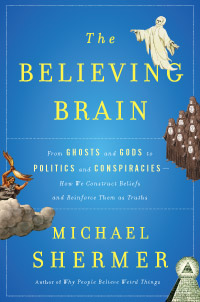 |
| Michael Shermer's The Believing Brain |
But I must admit to feeling twinges of disappointment and sadness while I read Shermer's latest. I remember how much fun I had as a kid, reading books about hokum like the Loch Ness monster, Bigfoot, sea serpents, and ghosts. That stuff was, as Denzel Washington's Training Day character Alonzo Harris put it, "bullshit...but entertaining bullshit." Much as folks of all ages spice up their dull as dishwater lives with the imagined possibilities of science fiction, so too the more colorful products of pseudo-science help us retain a bit of that childlike wonder, some semblance of a belief that there's more to the world around us than the banality of everyday life.
To be fair, The Believing Brain is not simply a debunking report on those characters of our dreams (and not a few nightmares). Shermer has attacked such targets in previous works, notably the earlier book, Why People Believe Weird Things. This current work serves up a straightforward examination of how the human brain works; it is a discourse on the cognitive processes that lead us believe ideas both common, ordinary and demonstrable (that sound in the bushes might be a dangerous predator, so watch out) and odd, outrageous and unprovable (the aliens have already arrived and are ruling the world from behind the scenes). Shermer makes his strong case that, contrary to intuitive thought, our beliefs come first, then we use our cognitive biases to reinforce those beliefs, until we find ourselves well convinced of our hold on the "truth."
All well and good, for the psych student. But such discourse does not necessarily make compelling reading for the casual observer. Though Shermer is by now a seasoned pro at writing interesting, accessible, and often humorous prose, parts of The Believing Brain can be difficult to connect with. Some readers will find it easy to get lost in the author's descriptions of the various parts of the brain and their various functions in perception and belief building. While Shermer's account of his personal journey from believer to skeptic is instructive and quite readable, his descriptions of "patternicity" and "agenticity" may prove too technical for many to understand. Reading the early sections The Believing Brain gives you the distinct impression that you're slogging through a bunch of details in order to get to "the good stuff" later in the book.
There are, in fact, pieces of "good stuff" in the book's latter pages. Particularly intriguing is the discussion of Galileo's discoveries at the end of the Middle Ages, and how the reliance on authority so prevalent at the time led otherwise intelligent observers not to see the very objects so readily apparent in Galileo's telescope. (The story suggests obvious parallel's to today's conservatives--current society's arch-lovers of authority--and their obstinate disbelief in evolution, climate change, etc.) And Shermer's account of the debates among astrophysicists regarding the nature of the universe--arguments that ultimately led to Hubble's cosmological discoveries--stands as an eloquent exemplar of the value of the scientific method.
So you can learn a lot reading The Believing Brain. Particularly, you will learn a lot about the author himself. How the reader responds to the ideas presented in the book may depend not upon empirical evidence, but upon how you feel about Shermer. It's hard not to view Shermer himself as part of this equation; the book is littered with the author's imprimatur regarding his subject matter. Many terms of the discourse are categorized as "what I call..." terms; i.e., "we practice what I call 'agenticity'." One suspects that many of the terms so labeled in the book are not necessarily of Shermer's own coinage. Plus, numerous concepts in the text are fleshed out through examples from the author's own experience--particularly when it allows Shermer to recall one of his television appearances, or the marathon bike race he founded and participated in, or to educate his audience about his preference for libertarianism. In fact, a reader could readily draw the conclusion that the one thing Michael Shermer truly believes in is Michael Shermer. That perspective must necessarily color the reader's judgment of the arguments presented in The Believing Brain. Is that shading enough to invalidate the concepts presented in the text? Not in this reader's view; Shermer's arguments retain their validity, based on their own strength. But it's easy to see others having their judgment thrown by the author's somewhat obtrusive personality.
Overall, The Believing Brain succeeds on its own terms. It may not be everyone's cup of tea, but the strength of the scholarship and reasoned argument it presents is not easily refuted. If we all read this book, and were moved to question our own deeply held beliefs--even for a few moments--that would probably be a good thing.
Friday, March 30, 2012
Wordsmith
Another term for Stephen's Dictionary:
Cunt Blanche
[noun]
The unconditional, unconstrained authority certain female creatures believe themselves to have, to be invoked however she pleases, in the manner most unpleasing to anyone who has to spend five fucking seconds dealing with her
Cunt Blanche
[noun]
The unconditional, unconstrained authority certain female creatures believe themselves to have, to be invoked however she pleases, in the manner most unpleasing to anyone who has to spend five fucking seconds dealing with her
Friday, March 16, 2012
D'oh! Not Udoh!
I just want to pop in here and make a few (time-stamped) comments on the recent activities by my local NBA outfit, the Golden State Warriors, at the trade deadline.
I don't have a problem with trading away Monta Ellis. A lot of folks have been grinding their teeth over the trade with the Bucks, because the W's sent away Ellis. That's not my beef; Ellis is a good player, and I appreciated watching him these last few years, but scoring guards are not hard to come by.
What really cheesed me about this deal was the departure of Ekpe Udoh. Few observers made any points about Udoh's loss, but I think in time this is going to be the real bungle to come out of this trade. (Especially when Andrew Bogut spends most of his Warriors career on the bench looking like a Mens' Wearhouse advertisment.) The Warriors' eternal quest has been for frontline players: guys who play near the basket, scoring down low, rebounding, and defending the rim. Udoh had the last part down cold; he's good for a couple of blocked shots a game, and altered an odd number of additional shots just through presence in the lane. Lately, in the last several games before the trade, Udoh showed a developing low post scoring game; he has made tremendous progress in that area since the start of last year's rookie season. And while his rebounding has been questioned, the willingness to work on his game--as exhibited by the developing scoring touch--promised better things in that area as well. In short, Udoh had all the promise of growing into exactly the kind of player the Warriors have been trying to get for years.
And they just traded him away. For the NBA equivalent of a handful of magic beans.
It says here that, in three or so years, when Udoh has blossomed to the point where he gets picked as a back up for at least one All-Star game--don't laugh; big men who are solid on both ends of the court are extremely rare, and just a little good game will go a long way--then everyone in the Bay Area will be griping about yet another player who got so much better after leaving the Warriors, and how they let another one get away. The only difference is, this time you heard it here first.
I don't have a problem with trading away Monta Ellis. A lot of folks have been grinding their teeth over the trade with the Bucks, because the W's sent away Ellis. That's not my beef; Ellis is a good player, and I appreciated watching him these last few years, but scoring guards are not hard to come by.
What really cheesed me about this deal was the departure of Ekpe Udoh. Few observers made any points about Udoh's loss, but I think in time this is going to be the real bungle to come out of this trade. (Especially when Andrew Bogut spends most of his Warriors career on the bench looking like a Mens' Wearhouse advertisment.) The Warriors' eternal quest has been for frontline players: guys who play near the basket, scoring down low, rebounding, and defending the rim. Udoh had the last part down cold; he's good for a couple of blocked shots a game, and altered an odd number of additional shots just through presence in the lane. Lately, in the last several games before the trade, Udoh showed a developing low post scoring game; he has made tremendous progress in that area since the start of last year's rookie season. And while his rebounding has been questioned, the willingness to work on his game--as exhibited by the developing scoring touch--promised better things in that area as well. In short, Udoh had all the promise of growing into exactly the kind of player the Warriors have been trying to get for years.
And they just traded him away. For the NBA equivalent of a handful of magic beans.
It says here that, in three or so years, when Udoh has blossomed to the point where he gets picked as a back up for at least one All-Star game--don't laugh; big men who are solid on both ends of the court are extremely rare, and just a little good game will go a long way--then everyone in the Bay Area will be griping about yet another player who got so much better after leaving the Warriors, and how they let another one get away. The only difference is, this time you heard it here first.
Monday, March 12, 2012
Recently Read
 |
| Pity the Billionaire |
by Thomas Frank
What's the matter with Thomas Frank? Nothing, in particular.
Frank, the author of multiple explorations of America's right-wing madness--including the now classic What's the Matter with Kansas?--has not sunk into a literary morass in any legitimate sense. His latest work, Pity the Billionaire, shares much in common with the author's published antecedents, particularly Kansas and The Wrecking Crew. Frank brings his usual keen insight into conservative minds and motives, and presents his thesis with impeccable logic and exhaustive research and citation. (Pity might be better reserved for Frank himself, who, judging by the extensive notes backing up this slim volume, must spend more time watching, reading, and immersing himself in right-wing media and live events than anyone ever could and still hope to remain truly sane.) And the author's greatest strength--Frank is one of the best wordsmiths in the field of political discourse--remains intact; when Frank describes Sarah Palin as the "[right wing] movement's snarling sweetheart," it is just one more example of his skill at delivering a wholly apt yet economical mot juste.
Yet, for all that, Pity the Billionaire never reaches the same heights of literary brilliance as Frank's earlier works. While the book delivers plenty of solid reporting, along with several chuckle-worthy turns of phrase, Billionaire never lifts the reader up to the seriocomic heights they way Kansas did. The latter book, with sublimely titled chapters like "Russia Iran Disco Suck," and its ludicrous exposé on the various anti-Popes who call the Sunflower State their home, meets no equal in Pity the Billionaire. Though it covers much of the same warm and fertile ground, Billionaire reaps a somewhat uninspiring harvest.
Why is this? One might first suppose that the latest work is simply an inferior effort, but that interpretation doesn't feel satisfactory. Upon further reflection, the problem may lie--ominously--with the passage of time. Here is Thomas Frank, pricking much the same balloon as he was nearly a decade ago...and yet, for all of its absurdity and wrongheadedness, that balloon never seems to deflate. Indeed, as the central thesis of Pity the Billionaire points out, the balloon keeps re-inflating itself, actually growing larger than before, no matter how forceful are the efforts of men like Frank to put it out of its (and our) misery.
The overall effect, then, is one of recognition and at least mild depression: recognition that this thing keeps happening to us, and a sense of depression when we recognize that we can't seem to escape it--that we should expect the same thing to keep happening to us, and keep doing the same damage over and over again. Knowing that Glenn Beck is an asshole does nothing to keep Beck, and others like him, from soiling our political landscape and leading legions of the misinformed down socially destructive paths. Frank can point out the folly, pick it apart for all to see, and we can absorb the knowledge he presents us--but we're still bound to have to live with half the population playing suckers and fools, to the detriment of(almost) all of us.
As Frank makes perfectly clear, there's no reason to pity the billionaires. Those .01%ers are doing just fine, as always. It's the rest of us who could use the pity. We can hope that Thomas Frank and his ilk keep trying to talk some sense into our nation; but it's becoming more and more clear that we can't rely on the lesson ever taking hold.
Saturday, February 25, 2012
My Life
Just read an extremely interesting article on AlterNet, Would We Have Drugged Up Einstein? How Anti-Authoritarianism Is Deemed a Mental Health Problem. It reads like a summary of my own life. In a minor sense, that is--I know I'm no Einstein, but I've definitely always had an issue with authority. The money quote:
I've said many times over the years, my take on psychological prescription drugs amounts to, "Here, you become a drug addict so the rest of us can stand to have you around." I first had that thought about 20 years ago, and I've seen nothing to change my mind on the subject since. And it is encouraging to see written words that, in some small way at least, back me up. Be careful whom you call crazy...or even a problem.
Many people with severe anxiety and/or depression are also anti-authoritarians. Often a major pain of their lives that fuels their anxiety and/or depression is fear that their contempt for illegitimate authorities will cause them to be financially and socially marginalized, but they fear that compliance with such illegitimate authorities will cause them existential death.I wouldn't say I have severe anxiety or depression. But financially and socially marginized? Check. Fear of "existential death." Check.
I've said many times over the years, my take on psychological prescription drugs amounts to, "Here, you become a drug addict so the rest of us can stand to have you around." I first had that thought about 20 years ago, and I've seen nothing to change my mind on the subject since. And it is encouraging to see written words that, in some small way at least, back me up. Be careful whom you call crazy...or even a problem.
Friday, February 24, 2012
Recently Read
Baseball in the Garden of Eden:
The Secret History of the Early Game
by John Thorn
It's an annual ritual, on a par with pitchers and catchers reporting in mid-February, the pomp and circumstance of Opening Day, and the passionate denouement that is the World Series: my yearly off-season quest for a literary baseball fix to get me through the dark, game-less days of Winter.
This year's entry into that long tradition is John Thorn's Baseball in the Garden of Eden. Subtitled "The Secret History of the Early Game," veteran writer and researcher Thorn's volume utilizes a two pronged approach to cover the baseball's earliest development. Much of the text is devoted to a straightforward narrative of the game's evolution from various forerunner activities into the sport that would become the nation's pastime. Wrapped around that core history is Thorn's somewhat well-documented, somewhat speculative account of the "secret history" that surrounds baseball's "creation myth"--specifically, the doings of the members of the Mills Commission of the early 1900s and their specious conclusion that the Civil War hero Abner Doubleday created the game out of whole cloth one day in Cooperstown, New York in 1839.
Thorn's narrative about the origins of the game--who really developed the rules of baseball, where and when the game truly became "baseball" (rather than ancestral forms like "rounders" or "three old cat"), where and when those pioneers played the game, and how it evolved into the sport we've followed for roughly 130 years--is far more successful than the other half of his presentation. Die-hard fans, even those well versed in the history of the game, will learn new and fascinating facts about early baseball, including: the antiquity of some of baseball's current rules (e.g., the rule that the catcher must cleanly catch a third strike to record the out goes all the way back to the earliest schedule of regulations, the Knickerbocker Club's rules from the 1850s); the fact that the "World Series" was played, under that specific name, as the post-season championship between the National League and the American Association, long before the 1903 detente between the NL and the new American League; that the DH was proposed, and almost enacted, back in the 19th century; and the eternal fact that free agency, player salaries, and ownership shenanigans (including syndicate ownership of multiple teams) were crucial concerns then as much as now. All of Thorn's revelations about baseball's primordial form and environment serve to deeply enrich the hardcore fan's appreciation of where the sport has been, and perhaps where it may yet go.
Unfortunately, the other side of Thorn's narrative--his meticulous examination of the development of the Doubleday creation myth--provides less interesting fare, even for the reader most primed for this sort of history. The author's study and speculations on the Mills Commission, the role Albert Spalding played in ginning up the Cooperstown fantasy (it was known contemporaneously to be a humbug among those in the know, despite the poobahs' pronunciations on the matter), even his conspiratorial notions about the role the Theosophical Society (of all things) played in the creation scheme--all of this examination proves to be of little particular interest.
Perhaps the problem is one of time and perspective. While this story might have been a revelation to baseball fans 50 years ago, today almost no baseball fan believes the Doubleday story. Even the favored alternate history, placing Alexander Cartwright in the sport's primal position, has been superseded by further revelations on baseball's antiquity, in some form or another, far exceeding Hoboken's Elysian Fields in 1845. (Thorn himself notes the now well-known reference to baseball, in the laws of the town of Pittsfield, MA, from 1792.) Since the whole thing is now widely regarded a sham, today's reader can see little more than a historical curiosity in the tale of American chauvinism and vague Victorian spiritualism leading Spalding to rig up Doubleday (a fellow Theosophist) as baseball's Prometheus. The creation myth exegesis is a story that probably won't resonate with most readers, and holds little connection to the modern organization of baseball, beyond the continuing location of baseball's Hall of Fame in Cooperstown.
Thus, Baseball in the Garden of Eden reaches to the reader as only half of a good story--or rather as one good story needlessly paired with a second, much weaker story. Still, those Winter nights are long and dark, with nary a pitch, bunt, double play, or home run to take the edge off the cold. Thorn's book has the necessary ingredients to make it worth a look while waiting for the opening of Spring Training. It's about baseball, after all, and it's hard to go wrong with a book about our most literary sport. Baseball in the Garden of Eden may not be a solid hit, but it will get the runner over to where he needs to be: in scoring position, ready to move when that hit finally does come.
The Secret History of the Early Game
by John Thorn
 |
| Baseball in the Garden of Eden |
This year's entry into that long tradition is John Thorn's Baseball in the Garden of Eden. Subtitled "The Secret History of the Early Game," veteran writer and researcher Thorn's volume utilizes a two pronged approach to cover the baseball's earliest development. Much of the text is devoted to a straightforward narrative of the game's evolution from various forerunner activities into the sport that would become the nation's pastime. Wrapped around that core history is Thorn's somewhat well-documented, somewhat speculative account of the "secret history" that surrounds baseball's "creation myth"--specifically, the doings of the members of the Mills Commission of the early 1900s and their specious conclusion that the Civil War hero Abner Doubleday created the game out of whole cloth one day in Cooperstown, New York in 1839.
Thorn's narrative about the origins of the game--who really developed the rules of baseball, where and when the game truly became "baseball" (rather than ancestral forms like "rounders" or "three old cat"), where and when those pioneers played the game, and how it evolved into the sport we've followed for roughly 130 years--is far more successful than the other half of his presentation. Die-hard fans, even those well versed in the history of the game, will learn new and fascinating facts about early baseball, including: the antiquity of some of baseball's current rules (e.g., the rule that the catcher must cleanly catch a third strike to record the out goes all the way back to the earliest schedule of regulations, the Knickerbocker Club's rules from the 1850s); the fact that the "World Series" was played, under that specific name, as the post-season championship between the National League and the American Association, long before the 1903 detente between the NL and the new American League; that the DH was proposed, and almost enacted, back in the 19th century; and the eternal fact that free agency, player salaries, and ownership shenanigans (including syndicate ownership of multiple teams) were crucial concerns then as much as now. All of Thorn's revelations about baseball's primordial form and environment serve to deeply enrich the hardcore fan's appreciation of where the sport has been, and perhaps where it may yet go.
Unfortunately, the other side of Thorn's narrative--his meticulous examination of the development of the Doubleday creation myth--provides less interesting fare, even for the reader most primed for this sort of history. The author's study and speculations on the Mills Commission, the role Albert Spalding played in ginning up the Cooperstown fantasy (it was known contemporaneously to be a humbug among those in the know, despite the poobahs' pronunciations on the matter), even his conspiratorial notions about the role the Theosophical Society (of all things) played in the creation scheme--all of this examination proves to be of little particular interest.
Perhaps the problem is one of time and perspective. While this story might have been a revelation to baseball fans 50 years ago, today almost no baseball fan believes the Doubleday story. Even the favored alternate history, placing Alexander Cartwright in the sport's primal position, has been superseded by further revelations on baseball's antiquity, in some form or another, far exceeding Hoboken's Elysian Fields in 1845. (Thorn himself notes the now well-known reference to baseball, in the laws of the town of Pittsfield, MA, from 1792.) Since the whole thing is now widely regarded a sham, today's reader can see little more than a historical curiosity in the tale of American chauvinism and vague Victorian spiritualism leading Spalding to rig up Doubleday (a fellow Theosophist) as baseball's Prometheus. The creation myth exegesis is a story that probably won't resonate with most readers, and holds little connection to the modern organization of baseball, beyond the continuing location of baseball's Hall of Fame in Cooperstown.
Thus, Baseball in the Garden of Eden reaches to the reader as only half of a good story--or rather as one good story needlessly paired with a second, much weaker story. Still, those Winter nights are long and dark, with nary a pitch, bunt, double play, or home run to take the edge off the cold. Thorn's book has the necessary ingredients to make it worth a look while waiting for the opening of Spring Training. It's about baseball, after all, and it's hard to go wrong with a book about our most literary sport. Baseball in the Garden of Eden may not be a solid hit, but it will get the runner over to where he needs to be: in scoring position, ready to move when that hit finally does come.
Monday, February 13, 2012
Authorship
Be it here announced that I have just published the third work of writing to go into my collection on Scribd. The latest piece, Bunts, Baseball, and the Virtue of Small Steps, is a study/rumination on baseball and life, and strategies thereupon for both. It's a brief little essay, and hopefully worth a few people's time. Check it out, if you feel like it (follow the link above).
Subscribe to:
Posts (Atom)


 Posts
Posts


