Sunday, November 13, 2011

Recently Read

The Big Squeeze
Visit author's website
The Big Squeeze
by Steven Greenhouse

It can hardly be called a secret: these days, in this country, if you're not rich, you're boned.

New York Times reporter Steven Greenhouse decided to set that fact down for the record, and the result was The Big Squeeze: Tough Times for the American Worker. Published in 2008, just as everything was going to shit in America's economy, The Big Squeeze documents the full gamut of the ways in which American workers are being screwed: diminishing wages, nonexistent job security, and a host of illegal activities, such as denying benefits, altering time sheets to cheat workers of earned wages, aggressive union-busting, and a general hostility towards the rights of workers--up to and including locking workers in on the night shift and not letting them out, regardless of what emergency may come.

As Greenhouse make clear, all of these actions are the products of a philosophical shift that seized corporate America's collective hive-brain sometime in the 1980s (the Reagan era, of course); that shift brutally devalued the contributions of those who work in favor of the demands (and even whims) of those who hold stock. In a land where the shareholder is king, those who earn paychecks are disposable peasants locked in a form of neo-serfdom--a portrait that author Greenhouse skillfully paints with the litany of grim stories presented in his telling prose.

Greenhouse wisely covers all the angles in telling his tale of dispossessed labor in America. To thwart those who might claim that the tribulations he documents are simply the sorrows of low-wage peons working dead-end jobs for the usual corporate suspects, the author provides powerful counterarguments by describing the problems of high tech workers--problems that, despite their high level of education and skill, mirror those of their uneducated working brethren. It's not just the lowly Mexicans who are getting screwed here, and the author spells that fact out through powerful, sympathetic stories that cover a whole socioeconomic range of victims.

Greenhouse also makes the cagey decision to offer the reader not just the villains in this piece, but a corporate hero as well, in the form of Costco. The membership driven wholesaler stands in sharp contrast to its chief competitor on the low-price front, Wal-mart (an organization Greenhouse routinely excoriates throughout his narrative). Somehow, unlike its competitor from Arkansas, Costco finds a way to pay decent wages and create a fair and equitable corporate culture while still providing its customers the inexpensive products they desire. Through that contrast, Greenhouse makes a strong case that, despite the bullshit that spews from the mouths of CEOs, our labor market doesn't have to be this way. The American economy could still work to the benefit of all of us; that it does not is a conscious choice on the part of those in power.

The Big Squeeze has a few minor faults. Much of the text reads like lengthy newspaper stories that have been somewhat inelegantly stitched together--no surprise, since much of the source material came from Greenhouse's work for the Times. The book as a whole is long, and textually denser than what the casual reader may be prepared to handle. Finally, the work is undeniably a downer. That fact inevitably results from the subject being covered, but it still affects the mood of the reader long before the final summary of suggested remedies. The few hopeful stories offered to the reader are buried too deeply within the grim litany to brighten the overall mood.

Nevertheless, The Big Squeeze documents the details of an important reality that we who are the 99% must face. Only by confronting that reality head on can there be any hope that it will change, through the actions of our own selves if not our so-called leadership. Greenhouse, with The Big Squeeze, has painted the bullseye on the most critical targets. It's now up to us to act.

Wednesday, November 9, 2011

The Essence of Hilarity

Courtesy stuffonmycat.com


I think someone's been hitting the juice.

Now that's what I call funny.

Saturday, November 5, 2011

Driven Insane, Just By Looking At It

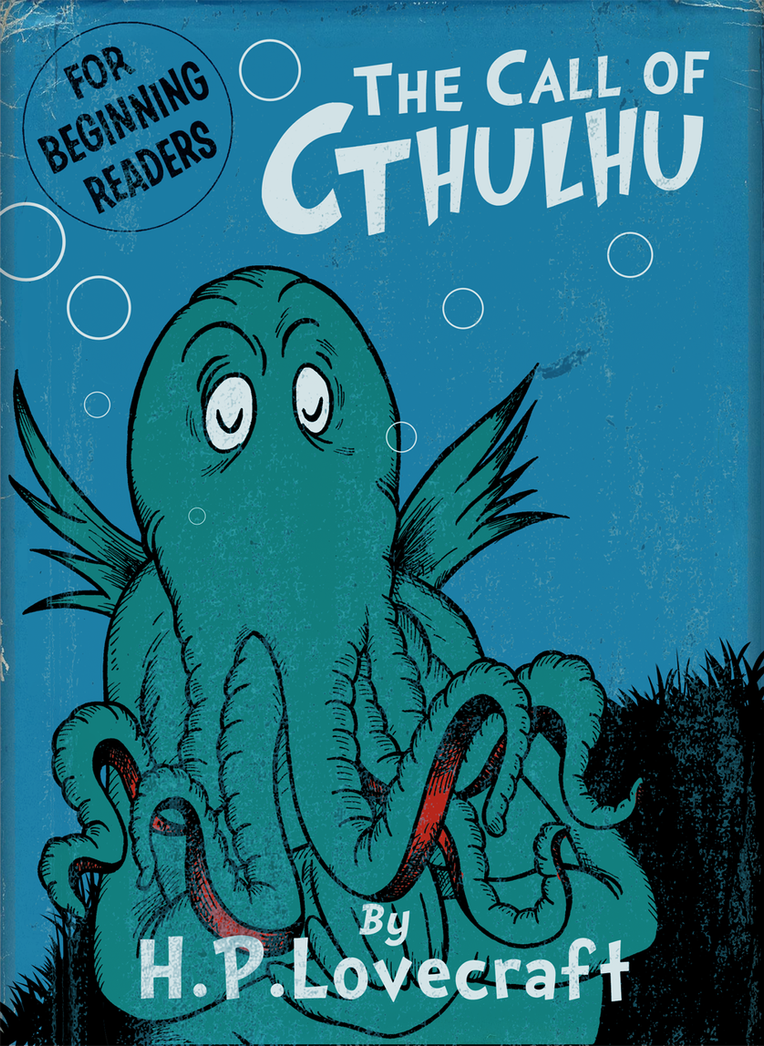
In my wanderings across the web, I came across this work of brilliance: The Call of Cthulhu for Beginning Readers, a work of art by a cat who calls himself DrFaustusAU. It's a brilliant parody/homage to not one but two of my favorite authors. Give it a look, especially if it's your lifelong dream to sink into the depths of eldritch madness through rhyming couplets. (Note: as of this post, the work is not finished yet--you'll have to check back frequently for updates until the tale is complete.

Bonus reading: the now legendary Tales of the Plush Cthulhu.

Recommended Reading

I'm a regular reader of journalist Matt Taibbi's blog on Rolling Stone's website; I've just added a link to the blog in My Sausage Factory over on the right. I highly recommend reading Matt's stuff, especially for cut-through-the-bullshit insight on the misdeeds of the financial sector.

Taibbi also writes on politics in general, and has produced a couple of very informative--if not horrifying--profiles on a certain candidates for the presidency, including an excellent piece on the troglodytic Rick Perry. The money quote:
I can't believe it, and neither can the assembled crowd of Georgia conservatives, who hesitate before breaking into polite applause. I feel like a high school cheerleader who just had her leg jizzed on in the back of a convertible. That's it? It's over? That was Rick Perry's stump speech?
The whole article lays bare the wretchedness that is the current Governor of Texas. Be sure to read the whole thing.

Sunday, October 30, 2011

I Made This

This my Cat-O-Lantern. I made it for Halloween using a template I found online. Sweet.

Saturday, October 29, 2011

Sound Advice

I'm not much of a college football fan. I'll take the pros over college any day. But every once in a while, when there's a really good local team playing, or there's a game that draws my interest, I'll give it a look. Or, alternately, when I've got absolutely nothing else going on and need to kill some time, I'll settle for whatever college game ESPN is showing that night.

Coach Lou Holtz
(aural representation only)
(Google Images)

This, unfortunately, has some consequences. Like for instance, the convergence of my ears and the verbal stylings of Lou Holtz. Holtz does studio duty for ESPN during their halftime shows, and occasionally makes his way into the broadcast booth for actual game play, as with this past Wednesday night's game between Pitt and Connecticut. I've now had several opportunities to get a taste of Holtz in his ESPN gig, and I'm just a little baffled by what I'm hearing.

You see, the man apparently has a little problem with his dentures, or a missing tooth, or...something--it's difficult to say what's the source of the trouble. Somehow, someway, no one at "the worldwide leader" has noticed this, but Coach Holtz has something of a speech impediment. Sort of like China has a Great Wall. And this is a problem for the viewers, especially the casual viewers like me. Because it's more than a little distracting when you're hearing analysis of a team's blitz package coming from Sylvester from the old Looney Tunes cartoons. It's bad enough when you're hearing him coming through your TV speakers; imagine what it's like for me, someone who does most of his television viewing with headphones on. (Noisy neighbors; long story; don't ask.)

Once upon a time, to get on TV, you had to have a certain combination of qualities. Looks helped; many a radio star saw his career go down the drain when television first arrived. Knowing what you're talking about (for analytical positions) helped a lot, too. But you also needed to sound good--like you weren't drowning the mic in spit. It's an aural medium as well as a visual one, and something as off-putting as a profound lisp should be a no-go when it comes to a major speaking role on a national television network.

Now, I don't want to be overly harsh here. By all accounts Coach Holtz is a fine man, much accomplished in his field and worthy of respect. And I have little doubt that his impediment is the product of his well-advanced age; he can't do much about it. But it's tough to listen to him for more than a few minutes without diving for the remote control. I get that ESPN values his insight into college football, but please--can't he just dole out his wisdom through a column in ESPN The Magazine? Our ears will thank you for it.

Thursday, October 27, 2011

Visual Aid

My sister sent me this pic, one of the best I've seen it a while. Nobody's colder than Ice.

Tripleheader

I have a tripleheader of baseball related grumblings to share with all of you. So without further ado:

"How can you not like Pujols?" I've been asked that question before, and a few days ago I was provided some concrete evidence as to my answer.

Albert Pujols, doing his thing
(Courtesy memphisflyer.com)
That Albert Pujols is one of the best players in the game is undeniable. Possibly the best player. But something about him has always rubbed me the wrong way. I'm always leery of ballplayers who are big on the Jesus thing; the heaps of praise offered over the slightest accomplishments is intrusive and annoying. The fact that he plays for the Cardinals--a.k.a. Anheuser-Busch, hardly my kind of company--doesn't help either.

Now, however, we have the evidence of Game 2 of the World Series, a game that turned on Pujols's 9th inning error, and its aftermath. Pujols bailed out of the clubhouse after the game without talking to a soul, leaving his teammates to answer questions about the Cardinals' late-game meltdown. Not exactly the stuff of legends, regardless of how many home runs he hit in the next game.

Furthermore, this act seems to have been taken place before that incident. Yahoo Sports writer Jeff Passan gave us the lowdown on both Pujols's behavior that night, and his history to date. The money quote:

They could disappear because of the culture Pujols created, one the organization enables. St. Louis manager Tony La Russa empowers Pujols to do what he pleases, right or wrong, even if it’s the equivalent of ordering the lobster-stuffed filet and sticking the minimum-wage worker with the bill. He will face no discipline. He never does. That is life with Pujols, and the Cardinals’ Omertà means nobody calls him on it.

To someone who spent the Nineties and Aughts living in the Bay Area and watching Bay Area baseball, that sounds an awful lot like the behavior of one Barry Bonds. This is not to say that Pujols is juicing, or is an equal to the surly presence that was Bonds. But it's not surprising to see him described this way. 

Again, there's always been something about Pujols that rubs the wrong way. Pujols has never hesitated to point to the sky--presumably to thank God--after hitting a home run; did he give the big man any props when he made that error, thanking the Lord for giving him the lesson in humility he could take from that error and its consequences? Nope. Later, Pujols was front and center after his Game 3 home run binge; "God" was almost the first word out of his mouth in the post-game interview. But faith is not strictly for the times of convenience; if he's that big on his religion, he could have been out front and center in his trying moment, just as he was in his moment of triumph.

But that wouldn't have been Albert Pujols. And that's how I can not like him.


OK. I guess it's up to me. No one else has stepped up to throw some cold water on this whole thing, so I'll take up the task. To wit:

Theo Epstein
(Courtesy bostinnovation.com)
Theo Epstein will not make the Cubs World Series champs.

There's been a lot of fever over this move by the former Red Sox GM to take over the perennial sad sack Cubs. Apparently, a few days after Boston folded at the end of the regular season, someone rolled back a rock in New England and found an empty tomb, with reams of sabermetric stat sheets scattered all over the floor. Soon thereafter, the new owners of the Cubs had a vision of Epstein on the road to Damascus--or possibly Des Moines--and lo, salvation was at hand.

I hate to break it to you...no, wait, I love bursting bubbles. And this one's easy to prick. We've seen this act before.

Earlier incarnations of this sort focused on the new coach who was going to lead the Cubbies to greatness. Dusty Baker came in, hot off his World Series appearance with the Giants. Then Lou Piniella was going to break all the curses with his personal championship history, and a few well-timed kicks of the dirt around home plate. Special players have also come and gone. The arms of Wood and Prior, the big bats of Sandberg and Dawson, Grace and Sosa--all achieved some success, none even made it to the World Series.

Now comes Epstein, and lots of folks are making lots of obvious parallels between the Cubs and the Red Sox, assuming that if Epstein could turn the hopelessness of Boston into two Series titles, then clearly he must be able to do that for hopeless Chicago.

But here's the thing: Boston wasn't that hopeless when Epstein slipped into the big leather chair. The Red Sox had already been regular winners when he signed on. His term as GM started in 2003, not long after Boston's wild card appearances in 1998 and 1999, and the team remained mostly competitive in the years leading up to Theo's ascension. And Boston was already well on its way to competing dollar-wise with the "Evil Empire" on free agent signings when Epstein showed up to rule the roost. Epstein's predecessor Dan Duquette laid a lot of the foundation for the team's ultimate, future success, particularly with the signing of Manny Ramirez in 2000. Bottom line: he had plenty in the cupboard going into his tenure.

In contrast, the Cubs--despite a few post-season appearances in the past decade-plus--are a far greater shambles than the Red Sox ever were before or during Epstein's time as GM. There is much more work to be done with Chicago, and it will take time to accomplish what needs to be accomplished.

And that's the rub: it will take time. With time, Epstein (like a lot of baseball executives) could turn the Cubs around and build a consistent winner. But he's not going to have that time. The expectations are going to be sky-high going in; hell, they're sky-high NOW. What happens when the results don't happen right away? There's good reason to believe it won't be easy. Consider the depth in the NL Central Division right now; Epstein's Cubs need to battle--and surpass--the Cardinals, Brewers, and possibly the Reds just to get into the playoffs. Unlike Boston in the AL East, it won't be as simple as challenging the Yankees and beating up on the rest of the patsies in the division. (Funny how Boston's success in the early Aughts gave way once the Rays started to step up and fight back against the big boys.) What happens when it's two years from now, three years from now, and the Cubs still haven't made it to the World Series?

Here's what happens: the pressure will grow, and moves will need to be made, just to relieve the burden. A new manager, a raft of new players, risky trades with big upsides (and big downsides, naturally)--all the moves that can lift a team up, but which as often as not just create the instability that leaves a franchise spinning its wheels.

It's not true that there are no second acts, either in baseball or America. But it is true that it's never as easy as it looks. For those of you in the Midwest, giddy with expectations now that Theo is in the fold--beware. The deed is not done yet.


Finally, it's a tradition unlike any other: every year the baseball playoffs and World Series arrive...and every year, we get to read a face full of shit about how the TV ratings are the lowest ever.

There are a lot of reasons for this, beyond the usual trope that "baseball is boring." Any intelligent observer can point out that the audience is vastly more subdivided than it was back in the glory years; number of viewers and audience share will inevitably come in lower today than back when there were only three real channels (and you had to actually get off your ass to change the channel). And the less said about the wretchedness that is the FOX and TBS (a.k.a. FOX Jr.) coverage of the game's showcase, the better. As someone old enough to remember NBC's coverage of the game back in the '70s and '80s, I will testify that the quality is not what it used to be, despite the vastly superior tools available to the broadcasters today (read: bad announcers, overproduction, etc.).

But one thing that never receives much attention is probably the most crucial element in baseball's perceived slide into obscurity: the horrifically bad, grotesquely incompetent marketing campaigns that MLB inevitably trots out in October--a screed of awful commercials and bad strategy that, at the very least, has no impact on growing the audience, and may be actively turning away otherwise interested viewers.

What's the problem? Well, there's the commercials. The bad commercials. The incessant commercials. The bad commercials that are incessantly run during the very games themselves. 

The spots are some marketing moron's typical idea of how to sell the game. Some little bitch whines about stars and seasons and possibly what his weird uncle did to him when he was five; I don't know, I tune out after the first few insulting notes. This aural insult accompanies a visual pastiche of highlights that flash by so quickly that I half suspect there's a subliminal message about buying more Coke or Pepsi tucked in between the frames. What's the payoff? I don't know--all the flashing images sent me into a seizure 10 seconds ago. Just perfect. How many fans have turned off their TVs and not watched the games out of simple disgust at that annoyance?

And then there's where the spots run. "Catch the World Series on FOX" the voice over guy says...to the people who are already watching the World Series. Aaaargh! How stupid can you be? We're already watching the damn game--why are you still shilling us on tuning in? We're already here--go find some new viewers to cage into watching the thing.

Except, of course, that's the whole problem: they don't run those commercials anywhere but during the games they're trying to sell. You watch anything other than the baseball coverage--any other sports, hell, any other programming at all--and you'll never see any ads for the baseball postseason. If you're not already tuned in to the games, the whole month of October could pass by without you ever knowing that MLB didn't call off the whole thing. What the fuck? How the hell are you supposed to bring in new viewers if you never reach out to them where they're living? That is to say, watching other channels. People tuned in to Law & Order or NCIS or NASCAR--or, dare I say it, the NFL on Sunday--may ignore the commercials and not tune in, but if they never see any promos for baseball, it's guaranteed they won't be changing the channel. You can't succeed if you don't even try.

Of course, other sports leagues and their partners--it's spelled N-F-L--know that. Watching the baseball games this postseason, I've seen more of Deion Sanders than I've seen of Tony LaRussa. DirecTV has been relentlessly pitching their NFL package during the baseball games. And you're likely as not to see those same commercials during just about any program you turn on. Pitch the games, get the viewers. Football knows that; MLB doesn't even try.

Naturally, I lay this all at the feet of The Idiot Selig, a whipping boy I've been flogging for two damn decades now. Everything bad that has happened in baseball the last twenty years has had that shyster's money-grubbing fingerprints all over it. Whatever success baseball has had during that period has happened despite the "leadership" from the commissioner's office, not because of it. Maybe, if the old Used Car Salesman keeps his promise and goes away sometime soon, the game will see new, intelligent leadership in that office--someone who at least understands that you need to get your promotional materials before the eyes of the people who are not consuming your product, if you want to bring them into the fold. But I won't hold my breath.

Wednesday, October 12, 2011

Wordsmith

Another term for Stephen's Dictionary:

Meanderthal
[noun]
A primitive subspecies of the human animal which, instead of striding purposefully in the direction in which it is heading, meanders in a slow, erratic, almost drunken fashion, with a tendency towards getting in the way of someone who is walking on the same ground and actually has somewhere to go

Staying in Touch

Just to make it that much easier on anyone interested, I've now added a new "Follow by Email" feature to the site, in addition to the previously set up subscription options. Just type your email address in there and away you go. Never miss out on even one of these scintillating posts.

Sweet.

Monday, October 10, 2011

Recently Read

Wind, Sand and Stars
By Antoine de Saint-Exupéry

Wind, Sand and Stars
Antoine de Saint-Exupéry, best known to posterity as the author of The Little Prince, served eight years as a pilot in the French mail service, winging his way to distant and dangerous lands in the 1920s and '30s--days when climbing into the cockpit of an airplane was no casual act. Out of those flights came the book Wind, Sand and Stars, offering the author's ruminations on life as a pilot and all that he saw from his lofty perch--not just the physical landscape, but metaphysical views about the world, nature, and man's place therein.

At its best, Wind, Sand and Stars offers de Saint-Exupéry's philosophical insights wrapped in poetic imagery that sweeps the reader away from his living room and back, through space and time, to the lonely wilds of Patagonia and the Sahara. Every so often the author writes prose so rich and satisfying to read that the book seems as elevated as the wings of the former pilot's plane. Yet, the text also suffers at the hands of the very same philosophizing; at times, de Saint-Exupéry's words trail through tangents that seem, if not pointless, then at least lacking in the same level of insight as other parts of the work.

Thus, the text veers up and down in accordance with the whims of the writer's thoughts. An emergency landing due to some mechanical failure--apparently an all-too-common occurrence in those days--produced the author's account of a visit with a family in Argentina, a delightful, charming, whimsical scene. Tales of days and nights spent in the desolation of the Sahara evoke exactly the sense of adventure and wonder one would expect from such adventures. And de Saint-Exupéry's account of a crash landing in the Libyan desert, an occasion when he and his engineer nearly died of thirst and exposure, brings to vivid life the experience of desperation and despair, as well as the joy of salvation felt upon their miraculous rescue by a Bedouin herdsman. These episodes are thoroughly enjoyable reads in their own right, even if they make together a disjointed narrative.

Then again, other passages go completely off course. Some of de Saint-Exupery's ruminations on life and being, while hardly worthy of contempt, come across as unsatisfying, and perhaps a little too far out of context, And the book's close--the author's lengthy account of his time spent in Spain during that nation's civil war, including his meandering contemplation of every man around him and his greater meaning--takes all the steam out of the narrative. The last thirty pages of the book are, to be frank, just plain boring--even though those pages are focused on the life and death struggle of a civil war!

Wind, Sand and Stars is uneven, to say the least. As a time capsule, revealing to its readers visions of a word long since past, and certainly never to be seen again, the book has some value. But too much of this work, when trying to soar to lofty heights, simply crashes and burns. How much pleasure you will get from these pages depends largely upon your interest in that other time, in aviation, in meditations upon the life of man--and your indulgence.

Saturday, October 1, 2011

Recently Read

In The Garden Of Beasts
by Erik Larson

At this point, we have long since passed the point when a standard, comprehensive history of Nazi Germany has much left to teach us. That ground has been long since thoroughly covered.

Hence, author Erik Larson made a canny decision to narrow his focus to a particular place and time (the diplomatic community in Berlin in 1933-34), and a particular pair of persons--Ambassador William Dodd and his twenty-something daughter Martha, during their first year in the Nazi capital--to show us new landmarks in that most familiar territory. The result is the highly illuminating monograph In The Garden Of Beasts. 

Between the two principal characters, Ambassador Dodd far and away comes across as the better person. Dodd had his faults; benign faults, such as excessive zeal for maintaining his common-man manner despite his lofty position as ambassador to a major European nation; and not-so-benign faults, such as his willingness to soft-pedal America's relations with the Nazi regime, despite his foreknowledge about the excesses and outright crimes of Hitler, his subordinates, and the Nazis' strong-arm tools such as the thuggish SA. Dodd greatly admired the German people, an admiration born in his days as a student in Leipzig; that feeling fed his sense that Hitler could be reasoned with, could be taken at his word (as with the Führer's oft-repeated but risible professions of peaceful intentions) until the dishonesty, the almost inhuman irrationality of the Nazi leadership finally brought his perspective to what is now the historical truth.

(The title of the book is a pun on the Tiergarten--the garden of beasts--which was the Berlin neighborhood where the diplomatic community live and worked. The irrational Nazi leaders, such as the sociopathic Göring, fit the image only too well.)

Unfortunately, Martha Dodd never quite made the transition her father did. The younger Dodd, a would-be writer whose literary talents seemed to lean more towards hobnobbing with writers rather than producing actual editable copy, displays a cornucopia of faults throughout Larson's narrative. Between an all-too enthusiastic embrace of the Nazi "revolution" (including turning a blind eye to its harrowing realities, even after her own eyewitness experiences), scandalizing the city with various affairs with various officials from various nations--including at least one go-round with Gestapo chief Rudolf Diels--and letting one particular dalliance set her on flirtatious course towards a potential career as Communist spy, Martha dances through the text as a frustrating, indeed irritating, presence. Taken as a whole, Martha's career in Germany and beyond testifies that she was--to put it in the most brutal terms--a shallow, self-absorbed slut. The reader affords her little sympathy upon learning that her actions ultimately led to a life of disappointment and exile.

One wonders, then, if Larson picked the best eyewitnesses to serve as the prism through which the reader might see a contemporary portrait of Nazi Germany. Thankfully, the author is a gifted prose stylist whose talent brings to vivid life the scenes of that strange time, and he punctuates his story of monsters and madness with plenty of dark humor and keen insight. That the Nazi leadership themselves were fascinating characters--as evil beings often are--helps a great deal to hold the reader's interest. And the heroic denouement of Ambassador Dodd's career--his eventual firm stance against the Nazis, including at least one brave public speech in Berlin, as well as numerous engagements after his return home, warning his countrymen against the developing threat in Europe--gives the story a redemptive and satisfying climax.

Even if one grows tired of Martha and her antics, In The Garden Of Beasts is itself never tiresome. It's a good read, a book that--through its intimate stance with its subject--helps the reader see the broader, well-known picture with fresh vision. For anyone whose interest in those dark days has not yet been satiated, In The Garden Of Beasts is worth a look.

Friday, September 30, 2011

Night Vision, Feline Division

I was sifting through my back pages recently and rediscovered this photo, posted a few years ago. I can only imagine what living in that neighborhood is like. Alameda is lousy with cats, but that's ridiculous.

Monday, September 26, 2011

Reel Reviews

The A-Team -- Stupid fun. I can't really say it's a good movie, per se; it has its faults, not the least of which is a muddled scenario with one too many villains. But I must admit that it's more artfully crafted than I would have expected, and the players are all appealing in filling their respective, very well-known roles. Don't expect anything epically great, and you'll do all right with this one. Posted 9/26/11.

Reel Reviews -- W

Waiting For Guffman (~) -- Given the talents involved--Spinal Tap veteran Christopher Guest is the auteur here--this should have been better. Still, it has its moments.

Waiting for "Superman"  -- I've seen better docs, but maybe none as important, certainly in terms of subject matter. This one makes a pretty good case regarding what can and should be done for our nation's schools, and the kids who attend them. The arguments are convincing, though they could use a little more depth. And the results of all the madness, when personalized on the screen for the viewer, can be downright heartbreaking. So brace yourself, take a look, and use it as a springboard for your thoughts on a most crucial subject. Posted 9/26/11.

Waking Life  -- This flick would probably have gotten a plus simply for showing that animation can be used for something other than standard Disney bullshit. Watching this movie is a bit like attending a Spike & Mike festival, with less ass and shit jokes. But don't be fooled--this movie has some serious stuff on its mind, and it deserves credit for showing that at least a few people out there are thinking about the nature of our world. Some of the philosophical discussions may fly over your head (particularly if you have not done any background reading), but you'll absorb at least some of it. Posted 11/28/02.

A Walk In The Clouds   -- It's hard not to like this film. Here's what you get: a visually sumptuous movie, with a gentle, lilting story that stays true all the way through and pulls at your heart without resorting to cheap, manipulative tricks. You know right from the start how it's going to end, and you're still glad to get there. All in all, a movie that delivers on all of its promises. Posted 3/21/05.

Walk The Line   -- The credits say the costars are Joaquin Phoenix and Reese Witherspoon; the real costars are Johnny Cash and his demons. That pair made for a compelling story, and combined with some excellent work from the actors, splendid musical performances, and a well-crafted presentation, the whole bundle makes for an exceptional and entertaining (if lengthy) movie. Posted 3/28/07.

A Walk To Remember (~) -- Mandy Moore: grrrrr. This movie: meh. Actually, I'm probably not being fair with that so-so squiggle; for the most part, this flick is well-made and the story is ultimately effective. However, points have to come off for a touch of predictability, and they could have been less insistent on trying to sell the soundtrack album (the tunes are really intrusive). As for the previously leered at Miss Moore: no, this isn't just another Titney thing--the girl really can act. Posted 3/11/03.

War Horse   -- The visuals dazzle, the music swells, the story touches the heart...so what's the problem here? I'm not sure there is one, but it's impossible to watch this film without knowing that you're staring at very conscious Oscar bait. That fact hints at a cynicism floating just below the surface, a vibe that will always make the alert viewer feel like he's being used. But most folks don't watch movies in that way; a picture should be judged on its merits for the general audience who will view it--and there's no denying that this is a well-crafted movie. To be sure, the story is obvious--nothing really comes as a surprise here--though it is unusually dark. In fact, this is very much a movie about grief and sorrow, which makes it tough to watch at times. But as an example of the craft, as an emotional journey, as a statement of disgust against war and all its miseries, this film accomplishes its goals. That earns it enough respect for a positive vote here. Posted 6/6/13.

War Of The Worlds (2006)   -- I knock Spielberg around sometimes, but I can't deny credit where it's due: the strength of this movie, the action set pieces, are phenomenal works of direction. The chaos of the alien attacks is realized to an astounding degree, creating scenes that are emotionally gripping and downright scary. It helps that the alien tripods (a bit of throwback fidelity to Wells's original story) are genuinely alien and creepy. So visually, the film is most impressive. On the down side, the character relationships are just about unbelievable (no kids, no matter how alienated from their father, would be that snotty when all that shit was going down), and there's at least one major story discontinuity. But this one really isn't a thinking movie; it's there to be seen, and you get what you want in that regard. Posted 4/20/07.

Wedding Crashers   -- Just sit back, throw up your hands, and let go. Take that attitude and you'll be all right. There's no aim for any "statement" here--they're just going for the cheap laughs. Which is OK--we can't all be Ibsen. So judged by its own standard, this film largely succeeds. There's a bit of unwelcome sappiness at the end, but there are more than enough laugh out loud moments sprinkled throughout to make up for that. Posted 3/28/07.

The Weight of Water (--) -- It starts out boring. And then it stays boring. A complete waste of Sean Penn's time and talent--not to mention us viewers. Posted 10/25/04.

Who Killed The Electric Car?   -- A fast-paced, gratifyingly straightforward documentary that doesn't fall into the trap of being too cutesy, too into itself, too convinced of its cleverness--a frequent failing of the genre lately. No, this one just gives you an effective--often devastating--presentation of its case: everyone's a little guilty here. It can be depressing to consider this story, but the film ends on an upbeat, positive note that tempers the despair and offers some direction for the future. A great effort, well worth seeing for the informed citizen. Posted 4/23/08.

Wild Things (~) -- If you like 'em smutty, you're in the right neighborhood. Actually, it's not that racy, but I suppose it's not exactly Disney Channel fare, either. The serpentine plot is a bit of a put off; eventually, you start paying less attention to the movie and more to thinking about how clever the writer thinks he is.

Wilde   -- Tough to make an uninteresting movie when Oscar Wilde is your subject; just the dialogue alone should carry you through. Such is the case here. It's a bit poignant despite all the wit, though, given Wilde's misfortune in being gay in a not very tolerant time.

Win Win   -- I don't know. We've seen a lot of this before. A small, indie film with a focus on the up and down trials (in one form or another) of a suburban family, with generous dashes of quirky humor thrown in. This template has almost been done to death by now. And no one would blame the choosy viewer if he skipped this one. But this is not a bad film; it's enjoyable to watch, with some very likable actors in the primary roles. I give it a tenuous approval, though I won't insist on anyone going out of his way to watch. Posted 3/3/13.

Winged Migration (~) -- Kind of a big disappointment. The visuals of migrating birds in this documentary are nice and obviously took some doing, but they're not so knockout as to be jaw-dropping. The movie's sparse narration is so matter of fact that one wonders if there really is a point to it, beyond a simple "wonders of nature" rap. And the New Age-y score does little to enhance the viewing experience; they would have been much better off with a classical or even a jazz score. Posted 3/22/04.

Wings Of Desire (~) -- A movie that has, much like the Germany from which it came, positives and problems. This film is very artsy, and much more abstract than its Hollywood version, City of Angels. There's too much philosophical stream of consciousness--very few heads are that far up in the clouds--and traditional story development takes a back seat to the demands of director Wim Wenders's unique presentation. But there are also many shining moments where the viewer can truly connect with that abstract foundation, scenes that provide a spark that enters your mind and illuminates. And Peter Falk's scenes bring the proceedings down to earth in a most welcome way. A tough call--better if you know German (though the language demands are not too daunting). Probably best for the adventurous viewer. Posted 9/6/06.

Wings Of The Dove (--) -- One of those stuffy British dramas; unfortunately, in this case, not a particularly engaging one. I can hardly remember it. I think Venice played some part in the story, but other than some nice visuals, not a lot to recommend here.

The Winslow Boy   -- Surprisingly entertaining story about a now obscure case of a young boy's trouble in WWI England, and his family's quest for justice. An interesting look at, among other things, an early example of a mass media-driven public sensation.

Wisegirls   -- You're waiting for me to tell you how awful Mariah Carey is in this movie. Sorry, but she's not. In fact, she's quite good in this role, strongly playing off lead Mira Sorvino. Beyond that, you've got an engrossing tale of mob restaurant waitresses, and what they do when the shit goes down. Worth a look. Posted 3/1/05.

The Wolf of Wall Street (~) -- Pretty standard issue Scorsese. Very high energy, actors chewing the scenery, everything very Noo Yawk...It’s an entertaining template, for the most part, but not nearly as great as his apologists like to believe. Case in point: at around three hours this film is way too long. How many orgy/drug fiend scenes do we need to see to get the idea that your guys are debauched? We get it; in fact, we got it the first five times. There’s so much nudity here that the viewer wonders if there’s actually a comment intended in it, some sort of meta-criticism of movies...but maybe Scorsese just wants to show us a lot of tits and bush. It’s hard to say. And ultimately, what’s the message? “Chickens come home to roost”? Not sure about that, not based on the ending. I leave you to sort out the muddle on your own. Posted 8/20/14.

The Wolverine   -- Another X-Men movie? Yes, and (surprise!) it’s a good one. There are lessons to be learned here: the cast, except for Jackman, is all unknowns (at least to an American movie viewer), the setting in Japan comes across as intriguing (instead of yet another well-worn string of action sequences in the all-too-familiar settings of this land), and a set of as yet unknown writers and filmmakers got a shot at telling their own story (one that still dovetails well with the already established canon). In other words, make it different and original, and even a series movie can seem fresh and exciting. Like this one. Give it a look. Posted 3/9/13.

Wonder Boys   -- Solid, and surprisingly funny. Good work by Michael Douglas and Tobey Maguire. Posted 5/13/02.

The World Is Not Enough   -- At this point, Bond movies all sort of run together; nevertheless, they're still solid entertainment.

World War Z   -- This is better than I ever figured it would be. The subject matter has a lot of inherent absurdity, and this film seemed destined to lead to a lot of eye-rolling. Perhaps it’s Brad Pitt’s skill at forming a connection with the audience that leads the viewer to give the story more credence than critical thinking would normally allow. There’s also a shrewd decision made by the director and screenwriters, in that the action comes quick and rarely lets up; there’s no real time for questioning, and that piece of cagey filmmaking serves this work very well. Posted 1/8/14.

The World’s End   -- Consistently amusing and entertaining story about drinking, friendship, and the apocalypse, not necessarily in that order. The Britishness of the principals involved really shines through, lending the film heavy doses of appealing eccentricity as well as a notable way with the language that sparks many of the laughs. Interesting to compare and contrast this with that other apocalyptic comedy, the recently viewed This Is The End; the differences clearly stem from the creators’ nationalities, and each film is appropriate to its own kind. Can’t really say which is better or worse; just that, in this case, this is exactly the kind of funny movie the limeys do best. Posted 4/27/14.

Wreck-it Ralph   -- Again, the Pixar problem, but this one overcomes it in a big way. That probably owes to the fact that this movie breaks the template in important ways (for instance, there’s a decided lack of ginned up, vaguely false sentiment here). Also, the film’s intelligence really shines through in the execution; the filmmakers create a world with its own rules, and they adhere to those rules all the way through. It’s just a very smart film. And, to top it off, it’s an extra hoot for anyone old enough to remember the originals of many of these games. Strong stuff. Posted 3/9/13.